

xAI's Grok Voice Agent Builder, launched in beta on July 1, 2026, genuinely does produce a working voice agent from a plain-language description in about two minutes. It runs on a single speech-to-speech model instead of three stitched APIs, prices at $0.05 per minute, and undercuts Vapi and Retell AI on cost. The catch: it's a brand-new beta, some developers are still hitting access errors, and nobody's published a fix for the classic misheard-instruction failure mode yet.
Most voice AI demos promise something in minutes that actually takes an afternoon of API wiring once you try it yourself. xAI's pitch for Voice Agent Builder is the same promise, a working phone agent in about two minutes, no code, so it's worth being skeptical going in.
Having dug through the technical breakdowns, pricing structure, and hands-on developer accounts from its first few weeks live, the two-minute claim actually holds up more than most. Here's what it does well, what it costs in practice, and the real gaps worth knowing before you build anything production-facing on it today.
What Is xAI's Voice Agent Builder Exactly?
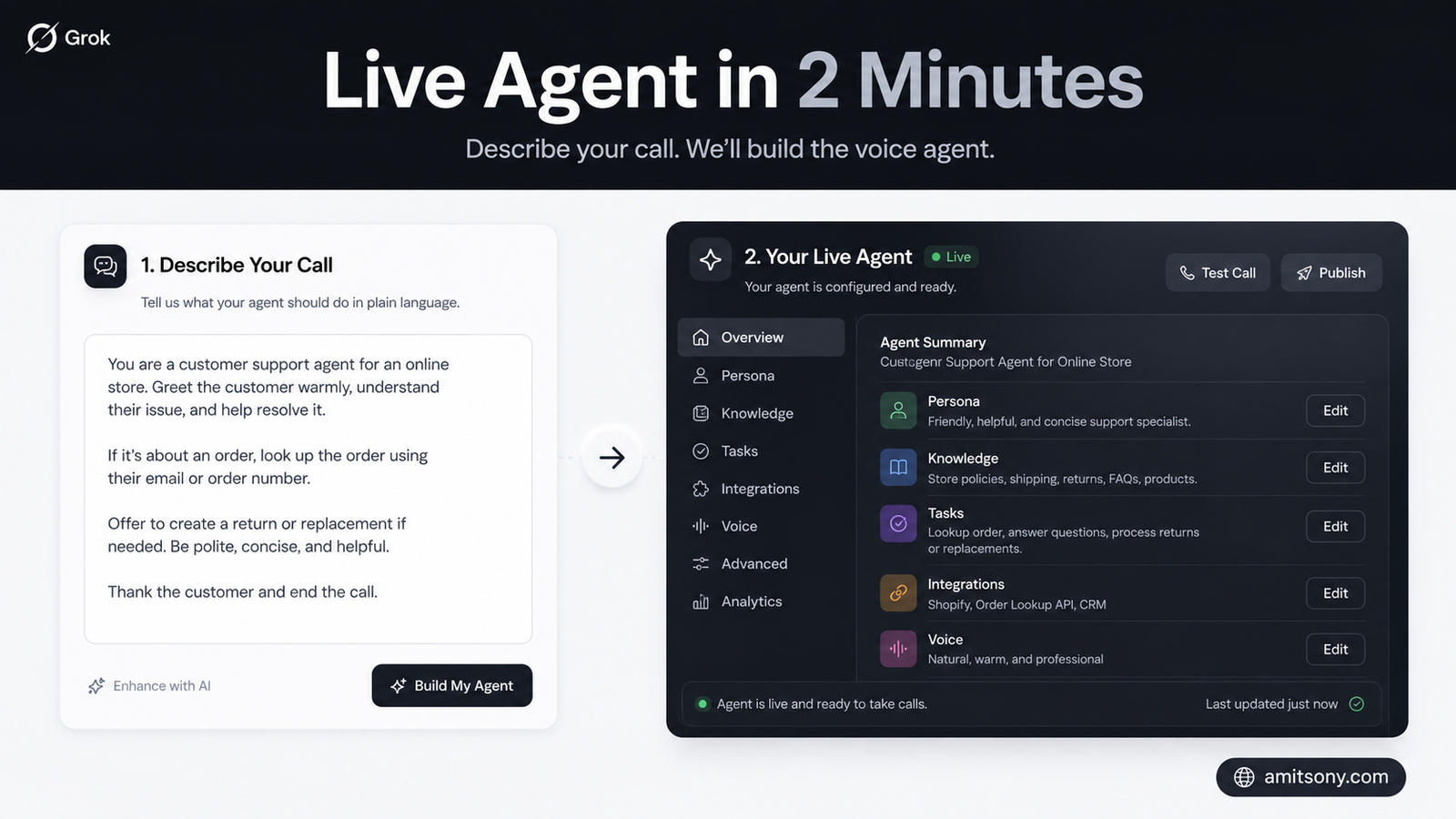
Voice Agent Builder is a no-code platform sitting on top of Grok Voice, xAI's speech model. You describe how a phone call should go in plain language, attach a knowledge base and any tools the agent needs, pick a voice, and it goes live, aimed at "operators and developers who want high-volume production voice agents without building the surrounding stack from scratch," in xAI's own framing.
It bundles the pieces that usually require stitching together separately, telephony, knowledge retrieval, tool calling, guardrails, and call review, all in one console. Every account also gets a free phone number to start testing immediately, and you can bring your own existing numbers, APIs, and MCPs instead of starting from zero.
This isn't xAI's first move into voice. The underlying Grok Voice Agent API actually launched back in December 2025, and custom voice cloning was added in May 2026. The Builder is the layer that makes that existing infrastructure usable without an engineering team.
Can You Actually Build a Working Voice Agent in 2 Minutes?
Based on multiple independent hands-on accounts from developers who tested it in its first few weeks, yes, that specific claim holds up. One developer testing it directly against a competing platform noted the console was easy to navigate and they had a working agent without writing code or needing to understand the full voice AI stack first.
The two minutes covers getting something live, not necessarily production-ready. A basic agent with a defined persona and call logic really does come together that fast. Getting it fully tuned, with a solid knowledge base, proper guardrails, and tested edge cases, is still real work, the same way it would be on any platform.
Where the speed genuinely shows up technically is response latency, not just setup time. Because Grok Voice runs as a single speech-to-speech model rather than the usual pipeline of separate speech-to-text, language model, and text-to-speech services, it achieves sub-second response times that stitched-together stacks structurally struggle to match.
How Much Does It Actually Cost to Run?
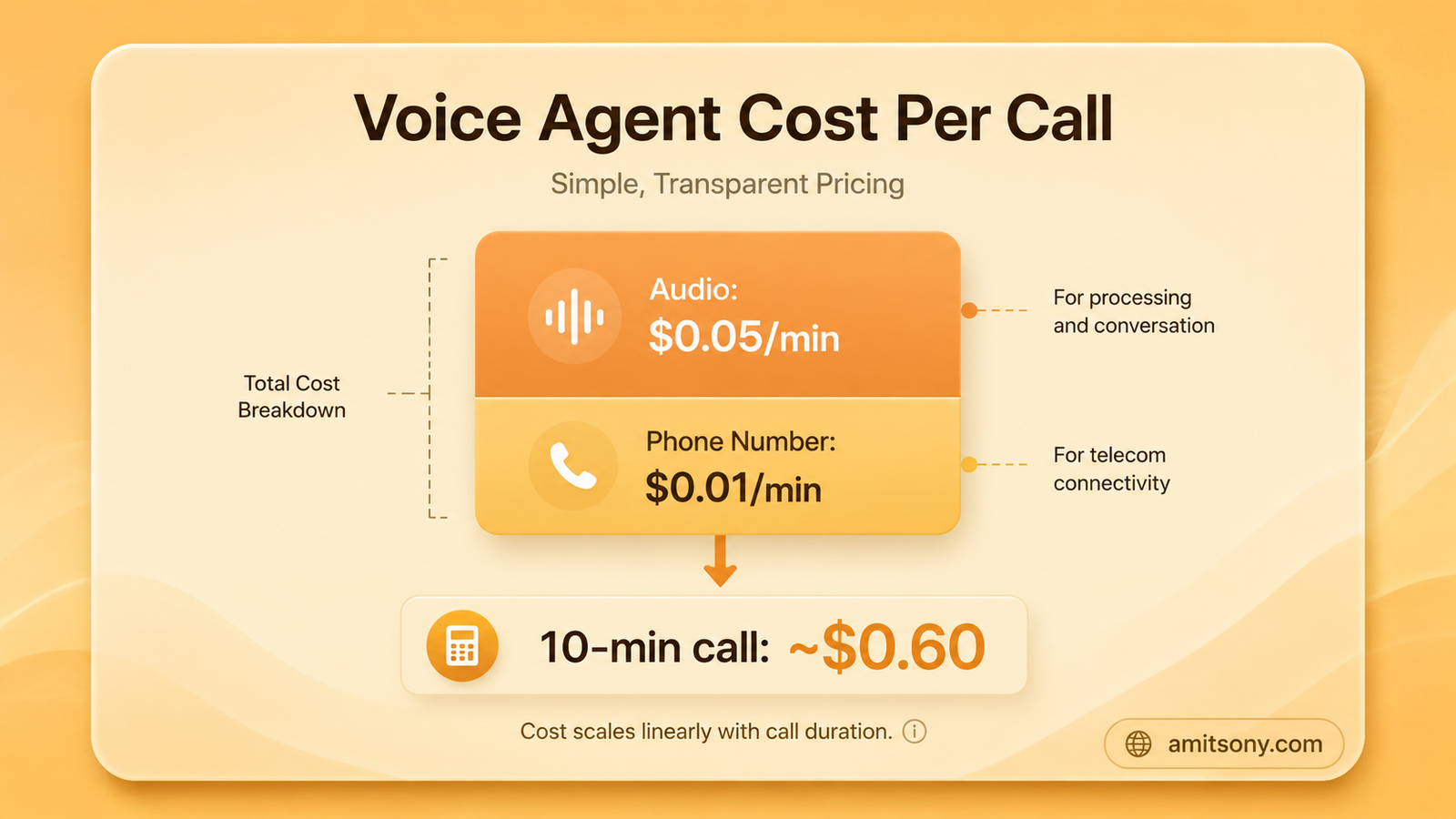
Pricing is genuinely straightforward and aggressive. Voice agent audio runs $0.05 per minute, voices included, with an extra $0.01 per minute if you're using a provisioned phone number through the platform.
Tool calls are billed separately from the base rate. Web and X search runs $5 per 1,000 calls, and document search costs $2.50 per 1,000 calls, so your actual bill depends heavily on how often the agent needs to look something up mid-call rather than answering from its own knowledge base.
A concrete example makes this easier to plan around. A ten-minute customer support call, including telephony, costs roughly $0.60 total on this pricing structure. That's meaningfully cheaper than most established competitors, which is clearly a deliberate positioning choice, xAI is going after budget-conscious teams that would otherwise default to a pricier, more established platform.
What Makes Its Architecture Different From Competitors?
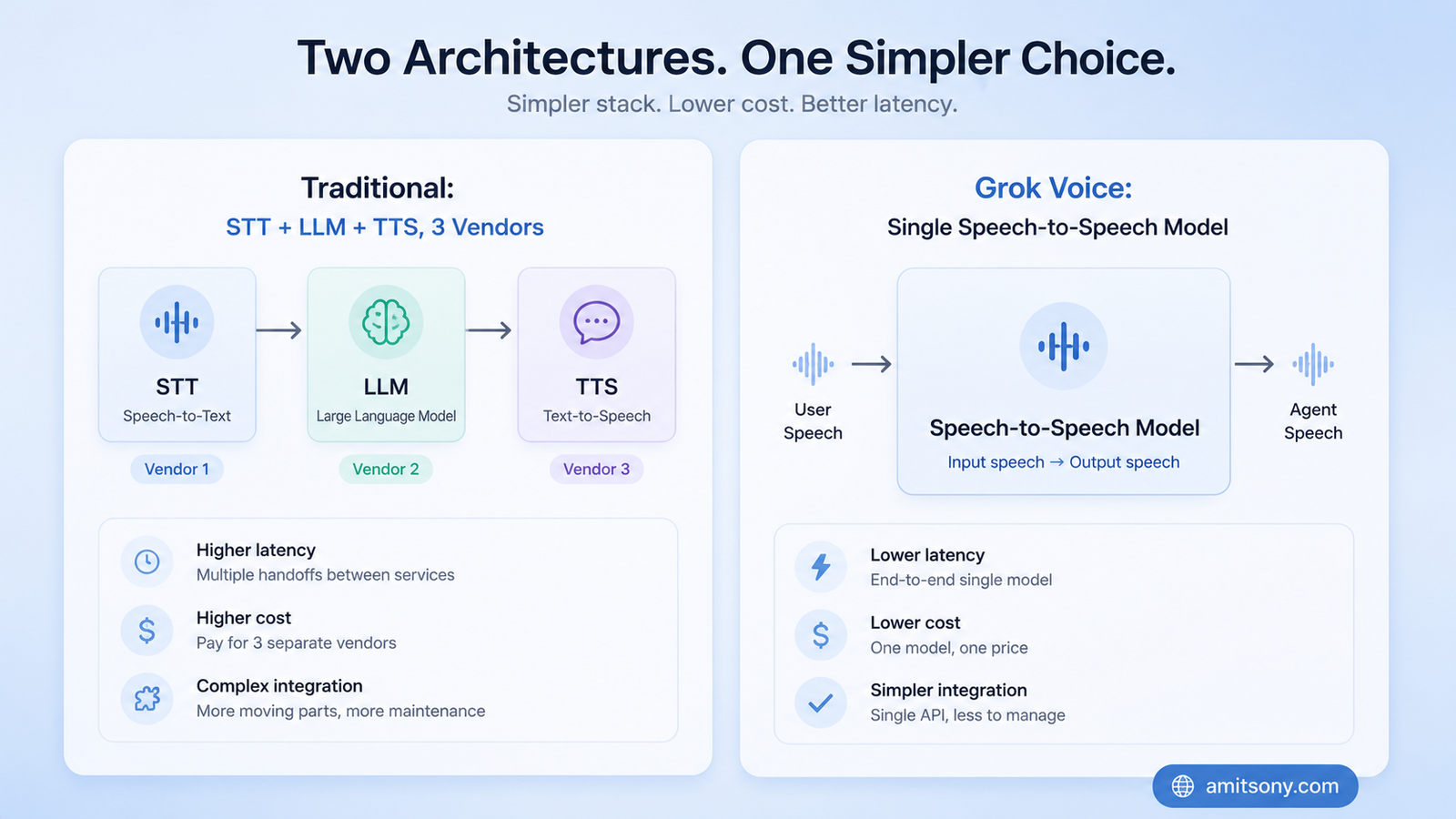
Most voice AI platforms on the market today are built from three separate vendors stitched together, a speech-to-text model converts audio to text, a language model generates a response, and a text-to-speech model converts that back to audio. Each handoff between those three steps adds latency, cost, and a separate point of failure.
xAI built its voice activity detection, tokenizer, and audio models in-house rather than assembling them from third-party pieces. Running as one integrated speech-to-speech system is what lets the company iterate on speed and intelligence together instead of being limited by whichever of three vendors is slowest to improve.
The measurable result of that architecture choice is xAI's Big Bench Audio ranking, where Grok Voice currently sits at #1. Combined with support for 25 or more languages and mid-conversation language switching, this is a legitimate technical differentiator, not just a marketing claim.
How Does It Compare to Vapi, Retell AI, and Bland AI?
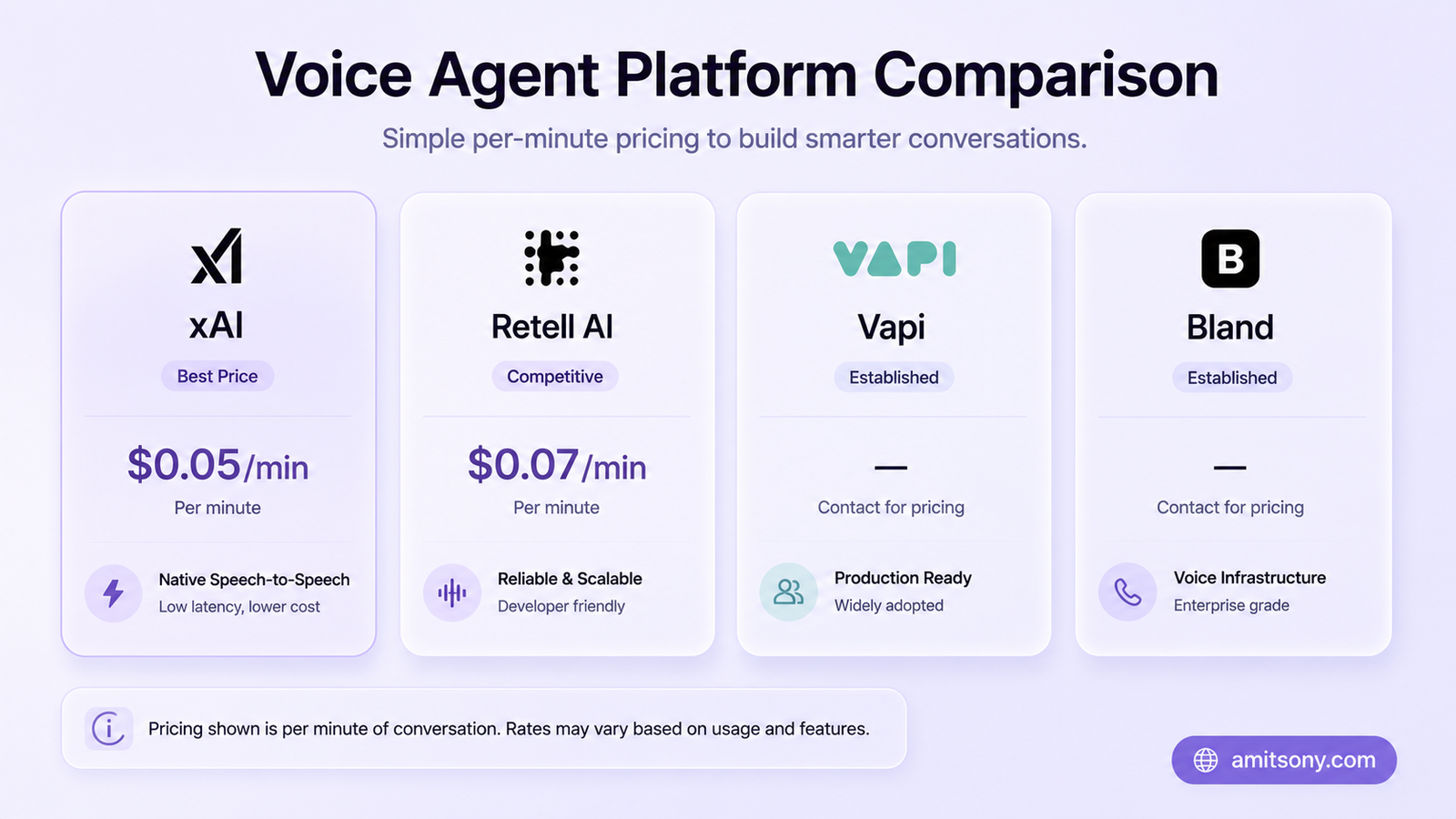
The core pitch is the same one Vapi, Retell AI, and Bland AI have all been making for a while now, turn a language model into a low-latency phone agent. What xAI brings that the others don't is full ownership of the underlying voice stack, rather than orchestrating third-party speech models the way most competitors do.
On price, xAI is positioned as the clear budget option. Retell AI, for comparison, charges $0.07 per minute with no separate platform fee, already one of the cheaper established players, and xAI's $0.05 per minute still undercuts it.
Where xAI is genuinely behind is maturity. Retell and Vapi have had real production deployments and iteration cycles for longer, with more documented edge-case handling and a larger base of proven use cases. xAI's advantage right now is architecture and price, not track record.
What Are the Real Limitations Right Now?
It's beta software, and that shows up in practical ways. Multiple developers testing it in its first few weeks reported hitting 403 "not authorized" errors trying to get access, which suggests the rollout is still uneven rather than fully self-serve for everyone.
The bigger open question is a genuinely unresolved one across the entire voice AI category, not unique to xAI. Nobody testing this platform has found a published, confirmed answer to the classic voice-agent failure mode, an agent mishearing an instruction and confidently acting on the wrong information. That's a real risk for anything handling bookings, payments, or account changes over the phone, and it's worth building your own confirmation step into any call flow that matters.
It's also worth being precise about what this tool actually is. It's a builder for voice and phone-specific agents that you configure and supervise yourself, not a fully managed customer support solution. If your actual support volume is mostly chat and email tickets rather than phone calls, this isn't solving that problem, it was never built to.
Who Should Actually Use This Today?
Teams building a phone agent from scratch, and comfortable being an early adopter on beta infrastructure, get real value here right now. The combination of speed to first working agent, sub-second latency, and the lowest price point in its category makes it a genuinely strong starting point for outbound sales, appointment booking, or basic support call handling.
Skip it for now if you need airtight, audited reliability for high-stakes calls involving payments or sensitive account changes, until more teams have stress-tested the misheard-instruction problem in production. An established platform with a longer track record is the safer choice for that specific use case today.
Fair verdict: xAI has built something genuinely fast and genuinely cheap, backed by real architectural advantages rather than just marketing. Whether it's ready for your specific production workload depends entirely on how much beta-stage risk you're willing to carry for that price difference.
Frequently Asked Questions
When did xAI launch Voice Agent Builder?
It launched in beta on July 1, 2026, built on top of the Grok Voice Agent API that had launched the previous December.
How much does xAI Voice Agent Builder cost?
Voice audio runs $0.05 per minute including voices, plus $0.01 per minute for a provisioned phone number, with tool calls like search billed separately.
Is xAI Voice Agent Builder cheaper than Retell AI or Vapi?
Yes, at $0.05 per minute it undercuts Retell AI's $0.07 per minute, positioning xAI as the budget option in the category.
Can Voice Agent Builder really create an agent in two minutes?
Yes, multiple hands-on developer accounts confirm a basic working agent comes together that fast, though full production tuning still takes additional time.
Is xAI Voice Agent Builder ready for production use?
It's usable today for lower-stakes calls like sales outreach or basic support, but it's still in beta with some access issues and an unresolved misheard-instruction risk for high-stakes calls.