
Short answer: not reliably. Vendors claim 98 to 99% accuracy, but independent testing puts real-world accuracy at 39.5 to 80%, and a Stanford study found detectors flagged 61% of essays by non-native English speakers as AI-written. Humanizer tools beat most detectors easily. Treat any single AI detection score as a hint, never proof.
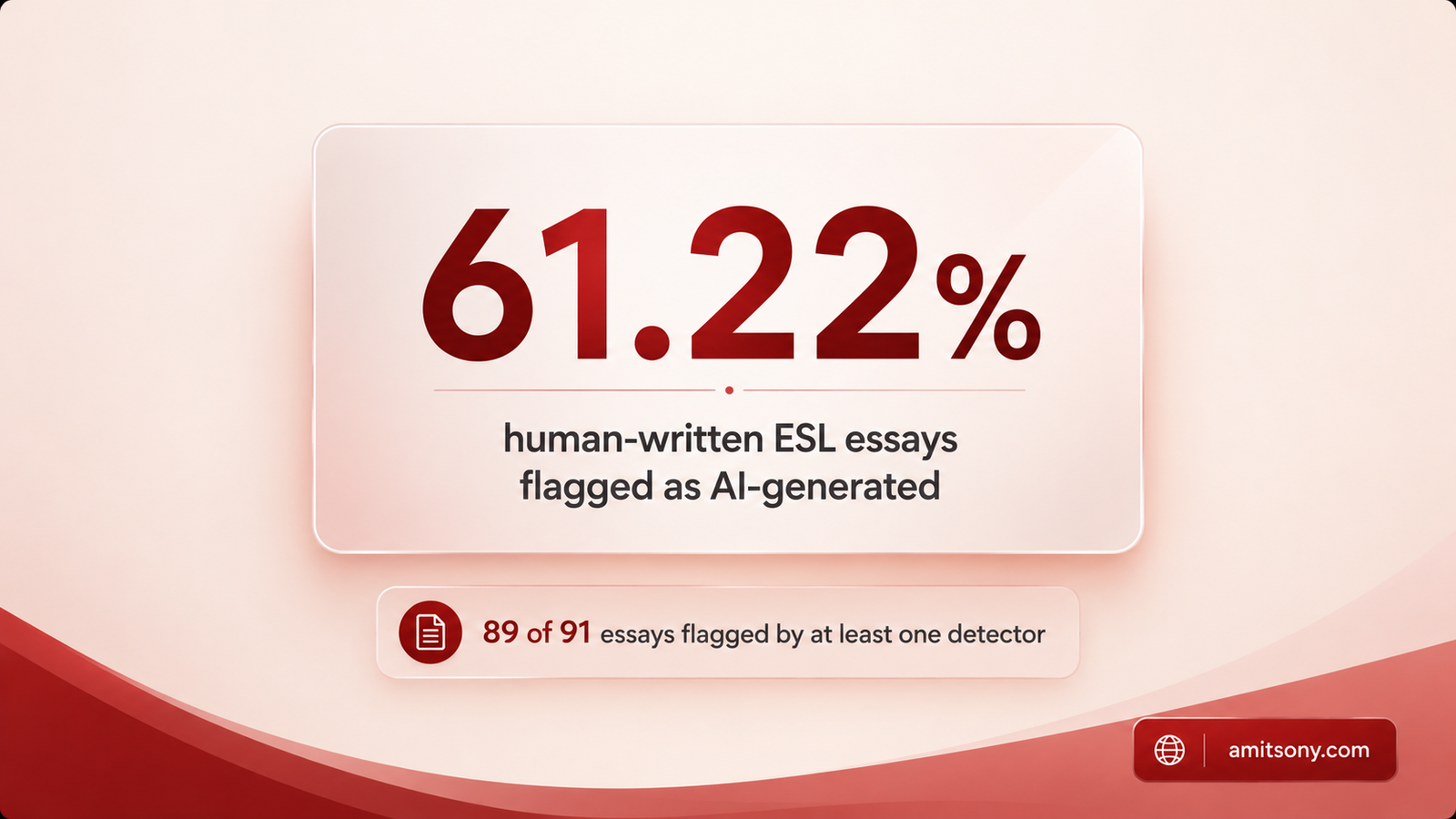
A Stanford study fed 91 TOEFL essays, real, human-written, non-native English student work, into seven major AI detectors. The result: 61.22% of those entirely human essays got flagged as AI-generated, and 89 of the 91 essays were flagged by at least one tool. Nobody in that study used AI. The detectors were simply wrong, a lot.
That's not a fringe result buried in an obscure paper. It's one of the most cited findings in this space, and it sits uncomfortably next to the 98 to 99% accuracy numbers every detector vendor advertises on their homepage. We pulled together every credible independent benchmark we could find, from peer-reviewed studies to large-scale third-party testing, to see which claims actually hold up.
What Happens When You Actually Compare Vendor Claims to Independent Tests?
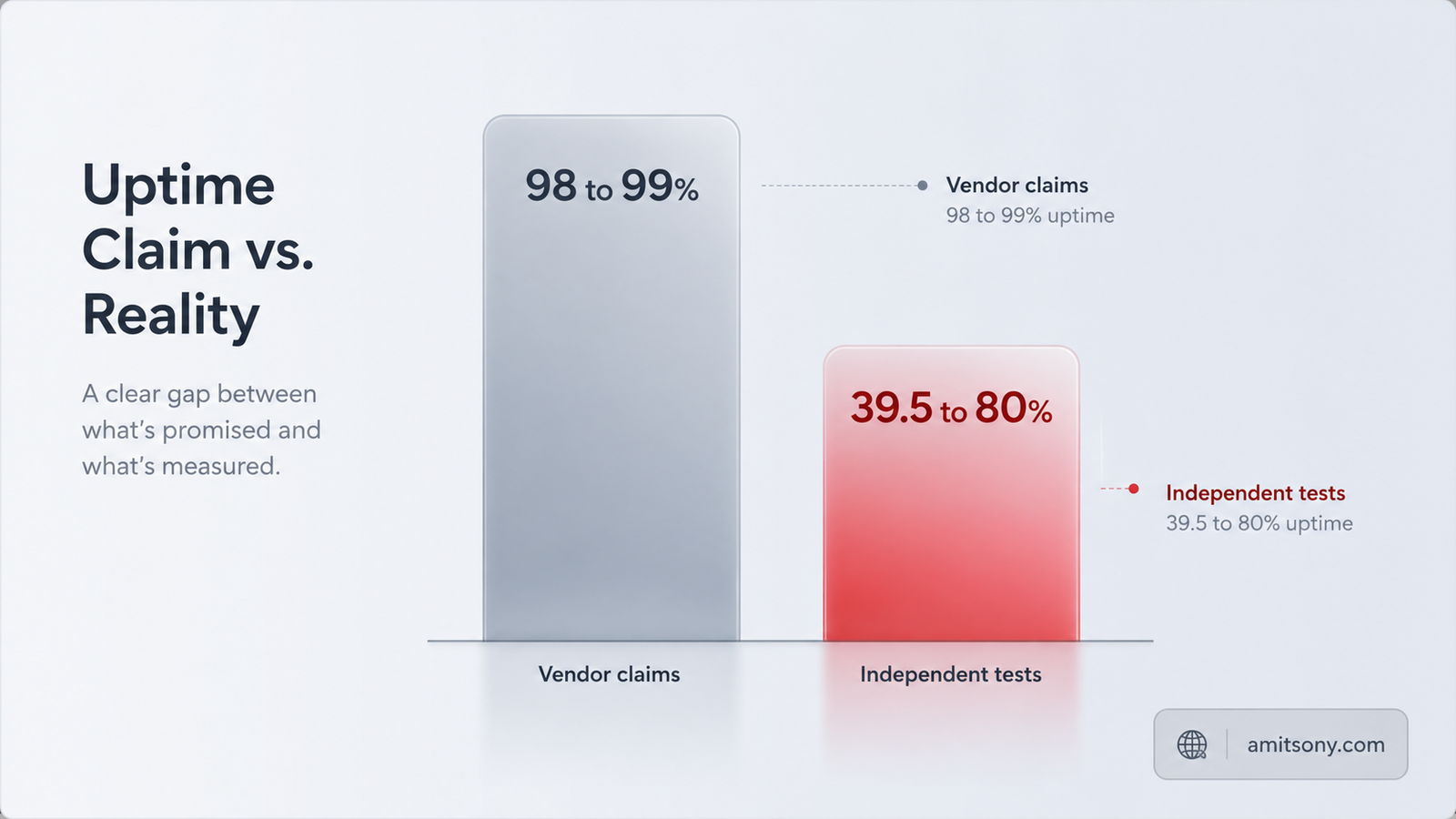
Every major AI detection company in 2026 claims accuracy between 98% and 99.5%. Turnitin says 98%+ with under 1% false positives. GPTZero's own benchmark claims 99.3% accuracy and a 0.24% false positive rate. Copyleaks and Winston AI both advertise numbers above 99%.
Independent testing tells a different story almost every time. Real-world accuracy across multiple third-party benchmarks lands between 39.5% and 80%, with false positive rates running 2% to 15% even for native English writers. That's not a rounding error, it's a 15 to 20-plus percentage point gap between what's advertised and what actually happens outside a controlled demo.
The gap exists partly by design. Vendor benchmarks tend to test raw, unedited AI output against polished human writing, the easiest possible comparison. The Stanford HAI 2026 AI Index Report confirms top-tier detectors do hit 94 to 96% accuracy on clean, unmodified GPT-4 and GPT-5 output. The moment that text gets paraphrased or lightly edited, accuracy drops to somewhere between 20% and 63%.
Does Turnitin Actually Catch AI Writing?
Turnitin publishes a 98%+ accuracy claim specifically for documents where more than 20% of the text is AI-generated, with under 1% false positives at that threshold. The company built its classifier on a large corpus of paired human and AI writing samples, including real student work from its own plagiarism-detection database.
The catch sits in the fine print. That 98% figure comes from Turnitin's own internal testing on curated samples, not an independent audit. Turnitin's own guidance to educators explicitly says the score shouldn't be used as sole evidence of misconduct, a fairly unusual admission for a company selling a detection product.
Academic technology centers, including Penn's Warren Center, have published guidance telling faculty to treat these scores with real skepticism rather than automatic proof. That's a reasonable response given how often non-native writers get flagged by detection logic built on similar principles.
Is GPTZero Accurate, or Just Confident?
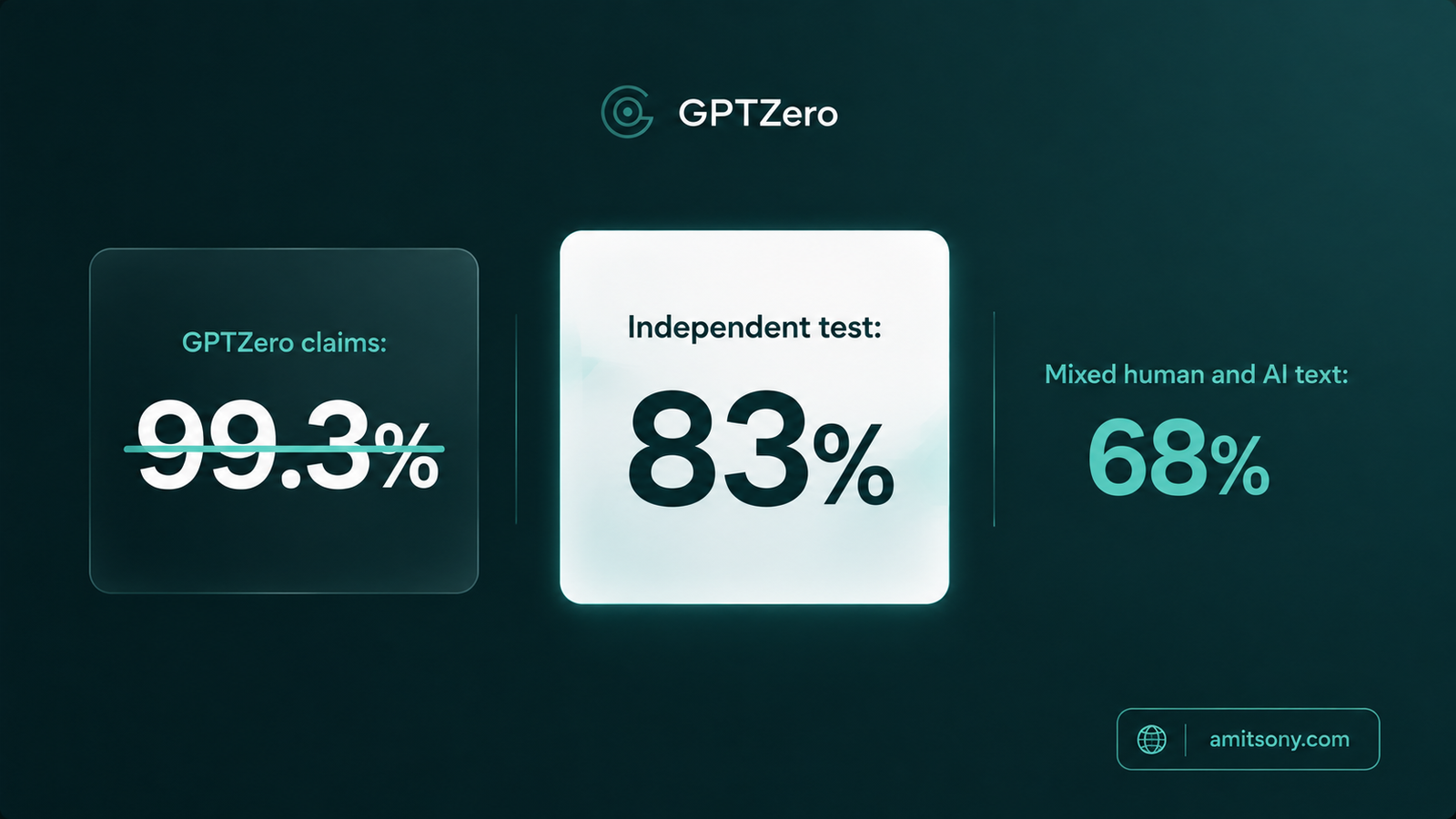
GPTZero own published benchmark claims 99.3% accuracy with a 0.24% false positive rate, among the most confident numbers in the industry. One independent 2026 test found real-world accuracy closer to 83%, with an 11% false positive rate.
That same independent test found accuracy dropping to just 68% on content that mixed human and AI writing in the same document, a genuinely common real-world scenario, not an edge case. GPTZero does lead one category specifically, academic essay formats, where it scored 91% in a separate benchmark, ahead of most competitors.
The pattern here matters more than any single number. A detector performing well on one benchmark and mediocre on another isn't unusual, it's the norm across this entire category, which says something about how fragile these accuracy claims are outside their original test conditions.
Does Originality.ai Deserve Its Reputation as the Most Accurate?
Originality.ai ranked first on the RAID benchmark, a large independent test spanning 11 different AI models, with 85% average accuracy. Its strongest showing was 96.7% accuracy specifically on paraphrased AI content, the best result any tool produced in that category.
Other independent tests land it lower. The Scribbr benchmark scored it at 76% overall, and a separate controlled study from ProofreaderPro found 74%. Originality.ai's own meta-analysis of 14 peer-reviewed studies claims 91 to 100% accuracy across the board, worth noting that a vendor's analysis of its own product tends to read more favorably than outside testing.
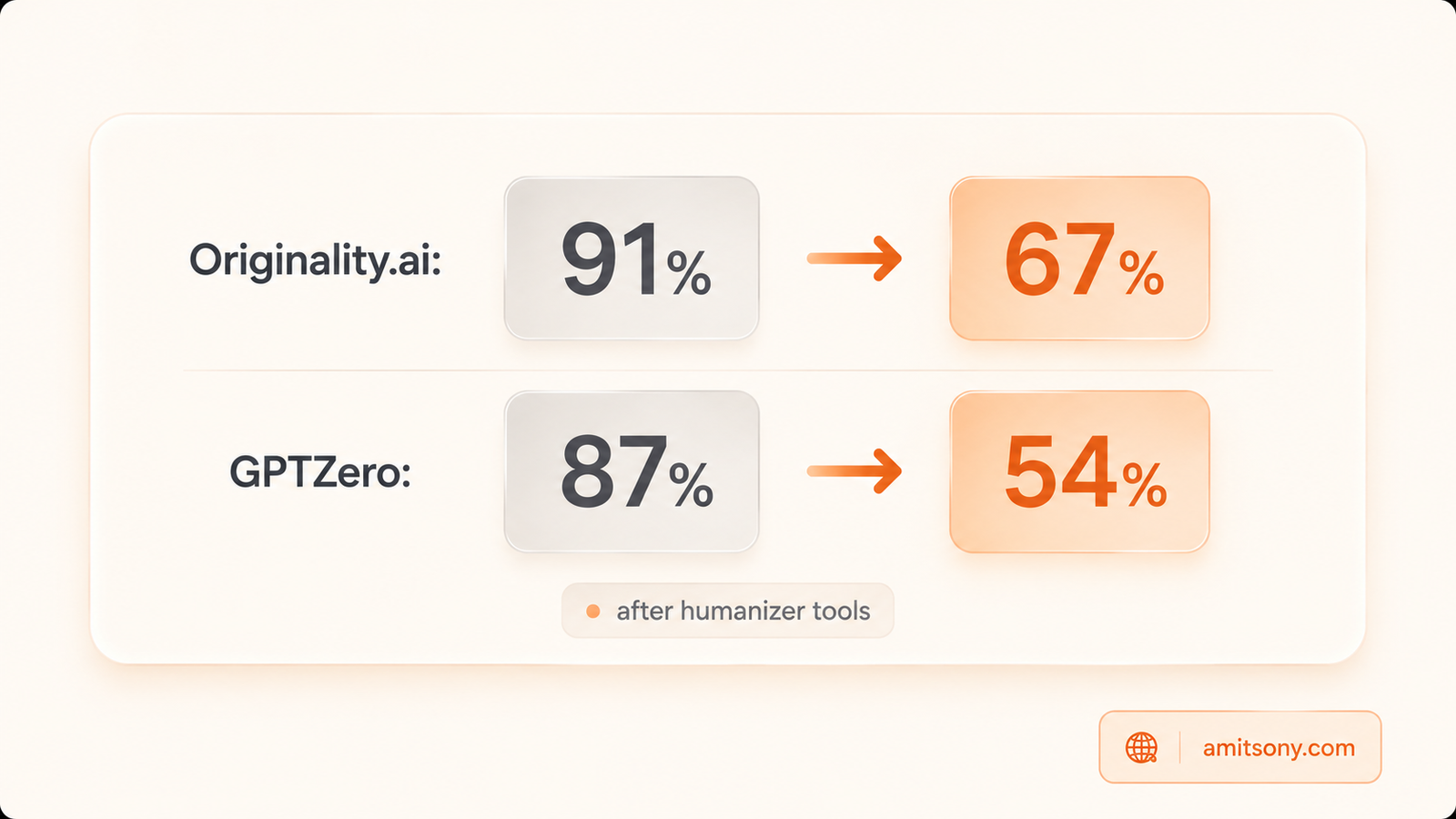
Even against humanizer tools built specifically to defeat detection, Originality.ai held up best of any detector tested, dropping from 91% to 67% accuracy rather than collapsing entirely. That's still a real drop, just a smaller one than its competitors.
Why Do Non-Native English Speakers Get Flagged So Often?
This is the least comfortable finding in the entire field. Liang et al.'s peer-reviewed 2023 study, published in Patterns, tested seven major detectors against TOEFL essays written by non-native English speakers. Every essay was genuinely human-written.
The result: 61.22% of those human essays were flagged as AI-generated, and 89 of the 91 essays triggered at least one detector. Separate independent research corroborates the pattern, putting false positive rates for ESL writers as high as 61%, compared to 2% to 15% for native English speakers.
The likely cause is perplexity, a measure of how predictable word choices are. Non-native writers, along with technical writers and anyone who writes in a more formulaic or simplified style, naturally produce lower-perplexity text, exactly the pattern most detectors were trained to associate with AI.
If a school or employer is using detection scores to make consequential decisions without a human review step, this single finding should be reason enough to stop.
Can Humanizer Tools Actually Beat AI Detectors?
A large independent benchmark ran 14 different humanizer tools against 6 major detectors across 2,400 total samples. Bypass rates ranged from 23% to 91% depending on the specific humanizer and detector pairing.
Average accuracy across all detectors dropped by 31 percentage points once the AI text had been run through a humanizer. Originality.ai proved the most resistant, falling from 91% to 67%. GPTZero fell the furthest, from 87% down to 54%, close to a coin flip.
No detector in that benchmark stayed fully robust against every humanizer tested. This is the part detection companies don't put on their pricing page: the tools designed to beat detection are, on average, working.
Do Detectors Work Differently Depending on What You're Writing?
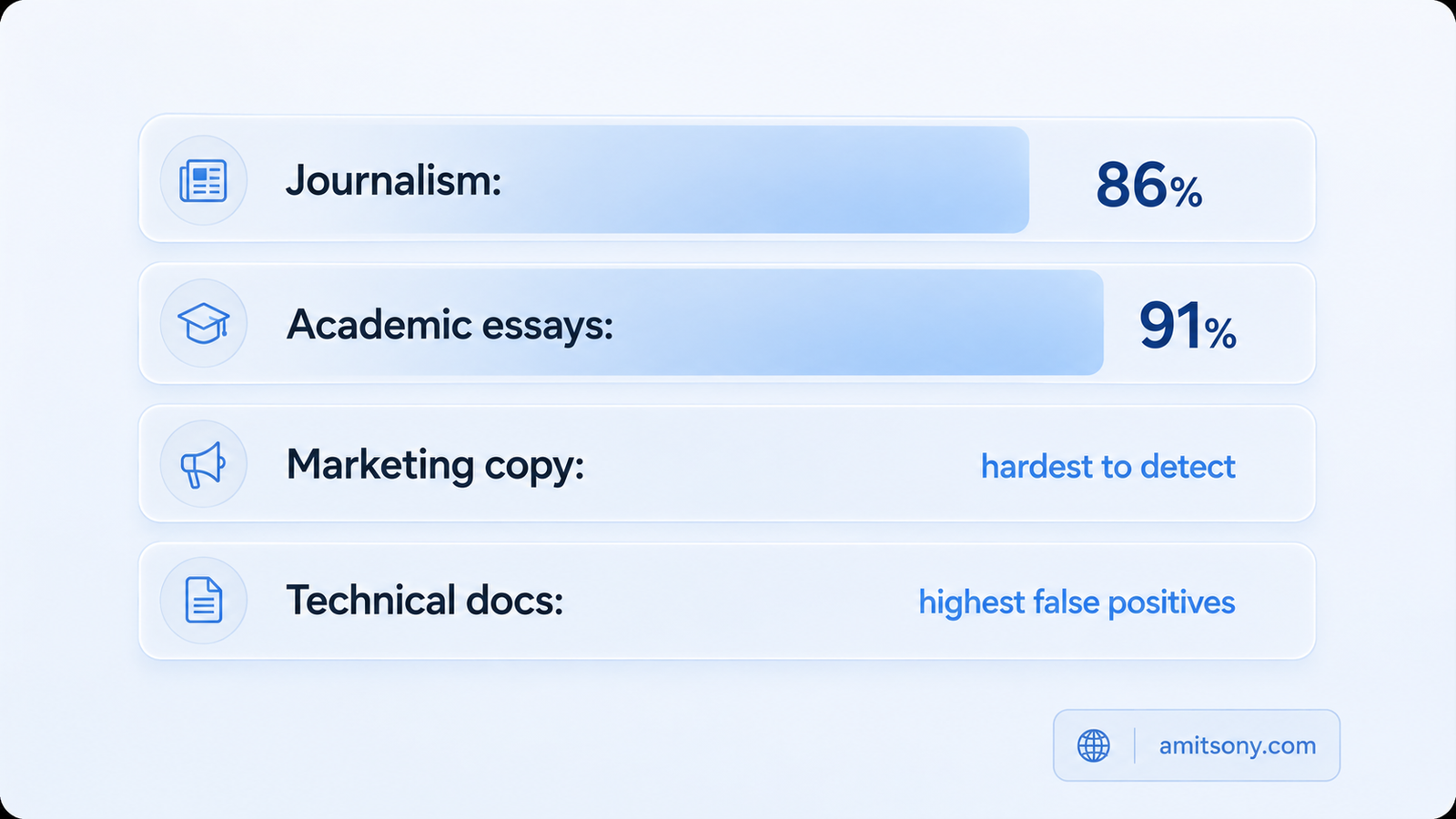
Content type changes the outcome more than most people assume. Journalism and news writing were the most consistently detectable category, averaging 86% accuracy across tools, with Hive Moderation hitting 92% specifically on news content.
Academic essays performed reasonably well too, with GPTZero leading that category at 91%. Marketing copy was the hardest category to detect accurately across the board, likely because professional marketing writing already leans toward punchy, low-perplexity phrasing that overlaps with AI-generated patterns.
Technical documentation produced the worst false positive rates of any category tested. Sapling AI flagged 31% of genuinely human-written technical docs as AI-generated. Even Originality.ai, the strongest performer overall, saw its false positive rate climb to 12% on technical content specifically.
So, Do AI Detectors Actually Work?
Yes and no, and the honest answer depends entirely on what you're asking them to do. On raw, unedited AI text with no attempt at disguise, top detectors genuinely do hit 94 to 96% accuracy. That's a real, useful signal.
The moment real-world conditions show up, paraphrasing, non-native English, technical writing, a humanizer tool, a mix of human and AI editing, accuracy drops fast and false positives climb. There's also a hard technical ceiling here: when researchers forced false positive rates below 1%, the standard needed for any high-stakes decision, most detectors became nearly useless, missing almost all actual AI content.
Treat a detection score as one data point, never a verdict. Cross-check with more than one tool if a decision actually matters, and if you're grading or hiring, keep draft history and process evidence as a real backstop, because a percentage on a screen isn't proof of anything on its own.
Frequently Asked Questions
What's the most accurate AI detector in 2026?
Originality.ai performs best across most independent benchmarks, ranking first on the RAID test and showing the strongest resistance to humanizer tools, though its score still varies significantly between different studies.
Can AI detectors be wrong about human writing?
Yes, regularly. A Stanford-affiliated study found detectors flagged 61.22% of human-written essays by non-native English speakers as AI-generated, and false positive rates for ESL writers run as high as 61% in independent research.
Do humanizer tools actually work against AI detectors?
Often, yes. An independent benchmark testing 14 humanizer tools against 6 detectors found bypass rates between 23% and 91%, with average detector accuracy dropping 31 percentage points on humanized text.
Should schools rely on AI detection scores to punish students?
Most academic guidance, including from Turnitin itself, says no. Detection scores shouldn't be the sole evidence for a misconduct decision, especially given how often non-native English writers get falsely flagged.
Why do vendor accuracy claims differ so much from independent tests?
Vendors typically test on raw, unedited AI output compared against polished human writing, the easiest case to detect. Independent tests use messier, more realistic samples, paraphrased text, mixed authorship, non-native writing, where accuracy drops sharply.