

Widely repeated numbers, 50,000 Optimus units, 10,000 Figure AI deployments, don't trace back to the companies themselves and don't hold up against actual filings. As of mid-2026, Optimus production at Fremont hadn't started, Musk has called current units "primarily for learning, not productive work," and public sales now target late 2027. Figure AI's most verified result is an 11-month BMW pilot. Unitree ships the most units of anyone, cheaply.
Search for humanoid robot deployment numbers in 2026 and you'll find confident, specific figures everywhere: Tesla past 50,000 cumulative Optimus units, Figure AI past 10,000 deployments, over a thousand robots working Tesla's own production lines. These numbers get repeated across dozens of blogs and business-advice articles with total confidence.
None of them come from the companies they describe. Tesla has never published an Optimus production count, audited or otherwise, and its own Q2 2026 delivery report contained no Optimus numbers at all. This guide separates what's actually verified from what's circulating as fact, and covers where the industry genuinely stands.
Do the Big Production Numbers Actually Hold Up?
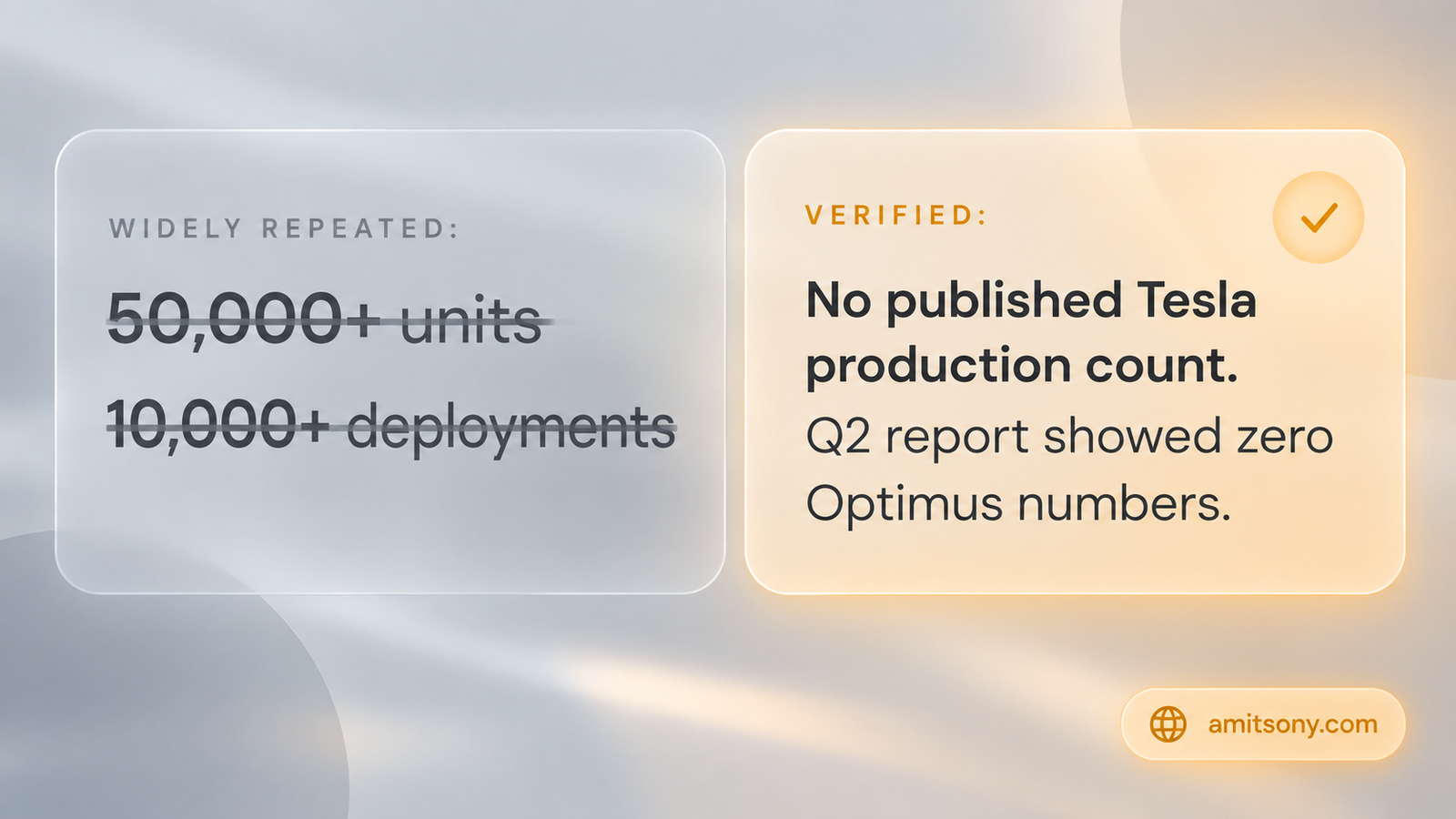
Not under scrutiny. As of mid-July 2026, Optimus production at Fremont had not started. Tesla's own guidance pointed to late July or August for a production start, and Elon Musk walked the newly installed Fremont line on July 1, explicitly pushing back on suggestions that output had quietly begun.
Analysts tracking Tesla's public communications have counted eight separate Optimus production milestones that were delayed or revised before their original due date. That's a consistent enough pattern that any near-term date Tesla announces is worth treating as a probability, not a commitment.
Figure AI and Agility Robotics, companies with considerably less public attention than Tesla, hold the strongest actually-verified deployment records in the category, not the company generating the most headlines.
What Is Tesla Optimus Actually Doing Right Now?
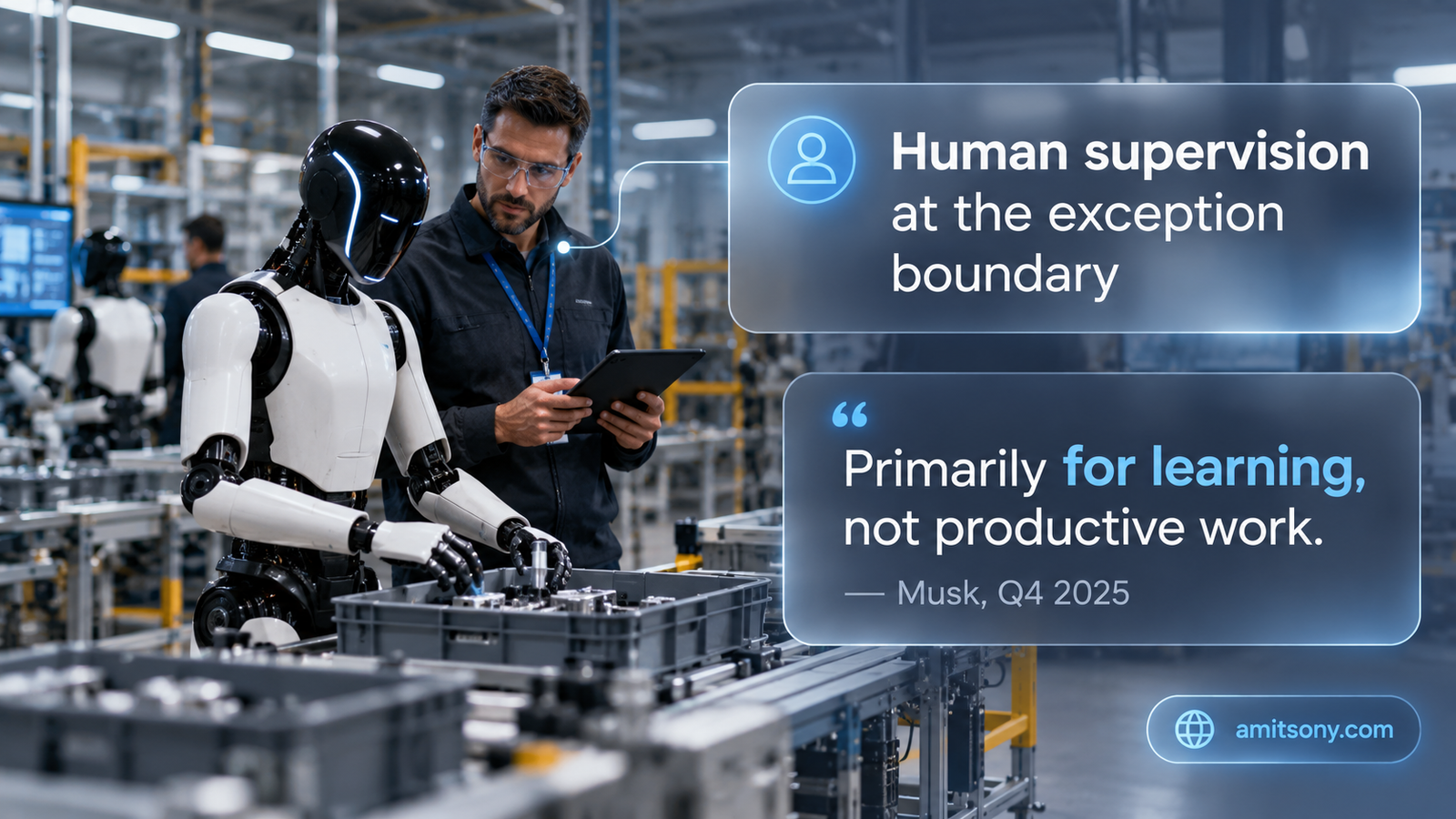
Tesla has deployed Optimus units internally at its Fremont and Austin facilities, working on tasks like battery component transport, seat assembly, and quality screening, under human supervision at what one industry analysis calls "the exception boundary," meaning a person steps in whenever the robot hits something outside its trained routine.
Musk himself gave the clearest, most honest framing of this on Tesla's Q4 2025 earnings call, acknowledging that current units are deployed primarily for learning, not productive work. That's a meaningfully different claim than "robots are already replacing workers on the line."
Tesla is repurposing part of its Fremont factory, previously used for Model S and Model X production, specifically for Optimus Gen 3 manufacturing, and integrating its own FSD chip into the robot's onboard compute. That's a real, capital-backed commitment, distinct from the unverified unit counts circulating separately.
When Will You Actually Be Able to Buy One?
Later than most 2026 coverage implies. Musk indicated at Davos in January 2026 that public sales were likely by the end of 2027, not 2026, a detail that's easy to miss among headlines focused on production milestones.
The target price sits at $20,000 to $30,000 per unit, aimed initially at Tier-1 suppliers and OEM assembly plants rather than individual consumers. Given the pattern of repeated delays on production milestones, treat this pricing and timeline as Tesla's stated intention rather than a locked commitment.
What Has Figure AI Actually Verified?
Figure AI's strongest documented result is an eleven-month pilot with its Figure 02 robot at BMW Group's Plant Spartanburg, a real, named, time-bound deployment rather than a round headline number. Figure 03, announced in late 2025, is a newer platform but is not yet in mass production, and the company hasn't published a public consumer availability date.
Figure AI's stated focus is expanding its industrial customer base through direct partnerships, BMW being the primary named one, rather than chasing a consumer product launch the way Tesla has signaled it eventually will.
For precision manipulation tasks specifically, independent comparisons give Figure's platform an edge over Optimus, while Tesla's advantage shows up more in manufacturing scale and vertical integration across its own supply chain.
Who's Actually Shipping the Most Units Right Now?
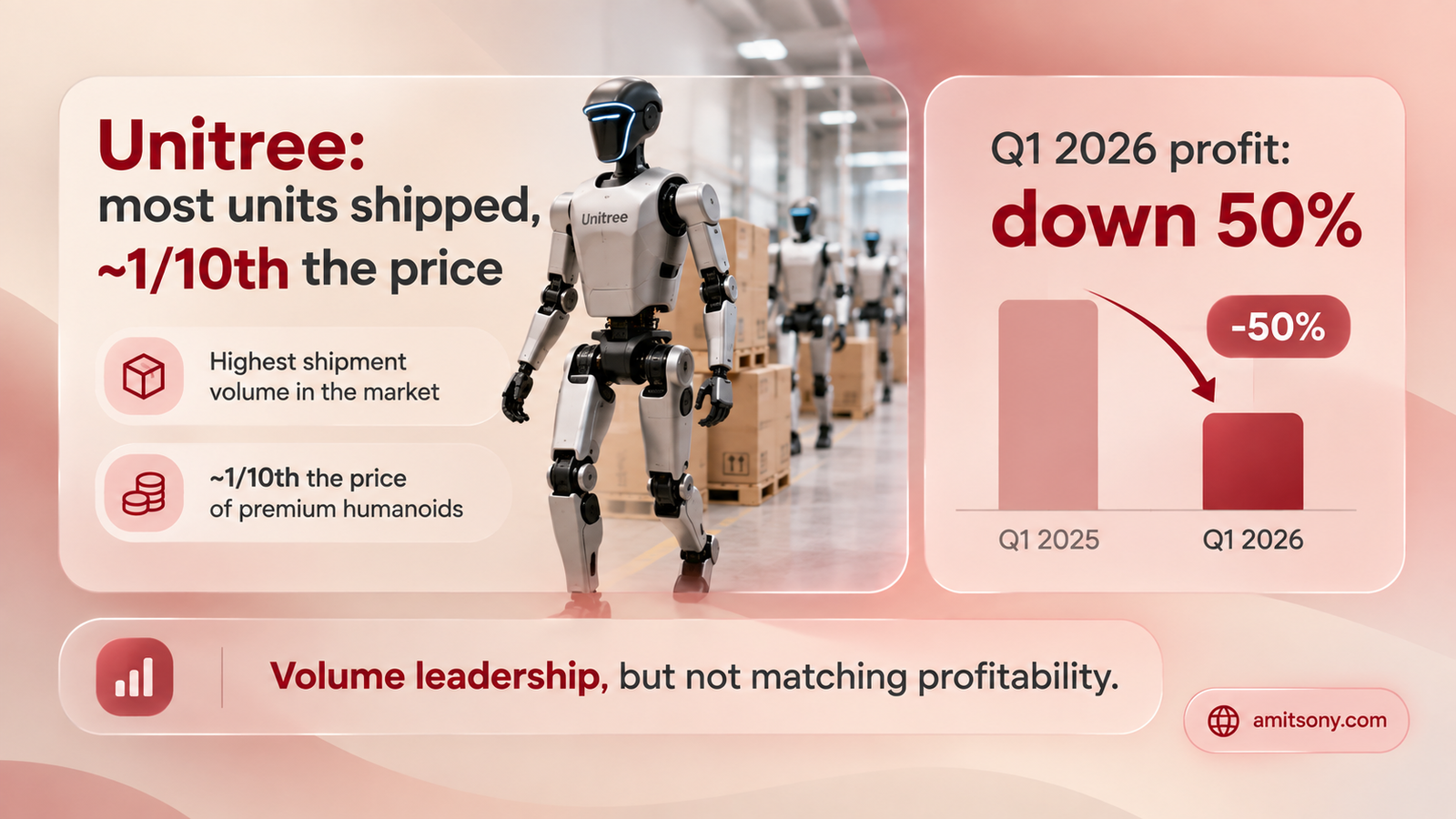
Unitree, a Chinese manufacturer, ships more humanoid units than any Western competitor, at roughly a tenth of the price of Tesla or Figure's platforms. Its G1 model is sold directly on Amazon, a genuinely different distribution model than the industrial-pilot approach everyone else in this category is using.
The honest business reality check: Unitree's own Q1 2026 profit fell by half even while unit volume led the category, a reminder that shipping the most robots and running the most profitable robotics business aren't automatically the same thing.
Other Chinese manufacturers, including Fourier Intelligence and AGIBOT, form a separate competitive cohort with substantial domestic industrial policy support and fast product iteration, though export potential remains constrained by geopolitical factors.
What Do These Robots Actually Do Today, Versus the Marketing Narrative?
The honest gap in this category sits between highlight-reel demo videos and what's actually running in a warehouse or factory today. Figure AI, 1X Technologies, Apptronik, Agility Robotics, and Tesla have all moved real units into customer pilots at manufacturing and logistics operations, and the pilots themselves are genuinely real.
But the robots working inside those pilots operate in bounded, structured environments with human oversight built in, not as autonomous, general-purpose workers making independent judgment calls the way marketing narratives sometimes imply. Capability has genuinely improved compared to three years ago, and the distance between that and a fully autonomous humanoid worker remains substantial.
Industry commentary has compared the category's current stage to where electric vehicles stood around 2012 to 2015, feasibility demonstrated, but the cost and reliability thresholds needed for real mass-market scale not yet met.
Which Industries Are Actually Piloting Humanoid Robots?
Automotive manufacturing is the clear proving ground: Tesla in its own factories, Figure AI with BMW, Hyundai with its Atlas platform. The appeal is straightforward, assembly lines are structured, tasks repeat predictably, and the industry already has decades of experience integrating robotic automation of other kinds.
Beyond automotive, warehouse logistics and structured, high-volume food preparation are the next most commonly cited near-term deployment environments, chosen specifically because they share the same traits: predictable layouts, repetitive tasks, and in many cases genuine existing labor shortages.
What's Coming Next?
Multiple sources converge on 2027 as the more realistic inflection point for broader commercial availability, rather than 2026, which is mostly still the year of expanded pilots and internal deployment. Unit costs are expected to keep drifting toward the $15,000 to $20,000 range as manufacturing scales, though exact figures should be treated with the same skepticism as this year's inflated deployment counts.
Long-range market size projections vary enormously depending on the source, Goldman Sachs estimates roughly $38 billion by 2035, while Morgan Stanley projects $152 billion by 2040. That gap alone is a useful reminder of how much genuine uncertainty still sits underneath this category's headlines.
Quick Verdict
The technology is real, the pilots are real, and the capital commitment from Tesla, Figure, BMW, and others is real. The specific numbers getting repeated as fact mostly aren't. Treat any round, impressive-sounding deployment figure in this category as a claim to verify, not a fact to repeat, and expect 2027, not 2026, to be the year commercial availability actually starts meaning something concrete.
Frequently Asked Questions
Has Tesla actually produced 50,000 Optimus units?
That number isn't verified. Tesla has never published an official production count, and as of mid-July 2026 its own guidance indicated Fremont production hadn't yet started.
When can consumers actually buy a Tesla Optimus?
Elon Musk indicated at Davos in January 2026 that public sales were likely by the end of 2027, not 2026, at a target price of $20,000 to $30,000, though the platform has a documented history of delayed milestones.
What has Figure AI actually verified in terms of deployment?
Its clearest documented result is an eleven-month pilot of the Figure 02 robot at BMW Group's Plant Spartanburg. Figure 03 has been announced but is not yet in mass production.
Which company ships the most humanoid robots right now?
Unitree, a Chinese manufacturer, ships more units than any Western competitor at roughly a tenth of the price, though its own profit fell by half in Q1 2026 even as volume led the category.
Are humanoid robots working autonomously in factories today?
Mostly no. Deployed units generally operate in structured, bounded environments with human supervision built in for anything outside their trained routine, rather than as fully autonomous general-purpose workers.