
OpenAI is removing GPT-4o, GPT-4o mini, GPT-4.1 and GPT-4.1 mini, plus their fine-tunes, from the API on January 14, 2027. The recommended replacement is gpt-6-luna. Build a test set, compare outputs, cost and latency, and roll out gradually, because Luna is not a drop-in swap.

If your product still calls gpt-4o or gpt-4.1, the clock is running. OpenAI sent the deprecation notice on October 14, 2026, which leaves about three months and, as of today, roughly eight weeks.
This guide lists exactly what shuts down, what the replacement costs, how to find every call in your code, and a dated plan that gets you migrated before the deadline. It also covers fine-tunes, voice models and the other dates people miss.
Which OpenAI models shut down on January 14, 2027?
OpenAI lists five snapshots on its deprecations page with a January 14, 2027 shutdown: gpt-4o-2024-08-06, gpt-4o-2024-11-20, gpt-4o-mini-2024-07-18, gpt-4.1-2025-04-14 and gpt-4.1-mini-2025-04-14. Fine-tuned versions follow the same schedule as their base models.
The notice period is only three months, from October 14. OpenAI's own policy promises at least six months for generally available models, so do not assume you have extra time.
Other dates sit close to it. The text-to-speech models tts-1, tts-1-hd and gpt-4o-mini-tts shut down on January 6, 2027. The gpt-4o-audio, gpt-4o-realtime and mini variants go on January 20. The Whisper and gpt-4o transcription models go on February 26. And gpt-5 and o3 shut down earlier, on December 11, 2026.
This is about the API only. ChatGPT is a separate product with its own model lineup. If you use Azure OpenAI, Microsoft runs its own schedule, which a secondary source lists as April 14, 2027 for the same snapshots, so check that page yourself.
What does OpenAI recommend instead, and what does it cost?
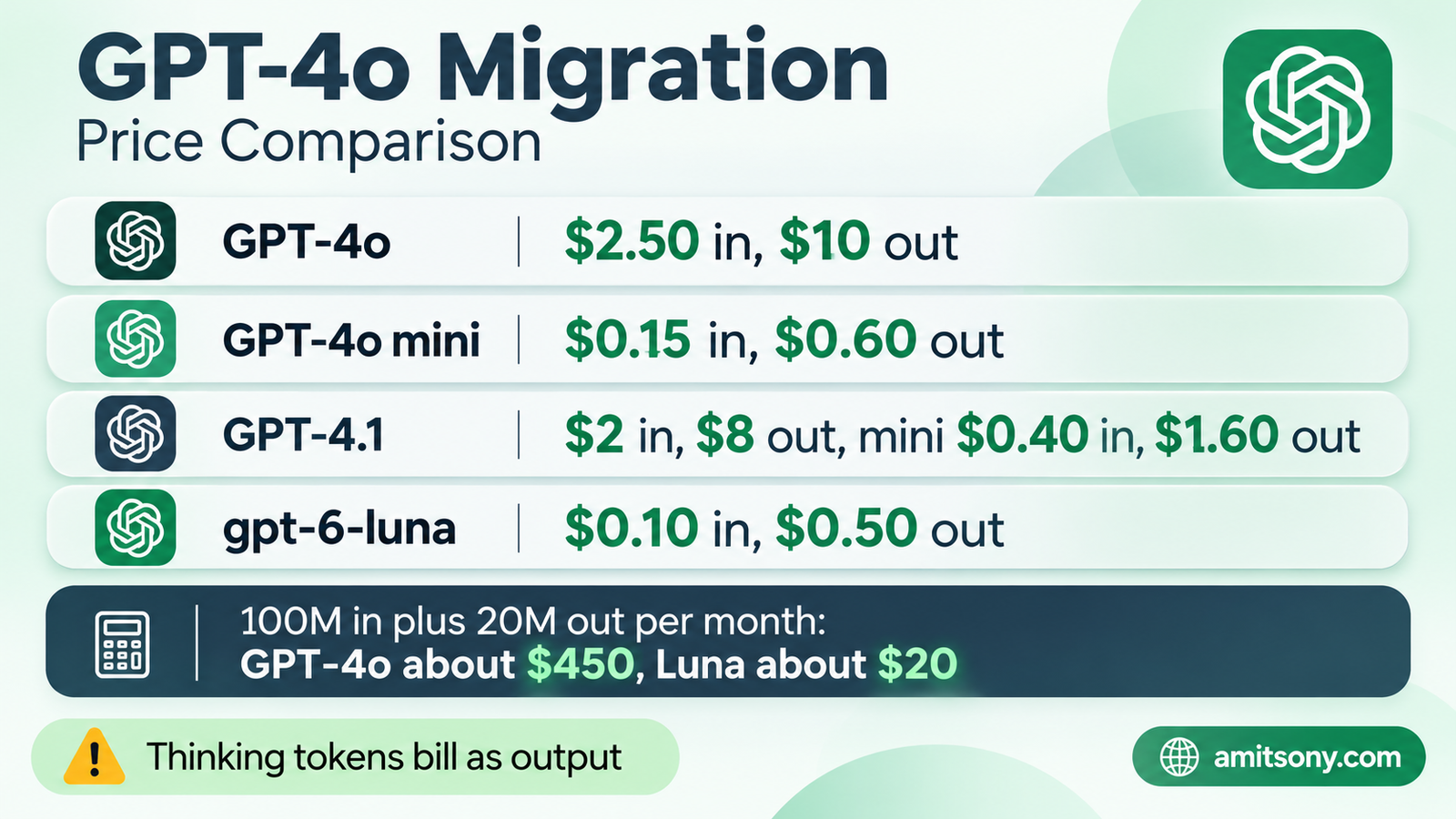
OpenAI names one replacement for all five: gpt-6-luna. The price difference is large.
GPT-4o costs $2.50 per million input tokens and $10 per million output tokens. GPT-4o mini costs $0.15 and $0.60. GPT-4.1 launched at $2 and $8, and GPT-4.1 mini at $0.40 and $1.60. GPT-6 Luna costs $0.10 and $0.50, roughly ₹9 and ₹44.
Take a workload of 100 million input tokens and 20 million output tokens a month. On GPT-4o that is about $450, or around ₹39,600. On Luna it is about $20, or around ₹1,760. For GPT-4o mini users the saving is smaller, about $27 down to $20.
Two catches. Luna's price steps up for prompts above 272,000 tokens. And if you use higher reasoning effort, thinking tokens bill as output, so your real cost per task can be well above the sticker figure. Measure it before you celebrate.
Is GPT-6 Luna a drop-in replacement for GPT-4o?
No. Changing the model string is the first step, not the whole migration.
GPT-4o and GPT-4.1 are non-reasoning chat models. Luna is a newer model with reasoning effort settings, a different token profile and different default behaviour. Output tone, formatting, refusal style and length can all shift, even when quality improves.
Check these before you switch. Does your JSON or structured output still validate? Do your tool calls behave the same? Are the request parameters you set, such as temperature and max tokens, still supported or renamed? How many output tokens does a typical answer use now? Is latency acceptable at the effort level you chose?
Read OpenAI's GPT-6 migration guide for the exact parameter rules, because they are the part most likely to break a working request.
For tasks where Luna falls short, move up a tier rather than patching prompts. GPT-6.1 Sol costs $2 and $10, close to GPT-4o's old price, and OpenAI already names it as the replacement for gpt-5 and o3.
How do you find every place your code uses GPT-4o or GPT-4.1?
Search your repository for the strings gpt-4o, gpt-4o-mini, gpt-4.1 and gpt-4.1-mini, including dated snapshots and aliases. Check environment files, config files, feature flags and database tables that store a model name.
Look beyond code. Prompts stored in dashboards, automation tools, low-code workflows, scheduled jobs, notebooks and third-party apps may hide the model name. Ask every team that has an OpenAI key.
Then check usage. Your OpenAI usage dashboard shows spend by model, which is the most reliable inventory of what is still being called.
You can also monitor shutdowns programmatically. The List models endpoint returns an optional shutdown_date field for each model, so a nightly job can warn you the moment a date appears on something you use.
What is a step-by-step migration plan before January 14?
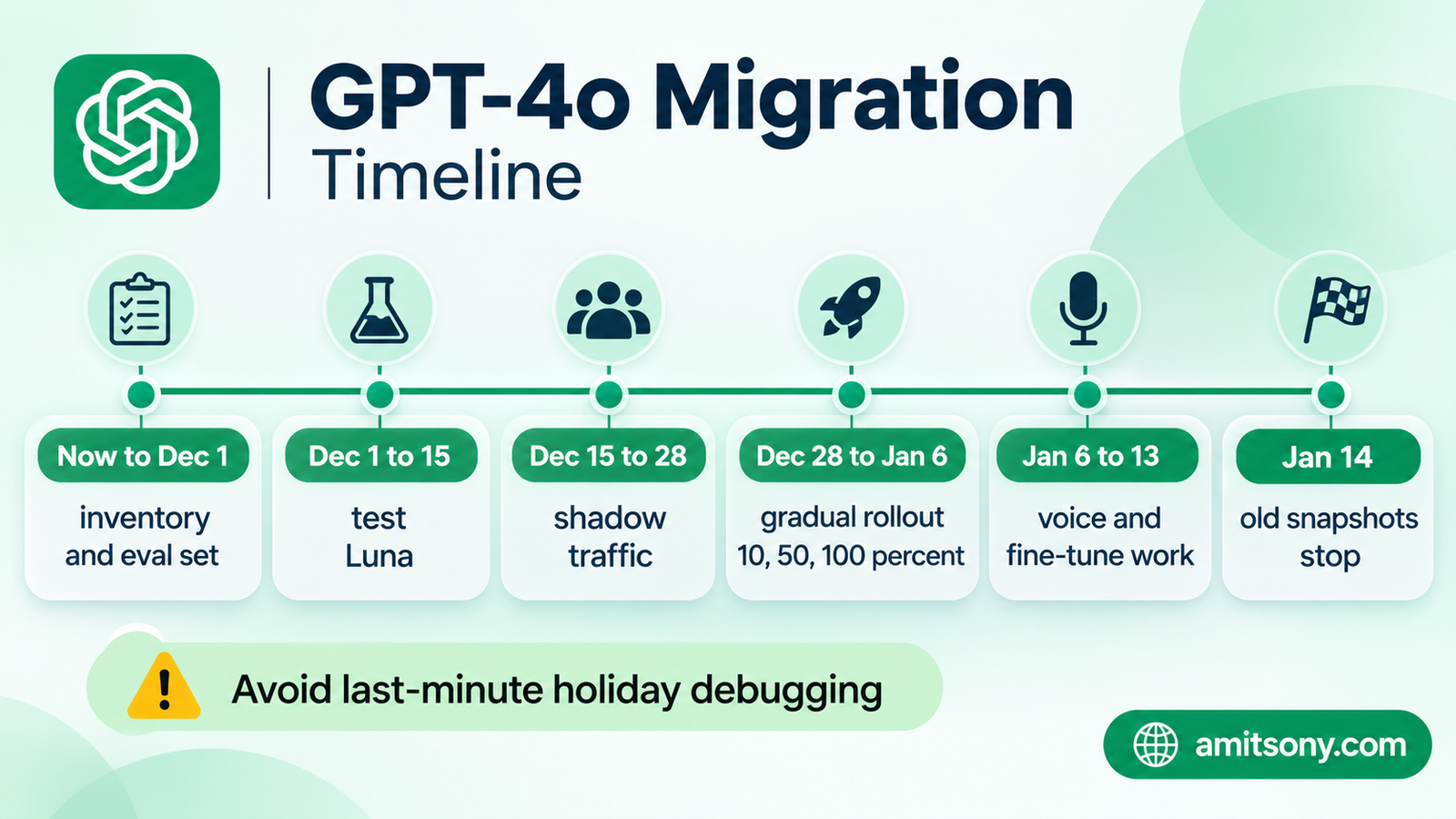
Work back from the deadline. With about eight weeks left, this schedule leaves a buffer.
Step 1, now to December 1. Inventory every call. Build an evaluation set of 100 to 200 real prompts with expected outputs or pass checks.
Step 2, December 1 to 15. Run Luna on the evaluation set. Compare quality, cost and latency against your current model. Tune prompts and effort levels.
Step 3, December 15 to 28. Run shadow traffic, where Luna answers in the background and users still get the old answer. Compare results on real requests.
Step 4, December 28 to January 6. Roll out gradually, 10 percent, then 50 percent, then 100 percent, behind a feature flag.
Step 5, January 6 to 13. Finish voice and fine-tune work, keep the flag so you can roll back, and watch error rates.
Step 6, January 14. Old snapshots stop. Remove the old model strings from your code and configs.
My advice: do this in December, not January. Holidays shrink the team just when you need people to debug.
How do you test the replacement properly?
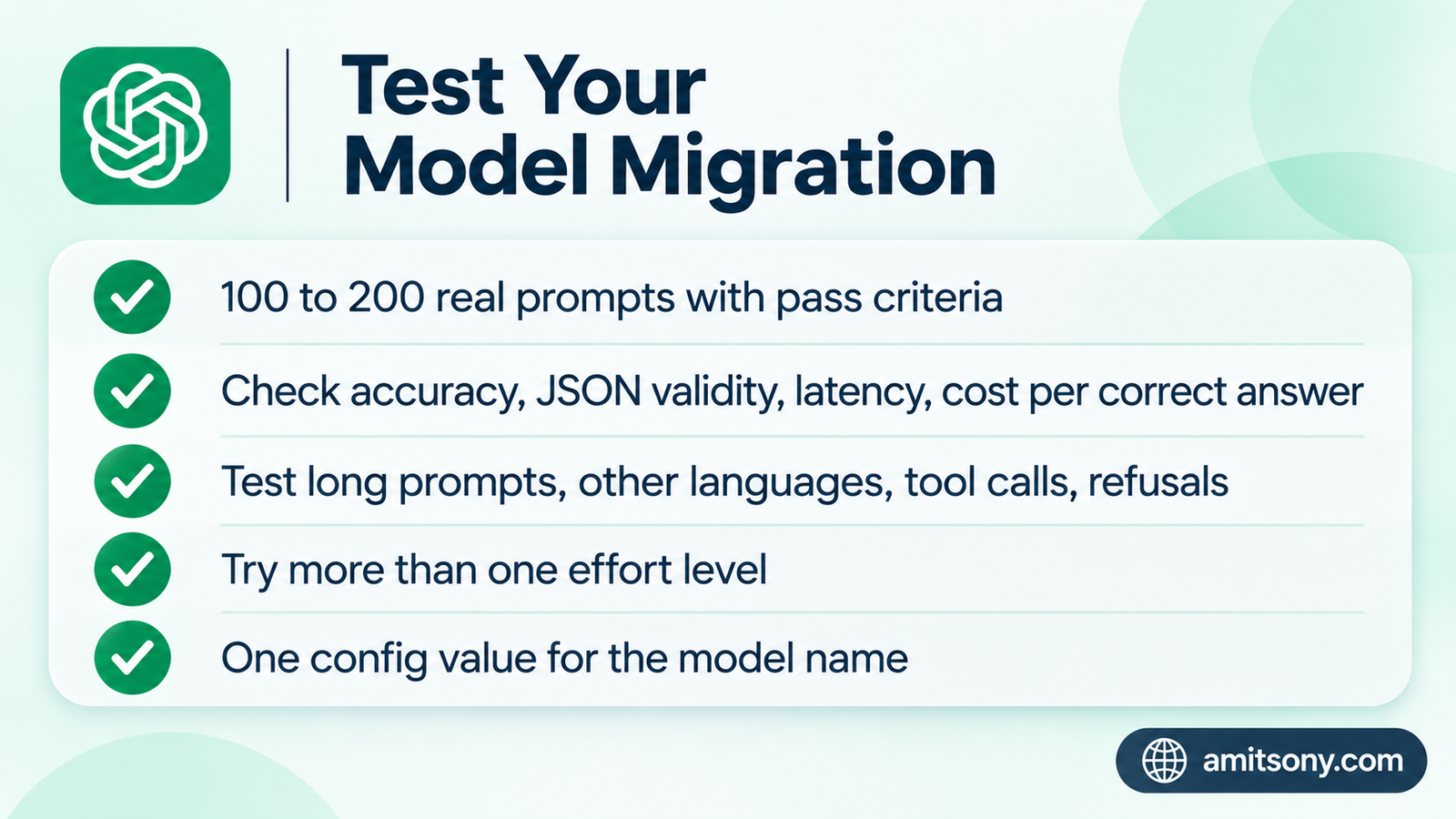
Use real prompts, not synthetic ones. Pull 100 to 200 requests from your logs, remove personal data and define what a correct answer looks like for each.
Measure four things: accuracy against your pass criteria, format validity such as JSON that parses, latency at the 95th percentile, and cost per correct answer including thinking tokens.
Test the awkward cases. Include your longest prompts, requests in other languages, tool-calling flows, empty or messy inputs, and requests that should be refused.
Run each set at more than one effort level. A lower effort often keeps quality while cutting cost and delay.
Keep the model name in one configuration value, not scattered across the code. That makes both the rollout and any rollback a one-line change.
What happens to your fine-tuned GPT-4o models?
They shut down with their base models on January 14, 2027. Inference on a fine-tuned model works only until the base model is deprecated, and then it stops.
There is an earlier date as well. From January 6, 2027, active existing customers can no longer create new fine-tuning jobs on OpenAI's self-serve platform. If you need a last training run, do it now.
At least one tracker also notes that the named replacement cannot be fine-tuned, so you may not get a like-for-like path.
Plan for that in three steps. Export your training data and evaluation set today. Test whether a well-written prompt with a few examples on Luna matches your fine-tune. If it does not, evaluate another provider that supports fine-tuning, or distil your own smaller model.
In some cases OpenAI offers dedicated capacity for continued access after a shutdown, but you have to contact its sales team. Do not plan around it.
What about voice, audio and transcription models?
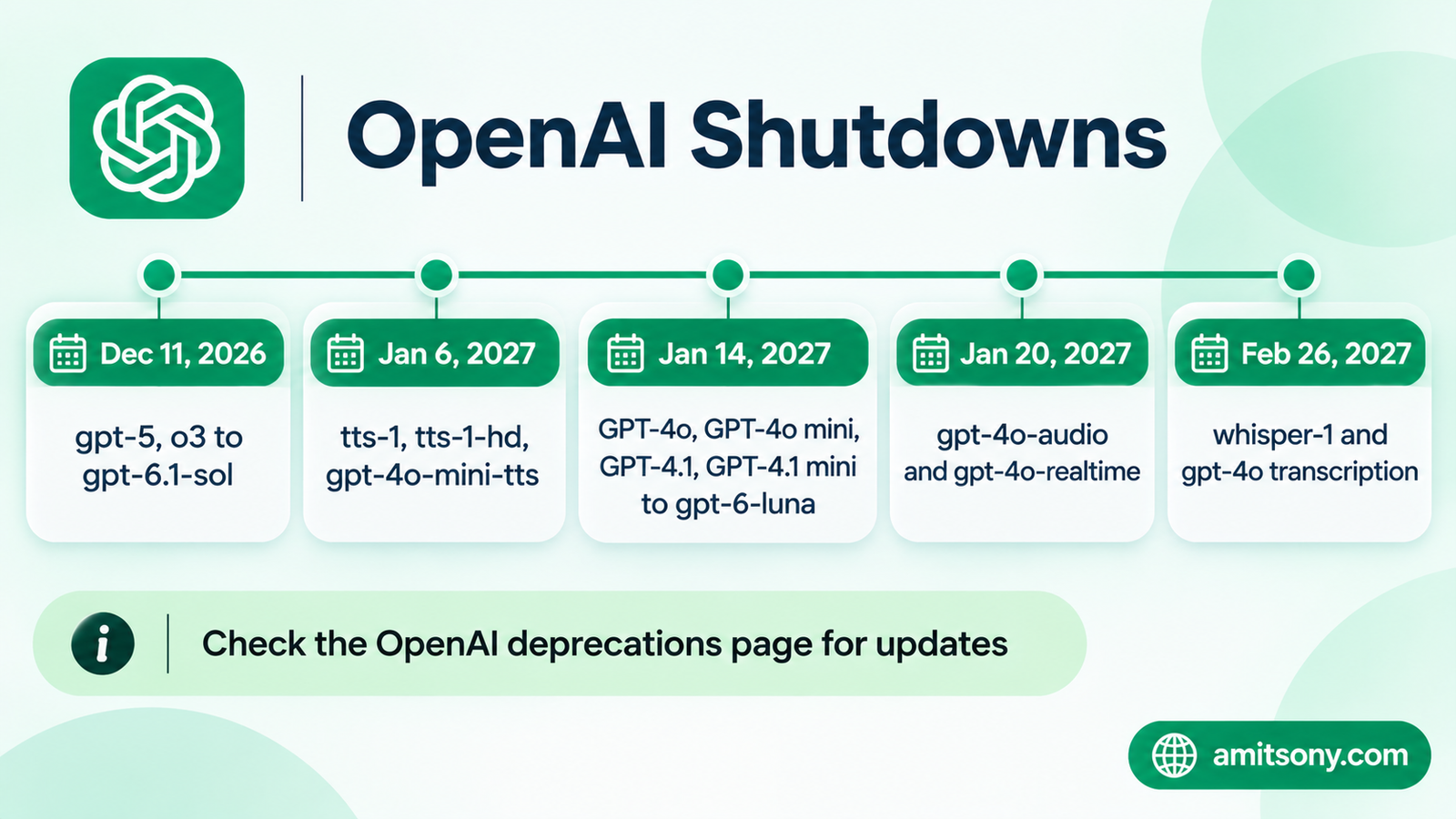
Check these separately, because their dates differ.
On January 6, 2027, tts-1, tts-1-hd and gpt-4o-mini-tts shut down. OpenAI's recommended replacement is gpt-realtime-2.1-mini. On January 20, gpt-4o-audio and gpt-audio move to gpt-audio-1.5, and gpt-4o-realtime moves to gpt-realtime-2.1, with the mini versions pointing to gpt-realtime-2.1-mini.
On February 26, whisper-1 and the gpt-4o transcription models shut down, with gpt-live-transcribe or gpt-transcribe as the replacements. The older translations endpoint also ends that day in favour of a realtime translations endpoint.
If your app speaks or listens, add these dates to the same calendar. January is crowded, with 6, 14 and 20 all in the same month.
Should you move to another provider instead?
First migrate to Luna to meet the deadline, since it is the least work and the same SDK. Then decide whether to diversify.
Alternatives cost about the same. Claude Haiku 5.5 is $0.10 and $0.50, the same list price as Luna. Google's Gemini API lists Gemini 3.8 Flash at an introductory $0.75 and $3.75. DeepSeek V4.1 Flash costs about $0.15 and $0.60 off-peak. Quality, speed and data policies differ, so test them on your own evaluation set.
The lesson of this deprecation is not which provider to choose. It is that any model name can disappear on three months' notice. Keep model names in config, write provider-neutral code, and consider a gateway such as LiteLLM so a future change is a setting, not a rewrite.
My verdict: pin the Luna migration now, then add a second provider as a tested fallback before the next deprecation arrives.
What happens if you miss the deadline?
After January 14, requests to the retired snapshots stop working through the standard API. Users of your product would see errors, not a graceful fallback.
Reduce the risk. Add an error alert for model-not-found responses, and set a fallback model in code so the request retries on Luna if the old model fails.
If you are stuck, contact OpenAI. Dedicated capacity is sometimes possible, and for Azure customers the later April date may give breathing room. But treat that as insurance, not a plan.
Finally, write down the lessons. Add the deprecations page to your team's monthly checklist and subscribe to the notification emails, so the next notice does not arrive in a forgotten inbox.
Frequently Asked Questions
When is the GPT-4o API shutdown?
January 14, 2027, for gpt-4o-2024-08-06, gpt-4o-2024-11-20, gpt-4o-mini-2024-07-18, gpt-4.1-2025-04-14 and gpt-4.1-mini-2025-04-14, plus their fine-tunes.
What should I migrate to instead of GPT-4o?
OpenAI recommends gpt-6-luna for all five retiring snapshots. For harder tasks, consider moving up to gpt-6.1-sol.
Is GPT-6 Luna a drop-in replacement for GPT-4o?
No. It behaves differently and has reasoning effort settings, so test output format, parameters, latency and cost before switching.
What happens to fine-tuned GPT-4o models?
They shut down on January 14, 2027, along with their base model. New fine-tuning jobs stop for existing customers on January 6, 2027.
Does this affect ChatGPT?
No. The notice covers the API. ChatGPT is a separate product with its own model lineup.