
ElevenLabs is excellent — but it is expensive at scale and not built for real-time voice agents. In 2026, Inworld AI leads on quality-per-dollar for developers, Cartesia leads on raw speed, Fish Audio is the cheapest high-quality option, Murf AI wins for content studio workflows, and Deepgram is the best all-in-one for voice agent pipelines. The right alternative depends entirely on whether you are making content or building conversational AI.
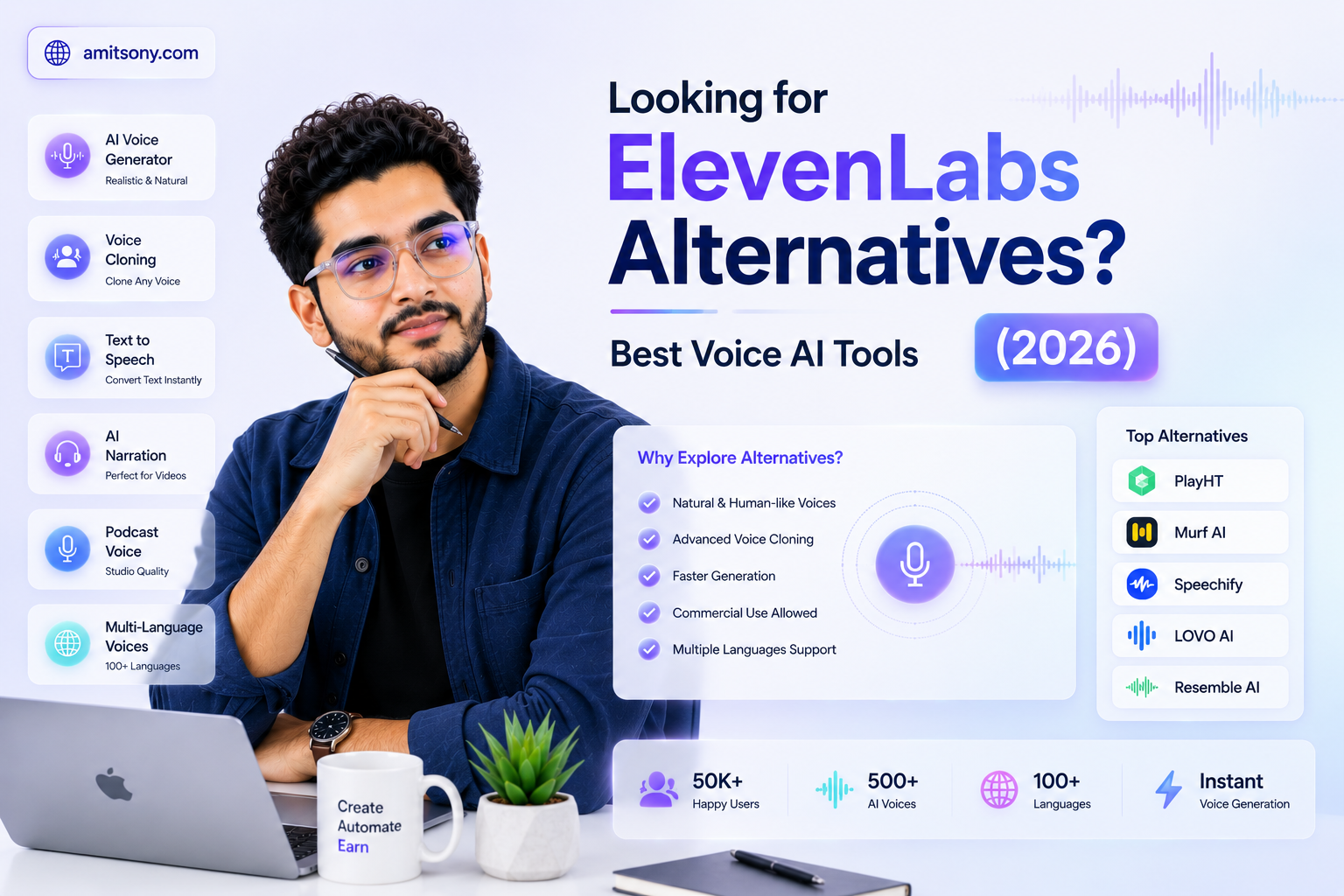
ElevenLabs changed what people expected from AI voice. The quality is genuinely good — emotional range, pronunciation accuracy, multilingual fidelity — and it remains the default pick for audiobooks, dubbing, and content production where output quality is the only metric that matters. But in 2026, a growing number of developers, creators, and teams are running into the same set of problems: unpredictable bills from the credit-based model, latency that makes it a poor fit for live voice agents, and per-character pricing that becomes punishing at production scale.
The alternatives have caught up, and in some specific categories they have genuinely overtaken it. New leaderboard data from Artificial Analysis (updated May 2026) shows three models ranking above ElevenLabs' Eleven v3 on pure voice quality — including Inworld AI TTS 1.5 Max, which also costs roughly ten times less per million characters. Meanwhile, Cartesia achieved 40ms time-to-first-audio on its Sonic-3 model — a speed no content-first platform was even designed to match. This guide breaks down the best ElevenLabs alternatives in 2026 by use case, with real pricing, benchmark data, and clear guidance on who should use what.
Why Are Developers and Creators Looking for ElevenLabs Alternatives?
Understanding why people leave — or at least diversify away from — ElevenLabs clarifies exactly what to look for in an alternative.
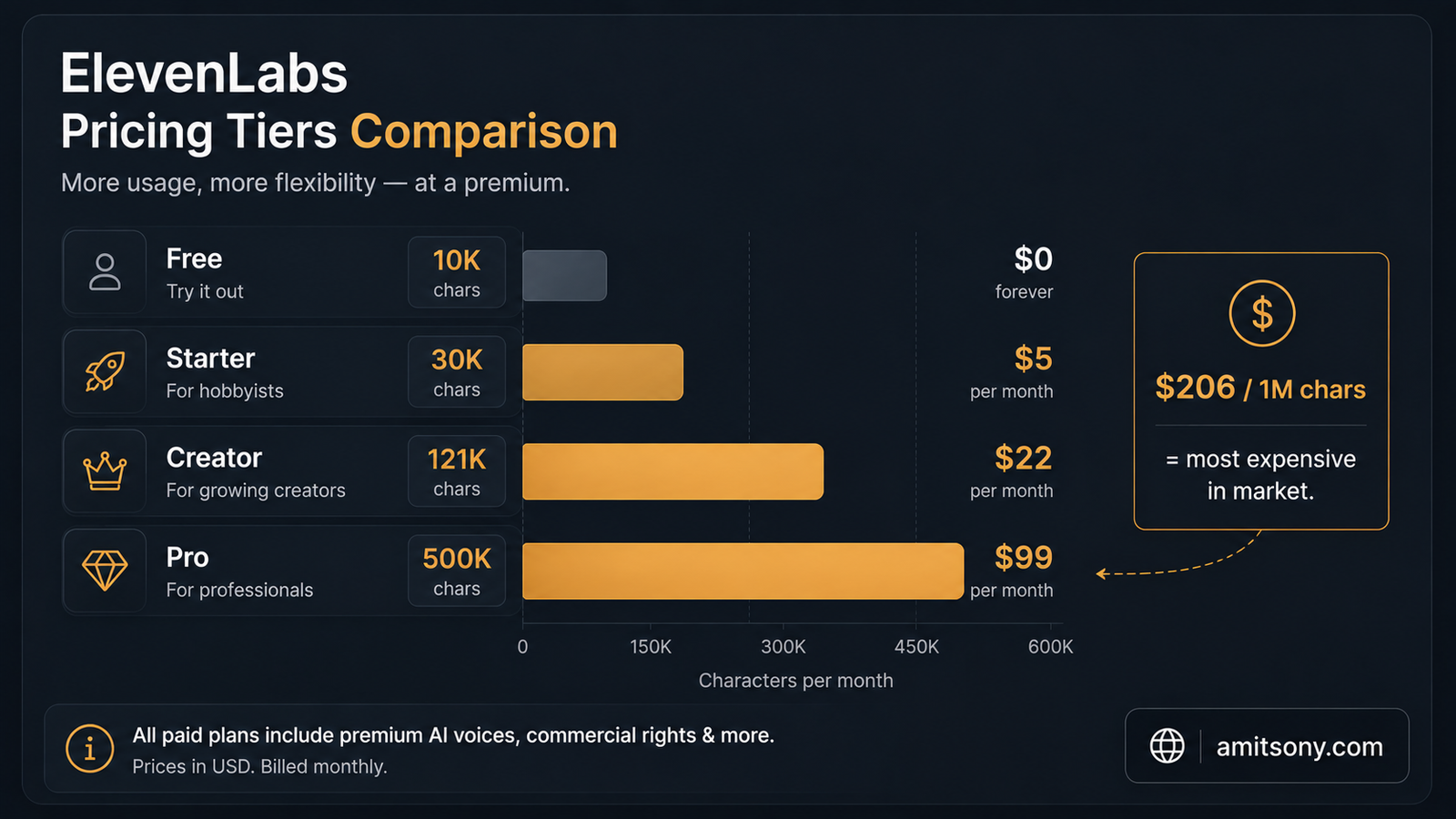
The most common complaint is cost predictability. ElevenLabs runs on a credit-per-character model: the free plan gives 10,000 characters per month with no commercial rights and mandatory attribution; the Starter plan at $5/month provides 30,000 characters and unlocks commercial use; Creator at $22/month gives 121,000 characters with professional voice cloning; Pro at $99/month jumps to 500,000 characters. The problem is that once you exceed your monthly allocation, overage billing kicks in at rates that make mid-month estimates unreliable for teams running higher volumes. The Flash model costs roughly 0.5 credits per character, which helps — but ElevenLabs' Multilingual v3 pricing at $206 per million characters is the most expensive tier in the industry.
The second issue is latency. ElevenLabs was engineered for high-quality audio production, not real-time conversation. Its Flash model achieves roughly 75ms inference speed, which is functional but inconsistent at scale — the latency IQR (interquartile range, a measure of consistency) sits at 28ms, compared to under 5ms for purpose-built real-time providers. For voice agents where a 300ms total response time is the ceiling for natural conversation, this matters.
A third factor in 2026: Play.ht — formerly one of ElevenLabs' most common alternatives — was acquired by Meta in July 2025 and wound down by December 2025. That migration pushed a large cohort of former PlayHT users into the market looking for alternatives simultaneously, which has accelerated adoption of Murf, Fish Audio, and Inworld over the past six months.
Which ElevenLabs Alternative Has the Best Voice Quality?
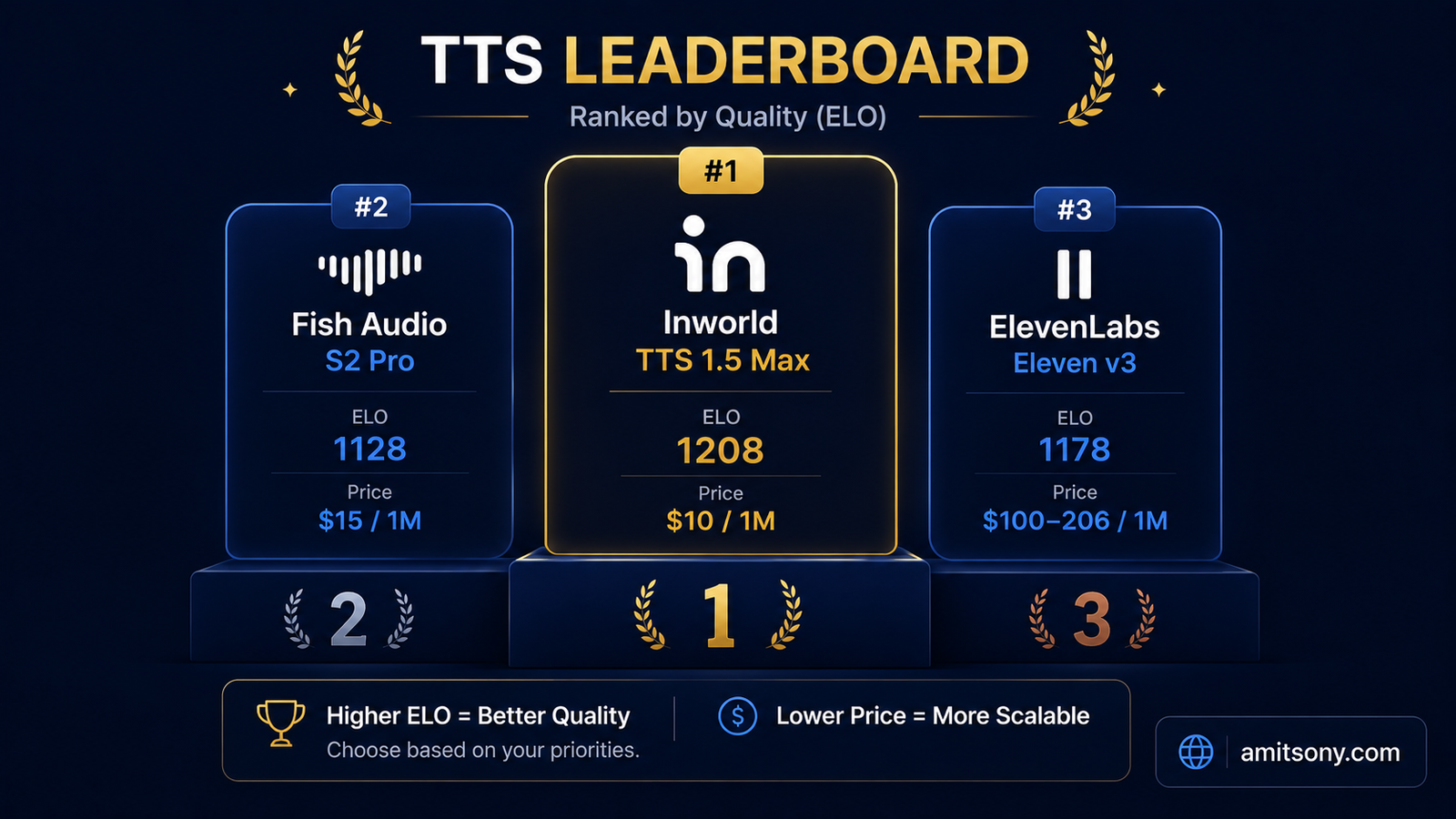
If raw voice quality is the primary constraint — for audiobooks, high-end narration, or branded voice experiences — the 2026 Artificial Analysis TTS Leaderboard is the cleanest objective reference available. It ranks models by ELO score based on thousands of blind user preference comparisons.
Inworld AI Realtime TTS 1.5 Max holds the top spot with an ELO of 1,208 as of May 2026, sitting above every ElevenLabs model on the leaderboard. ElevenLabs' strongest model, Eleven v3, ranks fourth with an ELO of 1,178. What makes Inworld's position remarkable is the price: Inworld TTS-1 is priced at $5 per million characters and Inworld TTS-1-Max at $10 per million characters — roughly 10 to 20 times cheaper than ElevenLabs Multilingual v3 at scale. The Inworld Realtime TTS-2 (launched as a research preview in May 2026) adds natural-language steering across eight dimensions — emotion, articulation, intonation, volume, pitch, range, speed, and vocal style — plus 100+ language support.
Fish Audio S2 Pro sits close behind with an ELO of 1,128 and API pricing at $15 per million characters — approximately 80% cheaper than ElevenLabs at comparable quality. It supports 80+ languages, sub-150ms latency, open-domain emotion tags, and an open-source core that allows self-hosting. Fish Audio's free tier covers personal use; the Pro plan starts at $9.99/month for 200 minutes of generation. For teams that previously used PlayHT and need a quality-first budget replacement, Fish Audio is the most direct comparable.
MiniMax Speech 2.6 HD is worth noting specifically for Chinese language content, where it outperforms every other provider. At $100 per million characters it is not a budget option, but for multilingual media brands targeting Chinese-speaking audiences it is the clearest choice on quality grounds.
What Is the Fastest ElevenLabs Alternative for Real-Time Voice Agents?
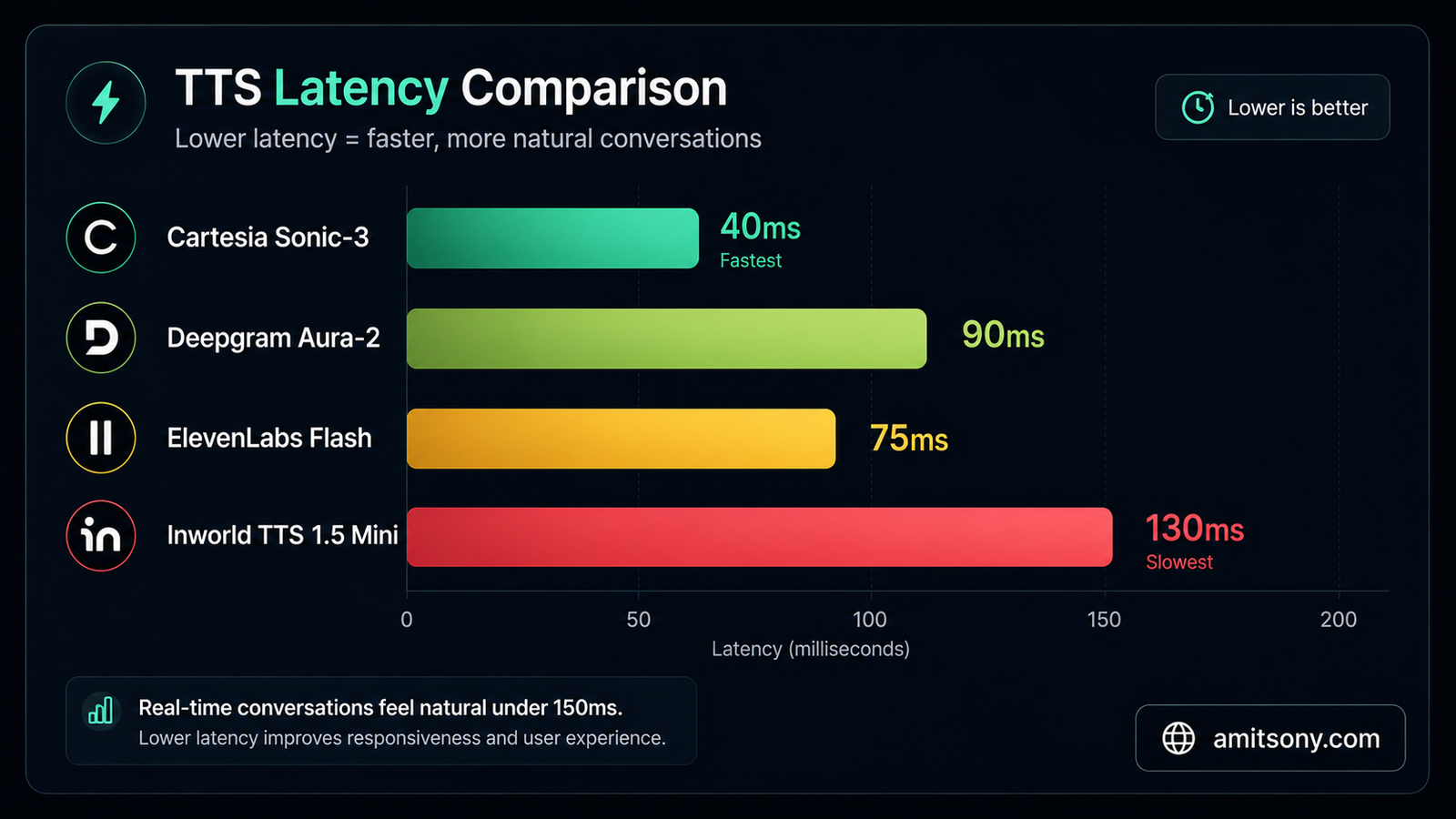
For developers building conversational AI, voice assistants, customer support bots, or phone agents, latency is the metric that matters most. Sub-100ms time-to-first-audio (TTFA) is the 2026 baseline for interactions that feel genuinely natural rather than slightly robotic.
Cartesia is the speed benchmark. Its Sonic-3 model achieves 40ms time-to-first-audio — the fastest measured across any platform in independent testing by Brilo AI (2026). Cartesia's Starter plan is $4/month and its Pro plan handles production workloads at $39 per million characters. Instant voice cloning requires at least 3 seconds of audio and is available from the Starter tier. The free plan gives 20,000 credits per month but restricts commercial use — you need the Starter plan or above for production deployment. Cartesia also ships a dedicated voice agent platform called Line, which handles WebSocket streaming and barge-in handling natively.
Deepgram Aura-2 is the strongest alternative when you need both speech-to-text and text-to-speech within a single API and billing relationship. Deepgram's Aura-2 TTS achieves sub-90ms baseline time-to-first-byte, with optimized performance reaching as low as 90ms. Pricing runs at $30 per million characters with volume discounts available. The real value of Deepgram for voice agent builders is architectural: using Nova-3 for transcription and Aura-2 for synthesis under a single API key eliminates the integration friction of managing two separate audio vendors. For regulated industries — healthcare, finance, government — Deepgram also offers on-premise deployment options that no pure-cloud provider matches.
ElevenLabs Flash v2.5 remains competitive in this category at ~75ms inference, but its production latency consistency lags purpose-built real-time platforms — an IQR of 28ms versus under 5ms for Deepgram. For teams already on ElevenLabs' higher tiers who want to stay in one ecosystem, Flash is a reasonable option. For greenfield voice agent builds, Cartesia or Deepgram is the better starting point.
What Is the Best ElevenLabs Alternative for Content Creators?
For YouTubers, podcasters, course creators, and marketing teams — people who need high-quality offline audio production rather than real-time agent performance — the decision matrix is different. Latency matters much less; voice variety, emotion control, cloning fidelity, and workflow integration matter much more.
Murf AI is the strongest ElevenLabs alternative for studio-style content workflows. Its key differentiator is not just voice quality — it is integration. Murf connects natively with Canva and PowerPoint, which makes it the natural pick for marketing teams who produce a lot of presentation-layer content alongside video. The Falcon model added WebSocket streaming support in 2025, which expanded Murf's relevance into lighter conversational applications. Pricing starts at $29/month for the Creator plan (lower than ElevenLabs Pro for comparable output), and the platform includes team collaboration features and enterprise security certifications that ElevenLabs' individual plans do not match. The trade-off: Murf does not have ElevenLabs' depth of voice cloning fidelity at the professional tier, and its language coverage is narrower.
Descript occupies a unique position because it is the only tool that combines a video and podcast editor with built-in AI voice generation. The Overdub feature lets you record your voice, build a model from it, and then type new words to add to a recording — which is genuinely useful for correcting audio without re-recording full takes. For solo creators who edit their own content and want voice AI embedded in the editing workflow rather than as a separate step, Descript is the most integrated option in this category. Plans start at $24/month for the Creator tier.
Fish Audio is also worth consideration for content creators who want quality without the premium price. The $9.99/month Pro plan delivers 200 minutes of generation at quality that independent benchmarks place above several tools that charge three to five times as much. The emotion tagging is strong, language support covers 80+ languages, and for high-volume faceless content production it offers the best cost structure of any quality-first platform.
Is There a Good Free ElevenLabs Alternative?
Yes — with important caveats around commercial rights that most comparison articles skip over.
ElevenLabs free gives 10,000 characters per month (~10 minutes of Multilingual v2 audio) but prohibits commercial use entirely and requires attribution in any public content. Cartesia free gives 20,000 credits per month — more generous — but also restricts commercial use to paid plans starting at $4/month. Fish Audio free covers personal use only; commercial rights require the Pro plan at $9.99/month. OpenAI TTS has no standalone free tier but is accessible via the standard OpenAI API — if you already have API credits from other usage, the cost is $15 per million characters for standard and $30/million for HD quality.
The genuinely free option for non-commercial work is Kokoro 82M — an open-source TTS model with an ELO of 1,056 on Artificial Analysis and self-hosting costs around $0.65 per million characters in compute. It is meaningfully worse than premium APIs on naturalness, but for developers prototyping agents, internal tools, or non-commercial projects, it eliminates per-character billing entirely. The setup requires a basic GPU instance and some Docker comfort.
One honest note: if you need commercial rights, no platform in 2026 offers a genuinely free commercial tier. The cheapest entry point with full commercial rights remains Cartesia Starter at $4/month or ElevenLabs Starter at $5/month. For most content creators, the cost is low enough that a paid plan is the practical starting point rather than trying to work around free tier limits.
Which Tool Is Best for Enterprise and Compliance Requirements?
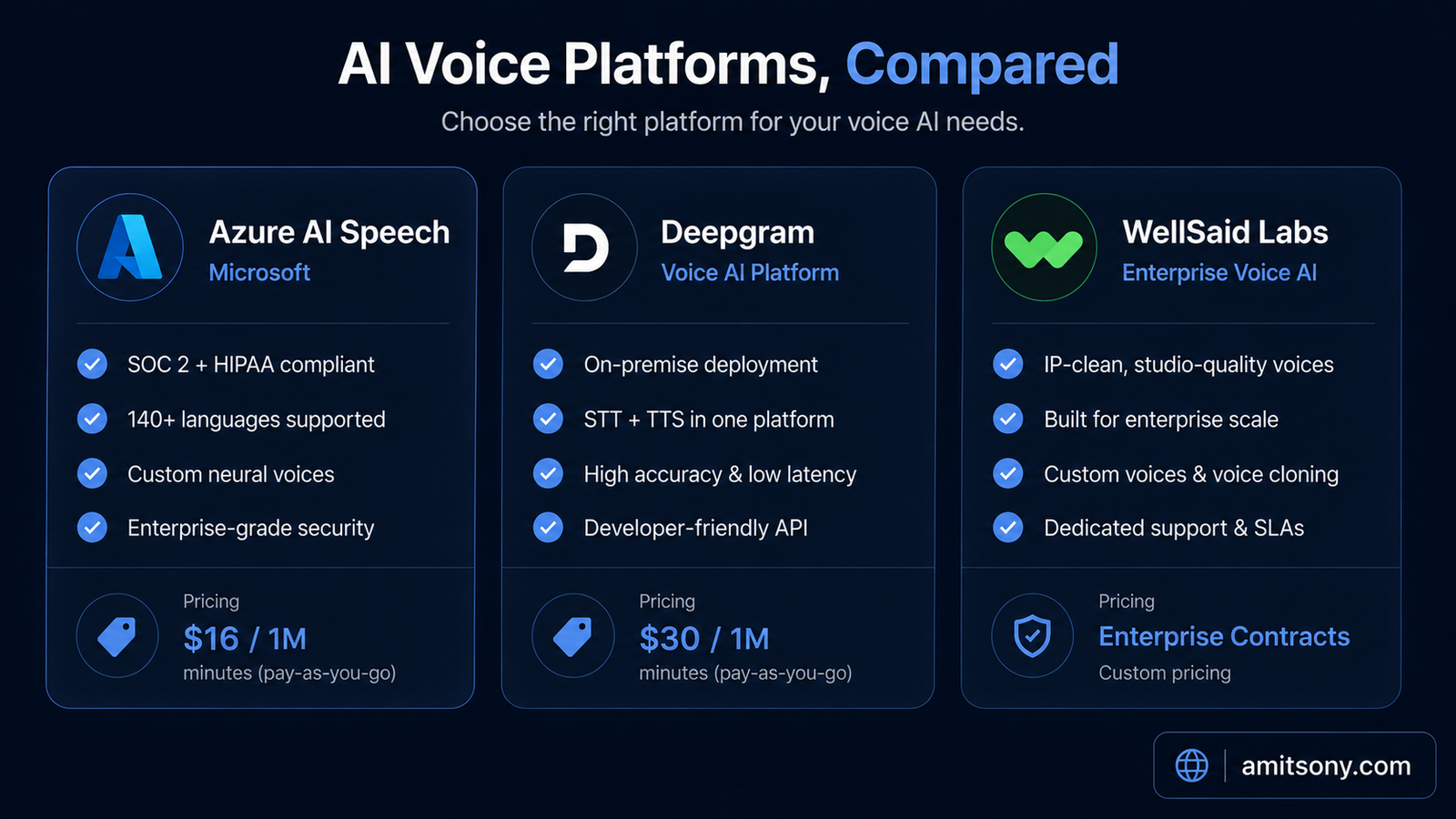
Large organizations have a different set of constraints: SOC 2 certification, HIPAA compliance, single sign-on, on-premise deployment options, and SLA-backed uptime guarantees. Most consumer-facing TTS tools do not clear these bars.
Azure AI Speech is the strongest option for enterprises already running on Microsoft infrastructure. It covers 400+ prebuilt neural voices across 140+ languages, supports custom neural voice training, real-time translation, and bundles STT and TTS under a single managed service. The free tier is generous — 500,000 characters per month — and paid pricing starts at $16 per million characters. SOC 2 and HIPAA compliance are included in standard enterprise agreements. The voice quality on Azure's newest HD neural voices has improved substantially in 2026 and is competitive with mid-tier independent providers, though it still trails the top ELO performers on naturalness.
Deepgram is the alternative for enterprises that prioritize on-premise deployment. Its Aura-2 TTS can be deployed on private cloud or on-premise, which matters significantly for financial services, government, and healthcare clients where data residency requirements make pure cloud solutions non-starters. Deepgram also offers multi-model deployment — using Nova-3 for STT and Aura-2 for TTS under one vendor relationship — which simplifies both procurement and audit.
WellSaid Labs is a niche but strong option for media and entertainment enterprises that need premium voice talent at scale with full IP rights and clean licensing. It does not compete on raw quality benchmarks but offers a curated library of professional voice talent, strict content policies that satisfy brand safety requirements, and enterprise contracts that include full commercial rights with no character limits or overage exposure.
How Do You Pick the Right One — A Clear Decision Framework
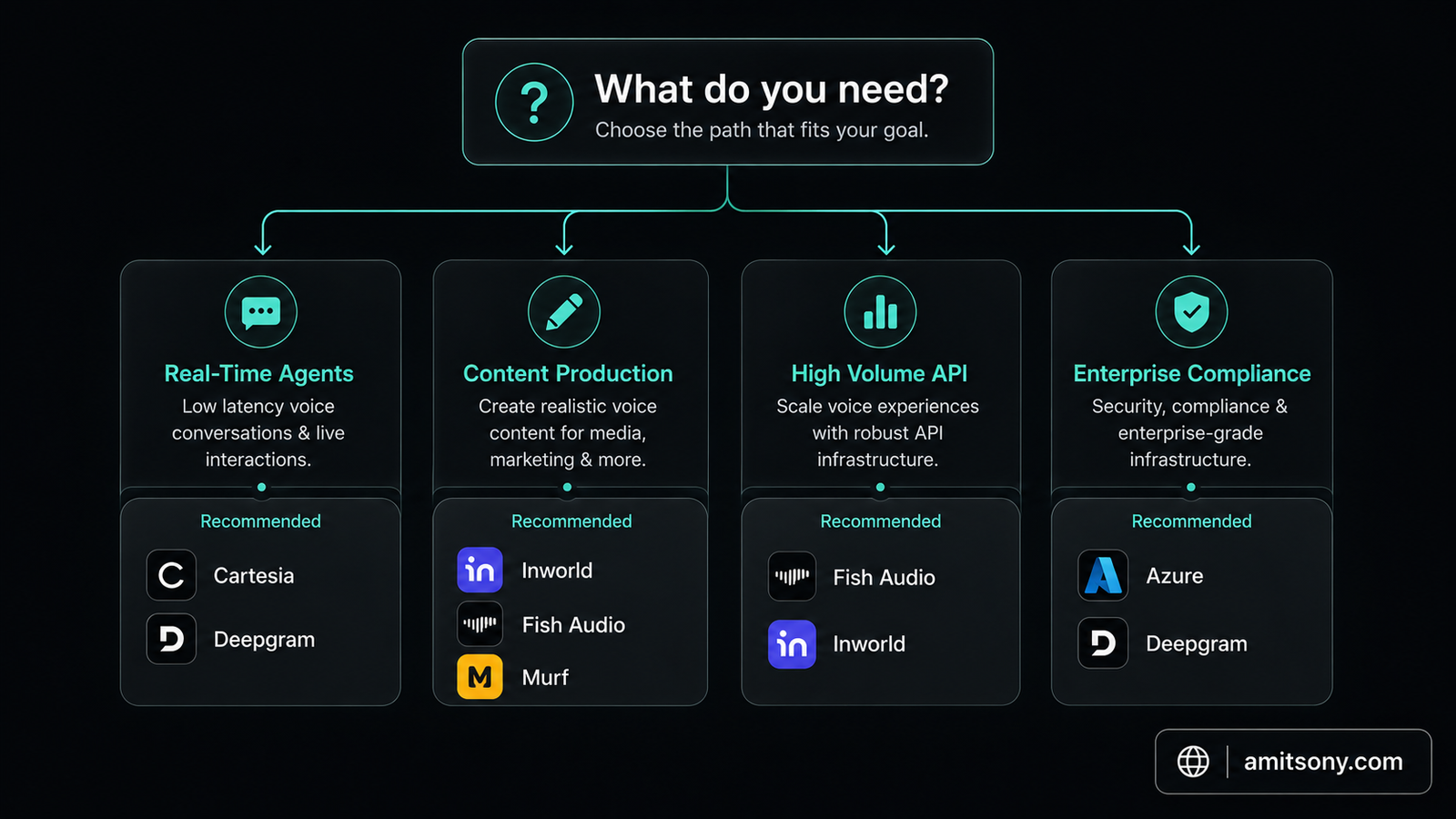
The 2026 TTS market has genuinely split into three tiers, and the most common mistake is picking a tool optimized for the wrong tier.
For real-time voice agents and conversational AI: Start with Cartesia (lowest latency, $4/month entry) or Deepgram (best for combined STT+TTS pipelines, on-premise availability). Both deliver sub-100ms TTFA that live conversations require. Inworld TTS 1.5-Mini is also strong here at sub-130ms P90 latency and competitive per-character pricing.
For content production — YouTube, podcasts, audiobooks, dubbing: ElevenLabs remains a strong option when budget allows and you need its specific voice quality ceiling. Inworld TTS-1.5 Max beats it on quality benchmarks at a tenth of the cost, making it the smarter default for new production pipelines. Fish Audio is the budget-first pick with quality that genuinely punches above its price. Murf AI wins for teams that need Canva and PowerPoint workflow integration built in.
For high-volume API usage at scale: Fish Audio at $15/million characters and Inworld TTS-1 at $5/million characters are the two options that actually survive the unit economics of scale. ElevenLabs at $100–$206/million characters is not designed for high-throughput production; it is designed for premium low-volume output where quality is everything. Hume Octave 2 at $7.60/million characters is worth evaluating here as well — it is the cheapest option with emotionally adaptive output.
For enterprise compliance: Azure AI Speech or Deepgram, depending on whether you need Microsoft ecosystem integration or on-premise flexibility.
Most serious production teams in 2026 end up with a two-tier stack: a premium provider for high-stakes output and a budget provider for high-volume background tasks. The per-character pricing differences make this hybrid approach meaningfully cheaper than running everything through a single premium platform.
Frequently Asked Questions
Is ElevenLabs still worth it in 2026?
Yes, for specific use cases. ElevenLabs remains strong for offline content production — audiobooks, dubbed video, podcast narration — where quality is the primary constraint and volume is moderate. It is a poor fit for real-time voice agents at scale, where Cartesia or Deepgram outperform it on both speed and cost.
Which ElevenLabs alternative is cheapest for bulk API usage?
Inworld TTS-1 at $5/million characters is the cheapest option that also ranks at the top of quality leaderboards. Fish Audio follows at $15/million characters. Both are 80–95% cheaper than ElevenLabs Multilingual v3 at comparable output quality.
Did Play.ht shut down?
Yes. Play.ht was acquired by Meta in July 2025 and wound down by December 2025. It now operates as PlayAI under Meta's ownership. Existing integrations carry deprecation risk. Murf AI and Fish Audio are the most recommended migration targets for former PlayHT users.
Can I get commercial rights without paying?
No major platform in 2026 offers free commercial TTS rights. The cheapest entry points are Cartesia Starter at $4/month and ElevenLabs Starter at $5/month. Free tiers across all providers restrict commercial use and typically require attribution.
What is the best ElevenLabs alternative for Hindi and Indian languages?
Azure AI Speech HD 2.5 supports 140+ languages including Hindi and has the broadest Indian language coverage. Google Cloud TTS also covers major Indian languages well and integrates cleanly with existing GCP infrastructure. Fish Audio covers 80+ languages at a lower price point and is worth testing for Hindi-English mixed content.
Is Inworld AI only for gaming?
No. Despite being known initially for game NPC voice, Inworld TTS 1.5 Max is a general-purpose text-to-speech API used across content production, conversational AI, and interactive applications. The Realtime TTS-2 model (May 2026 research preview) supports 100+ languages and natural-language voice control — it is a direct competitor to ElevenLabs in any workflow, not just gaming.