
For most teams, DeepSeek V4.1 Flash is the better open-weight 1M-context model: it is cheaper, slightly higher on independent scores and much faster. Choose Mistral Large 4 if you need a clearly documented licence, a European vendor and a flat price with no peak-hour surcharge. Check weight licences before you resell anything.
Two open-weight models now offer a 1 million token context window at prices that would have looked absurd a year ago. Mistral Large 4 is the European heavyweight, and DeepSeek V4.1 Flash is the budget speedster.
Both are easy to call through an API, and both can be self-hosted if you have the hardware. This comparison covers price, scores, speed, licences and who should pick which, with a few catches that sticker prices hide.
What are Mistral Large 4 and DeepSeek V4.1 Flash?

Mistral Large 4 is a mixture-of-experts flagship with roughly 1.05 trillion total parameters and about 52 billion active per token. It went into public preview on October 6, 2026, and Mistral published the weights on October 29. FP8 and NVFP4 checkpoints are on Hugging Face.
DeepSeek V4.1 Flash is a leaner model of about 763 billion parameters. The updated version, labelled 1017, arrived on October 17, 2026. Several trackers list it as an MIT-licensed open-weight model of roughly 429 GB in NVFP4.
One caution. At least one review could not find a downloadable weight release or licence on DeepSeek's official pages for this model. Check the Hugging Face model card before you plan to self-host.
Both advertise a context window of about 1 million tokens. Artificial Analysis measured the Mistral preview at around 524K, so test long prompts yourself.
How do Mistral Large 4 and DeepSeek V4.1 Flash compare on price?

Mistral Large 4 costs $0.70 per million input tokens, $0.07 cached and $2.10 output, a flat rate from October 29, roughly ₹62, ₹6 and ₹185.
DeepSeek V4.1 Flash lists $0.15 input and $0.60 output off-peak, with cached input at $0.006. Peak hours double the headline rates to about $0.30 and $1.20. Third-party hosts differ: one lists $0.22 and $0.66, and OpenRouter shows lower figures on some routes. Always read your provider's page.
Here is a worked example. Take 50 million input tokens and 10 million output tokens a month. Without caching, Mistral costs about $56, or around ₹4,930. DeepSeek costs about $13.50 off-peak, around ₹1,190, or $27 at peak.
Now assume 70 percent of input is cache hits. Mistral falls to about $34, around ₹2,990. DeepSeek falls to about $8.50 off-peak, around ₹745, or $17 at peak. The cached rate is Mistral's most underrated feature, but DeepSeek still wins on price in every case.
Output is where the gap bites. DeepSeek's output price is a third of Mistral's, and output tokens dominate agent and coding bills.
How do they score on benchmarks?
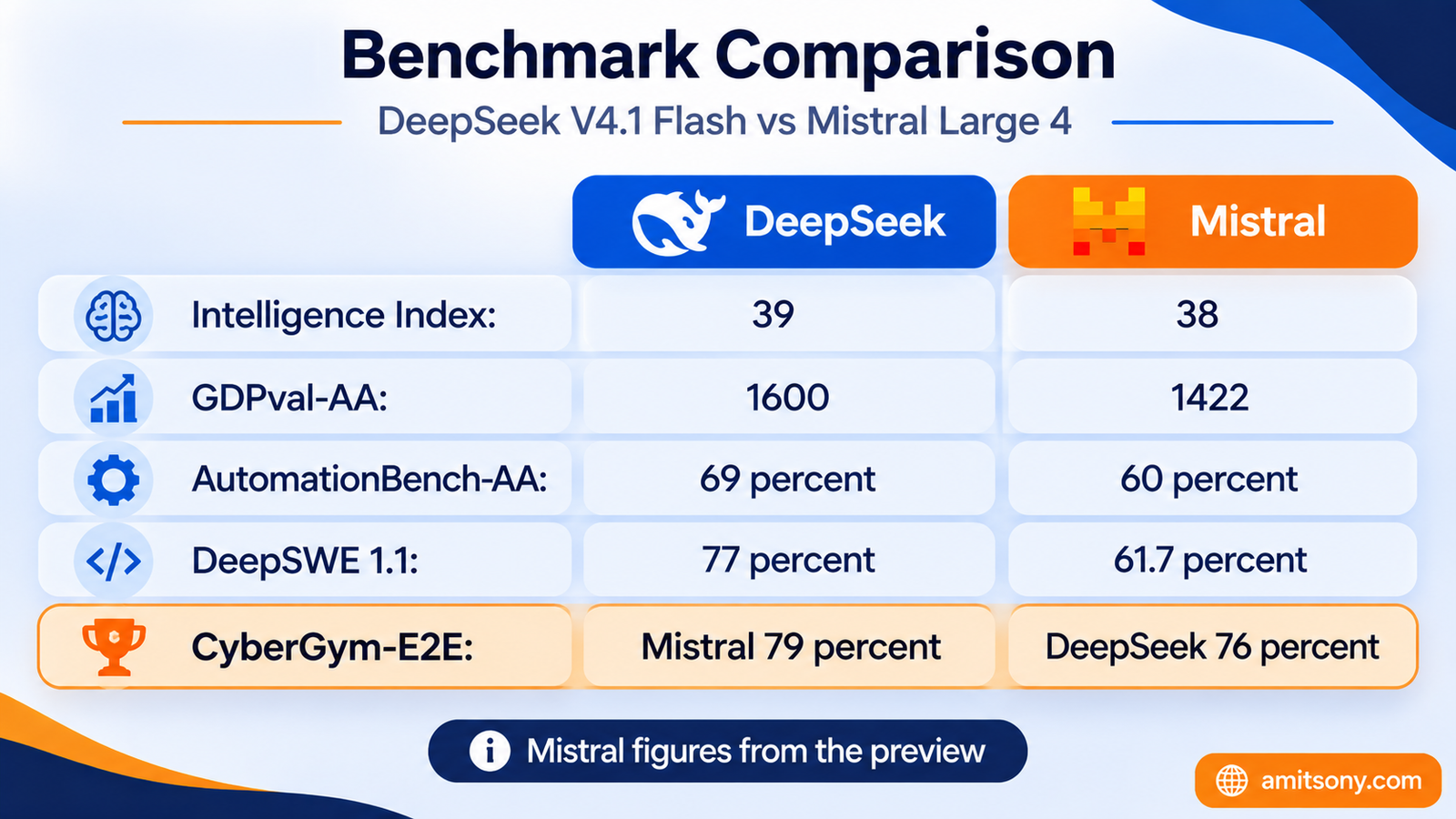
On Artificial Analysis, DeepSeek V4.1 Flash at max effort scores 39 on the Intelligence Index, against 38 for the Mistral Large 4 preview. That is a near tie, with a slight edge to DeepSeek. Artificial Analysis also shows DeepSeek ahead on GDPval-AA, at 1600 against 1422, and on AutomationBench-AA, at 69 percent against 60.
A separate comparison gives DeepSeek the lead on DeepSWE 1.1, at 77 percent against 61.7, and an aggregate score of 48.6 against 45.6.
Mistral wins one notable row. On CyberGym-E2E, one analyst lists Mistral at 79 percent against DeepSeek's 76 percent.
Treat these as signals. Scores depend on the effort level, the provider and the version, and the Mistral figures come from the preview. My verdict: they are close enough that price, licence and speed should decide.
Which model is faster?
DeepSeek V4.1 Flash, by a wide margin. On OpenRouter's measurements it shows a median latency of about 0.35 seconds and throughput near 176 tokens per second, while Mistral Large 4 shows about 2.24 seconds and 57 tokens per second.
That gap matters for live chat, voice agents and tool loops with many steps. A 3x speed difference compounds across 20 tool calls.
Speed is a provider property as much as a model property. A different host or a self-hosted setup will change both numbers, so benchmark the endpoint you will actually use.
What are the licences, and can you self-host them?
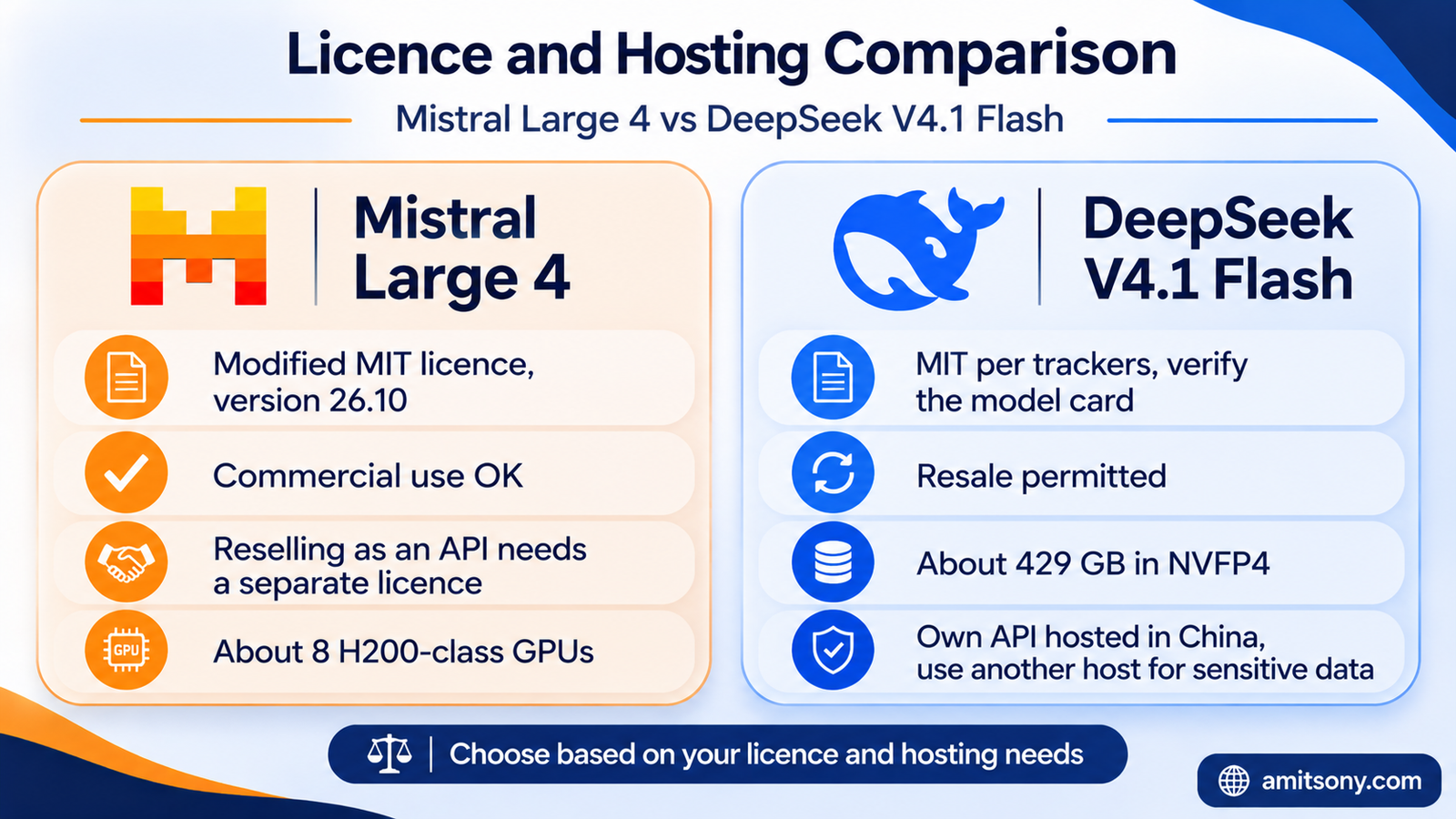
Mistral Large 4 uses the Mistral Ecosystem Open-Weight License, version 26.10. Mistral describes it as a modified MIT licence. Commercial use is allowed, but a company that runs a model-as-a-service business needs a separate licence from Mistral.
DeepSeek V4.1 Flash is listed as MIT by several trackers, which permits resale without that restriction. Confirm this on the official model card.
Hardware is the other issue. Mistral Large 4 needs roughly eight NVIDIA H200-class GPUs. DeepSeek's NVFP4 weights are around 429 GB, which also means a multi-GPU server. Neither fits a laptop. For small teams, renting an API is the realistic route.
There is a data question too. DeepSeek's own API is operated from China, which may not fit regulated or sensitive workloads. Use a Western host or self-host. Mistral is a European company, which can simplify compliance for EU buyers.
Mistral Large 4 or DeepSeek V4.1 Flash: which should you pick?
Pick DeepSeek V4.1 Flash for most work. It is cheaper by a wide margin, slightly ahead on independent scores, much faster, and carries the simpler licence. High-volume coding agents, document pipelines and anything you will resell fit here.
Pick Mistral Large 4 if you need a European vendor, a licence that is clearly documented and versioned, or a price with no peak-hour surcharge. Its cached input rate of $0.07 is also a strong feature for prompts that repeat.
Skip DeepSeek's own API for sensitive data, and skip Mistral for resale unless you have the extra licence.
The best setup is simple. Route routine and long-context traffic to DeepSeek, keep Mistral as the compliance-friendly option, and test both on your own prompts before you commit.
How should you test them before choosing?
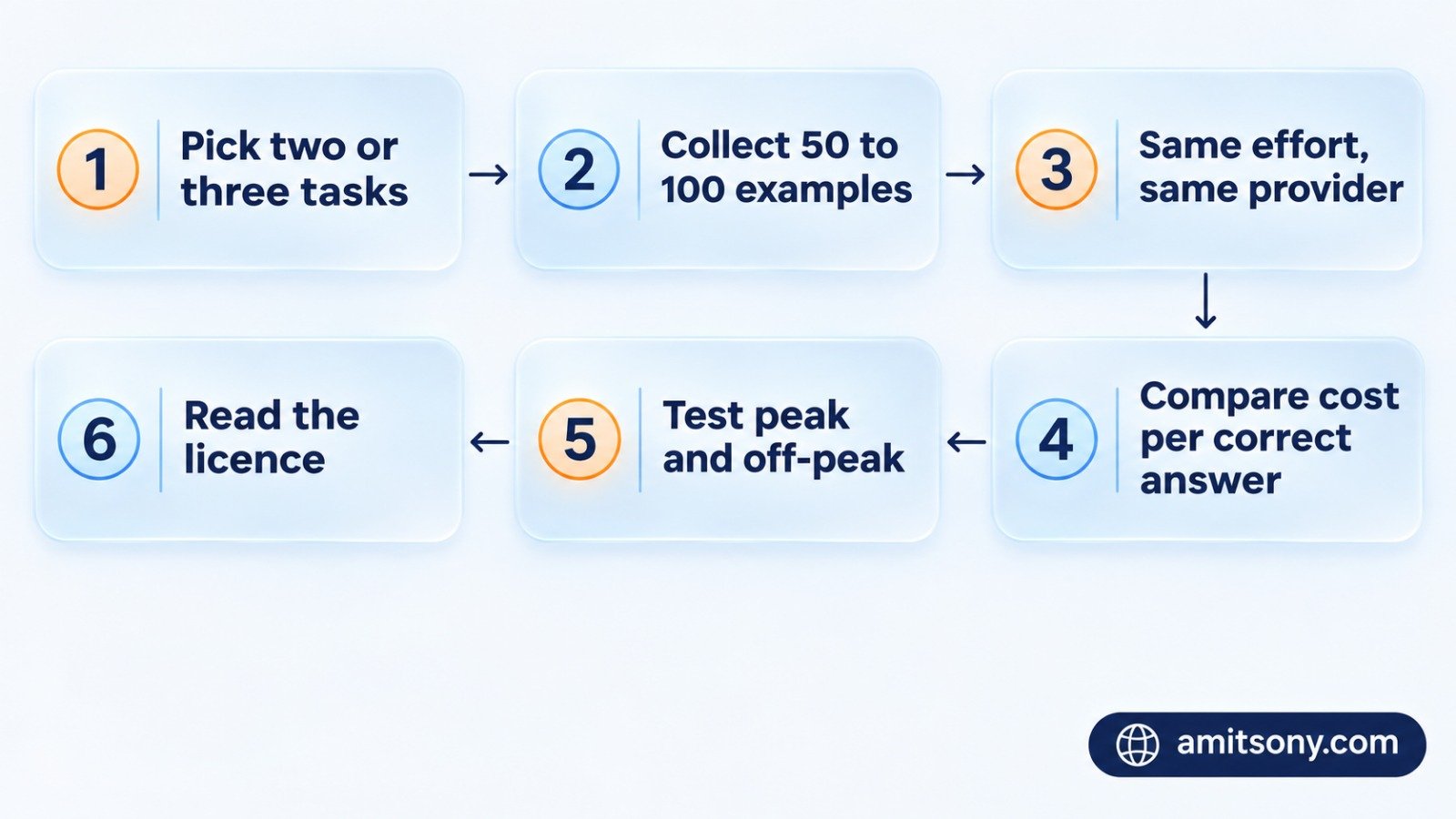
Step 1. Pick two or three real tasks, one with a very long prompt.
Step 2. Collect 50 to 100 real examples with a clear idea of a correct answer.
Step 3. Run both models at the same effort level on the provider you will really use.
Step 4. Record cost per correct answer, latency and failures, not just price per token.
Step 5. Test peak and off-peak, since DeepSeek's price doubles at peak hours.
Step 6. Read the licence for your use case, especially if you plan to resell access.
Frequently Asked Questions
Is Mistral Large 4 better than DeepSeek V4.1 Flash?
Not on price, speed or most independent scores, where DeepSeek has a slight lead. Mistral wins on licence clarity and on some security tests.
How much does Mistral Large 4 cost?
$0.70 per million input tokens, $0.07 for cached input and $2.10 per million output tokens, flat.
Are both models open-weight?
Mistral published weights for Large 4 on October 29, 2026. Several trackers list DeepSeek V4.1 Flash as MIT open-weight, but confirm on the official model card.
Can you resell Mistral Large 4 as an API?
Not without a separate commercial licence from Mistral. The standard licence allows commercial use but excludes model-as-a-service businesses.
What is the context window of each?
Both advertise about 1 million tokens. Artificial Analysis measured the Mistral preview at about 524K, so test long prompts yourself.