

Meta Muse Wonder is a credible frontier model, released October 12, 2026, that costs $4 and $20 per million tokens, the same as Claude Opus 5.5. It is strong on legal, finance and memory tasks, but the best version, Wonder Full, is not on the API, and independent scores still put Opus 5.5 ahead.

Meta spent more than a year rebuilding its AI team and a lot of money doing it. Muse Wonder is the first model from that effort that Meta itself calls frontier class, and it is priced like one.
This review covers what Wonder is, why there are two of them, what they cost, how they score, where they fall short, and whether they are worth a test.
What is Meta Muse Wonder?
Meta Muse Wonder is a pair of models from Meta Superintelligence Labs, released on October 12, 2026. Muse Wonder is the version you can call through the API. Muse Wonder Full is the larger and stronger sibling, available only inside a Muse Code subscription.
Wonder has a 1,048,576 token context window and accepts text, images, video, audio and PDFs. It has reasoning effort settings from minimal to max, and the API model is still labelled as a preview.
Meta pushes one feature above the rest: memory. Its researchers say the model is built to remember what matters to you over days, weeks and months. Meta also released open-weight models earlier, including Muse Glimmer in August and Muse Spark Open in October.
How much does Muse Wonder cost, and who can use Wonder Full?
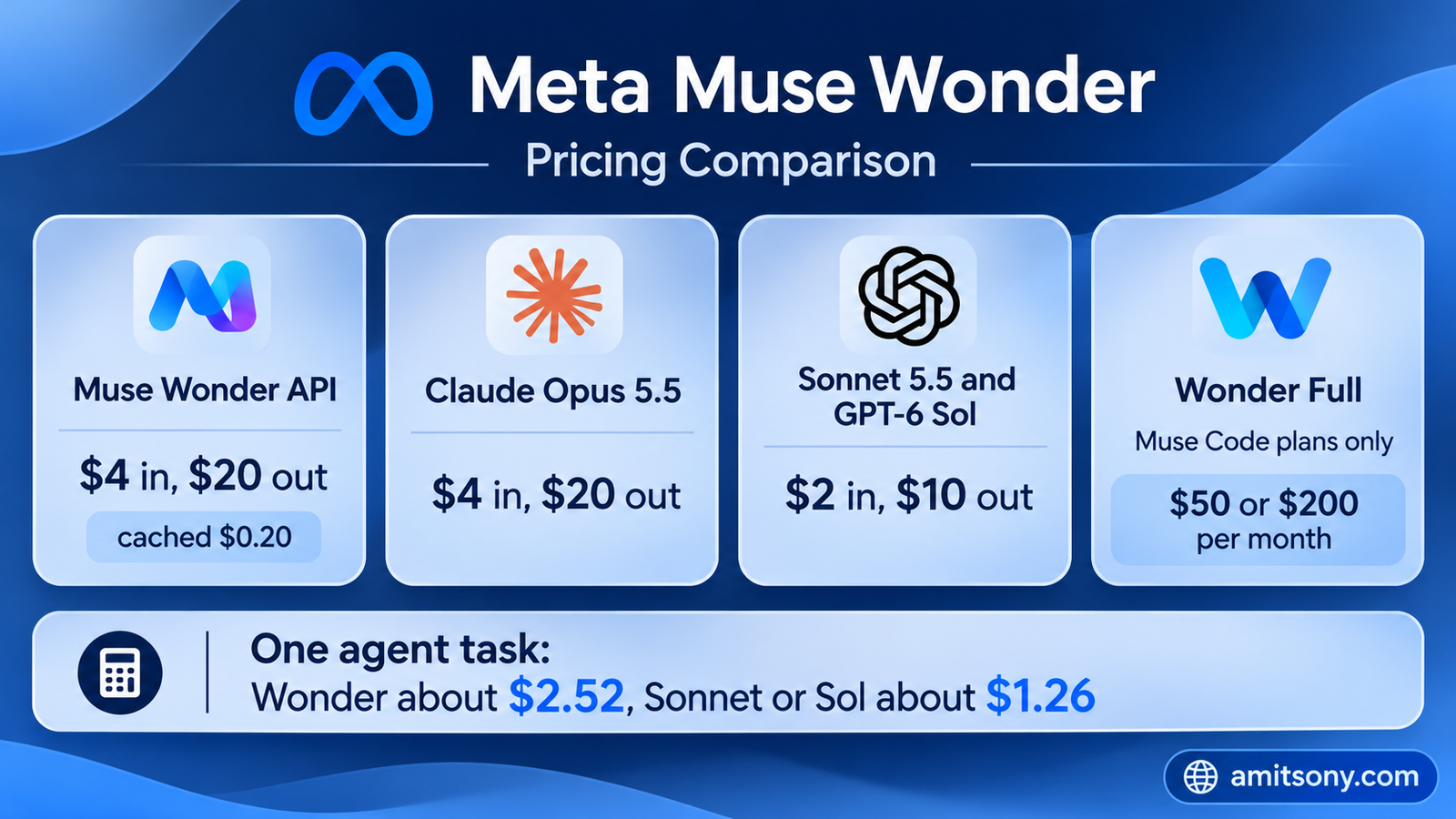
On the Meta Model API, Wonder costs $4 per million input tokens and $20 per million output tokens, roughly ₹352 and ₹1,760. Cached input is $0.20. The 1 million token context window has no long-context premium. That price matches Claude Opus 5.5 exactly and is double the $2 and $10 charged by Sonnet 5.5 and GPT-6 Sol. You can also reach it through OpenRouter and every Muse Code plan.
Wonder Full is not sold per token. You get it only on the Power Usage and Maximum Usage Muse Code plans, at $50 or $200 per month.
Watch the billing detail. Reasoning tokens count as output, so a model that thinks hard is billed at the $20 rate.
Here is a worked example. Take an agent task with 0.4 million fresh input tokens, 1.6 million cached input tokens and 30,000 output tokens. On Wonder that costs about $2.52, or around ₹222. Opus 5.5 costs the same. Sonnet 5.5 and GPT-6 Sol cost about $1.26, roughly half. Over 1,000 tasks, that is $2,520 against $1,260. That is my arithmetic, so rerun it with your own numbers.
How does Muse Wonder score on benchmarks?
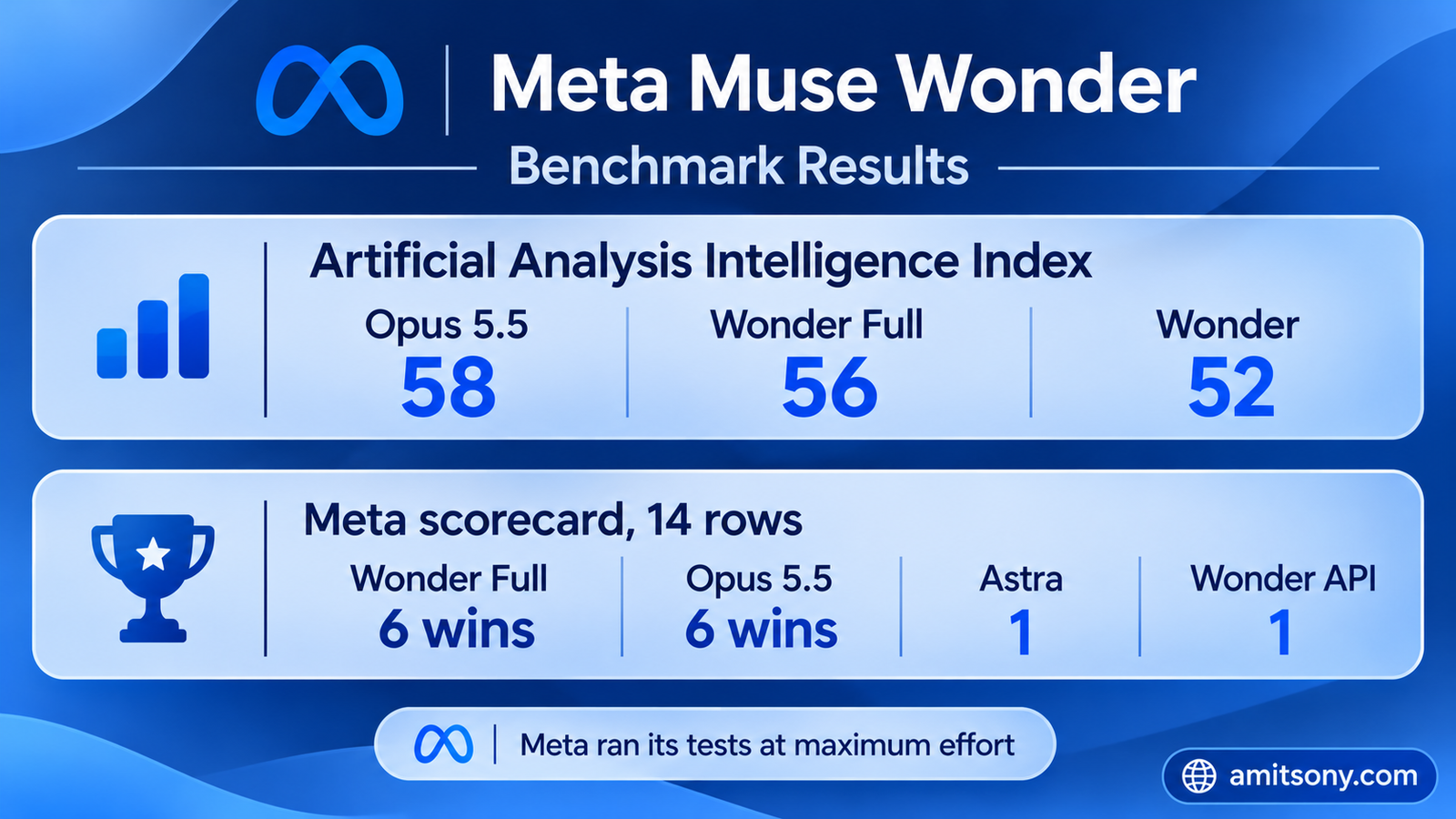
Meta's own scorecard has 14 rows, comparing Wonder Full, Wonder, Claude Fable 5.1, GPT-6 Astra and Claude Opus 5.5. Wonder Full wins six rows and Opus 5.5 wins six. Astra takes one, and the API Wonder takes one, a memory benchmark.
The independent view is less flattering. Artificial Analysis places Opus 5.5 at 58 on its Intelligence Index, Wonder Full at 56 and Wonder at 52. So the model you can pay for by the token sits below Opus and below the top of Meta's own table.
Meta's tests were run at maximum reasoning effort, which is also the most expensive setting. Treat the scorecard as a ceiling, not an everyday result.
What is Muse Wonder good at?
Legal agent work. On Harvey's legal agent benchmark, Wonder scores 10.0 and Wonder Full scores 13.1, against 4.2 for Opus 5.5 and 8.6 for GPT-6 Astra. That is a large gap on a hard task.
Finance. On Vals Finance Agent, Wonder reaches 56.6 and Wonder Full 59.1, against 58.6 for Opus 5.5. That makes the full model slightly ahead and the API model close behind.
Business workflows and memory. On AutomationBench, Wonder Full scores 45.4 percent against 41.2 for Opus 5.5, and Wonder 39.1 is just behind. The memory benchmark is the one row where the API model beats everyone.
Long coding runs also favour Wonder Full, though that is the version you cannot call by API.
My verdict: if you work with legal, finance or memory-heavy agents, Wonder deserves a test, because the price matches Opus and the results can beat it.
Where does Muse Wonder fall short?
The best version is locked behind a subscription. The headline wins belong to Wonder Full, which developers cannot call by API, so the model most teams can build on is the weaker one.
Health tasks. On HealthBench Pro, Wonder scores 60.5 and Wonder Full 62.3, against 65.6 for Opus 5.5 and 65.3 for Astra.
Independent scores. Wonder's 52 on the Intelligence Index is behind the 58 that Opus 5.5 reaches at max effort.
Rough edges. Early hands-on tests of Wonder Full found strong coding benchmark results but inconsistent creative and rendering output. A full safety report with extra evaluations is still to come, and for now the main public document is a 13-page model card.
Track record. It is a preview model from a company that has only just returned to the frontier. Opus and GPT-6 have a longer record in real production work.
Muse Wonder vs Claude Opus 5.5 vs GPT-6 Sol vs Gemini 4 Argon: which should you pick?
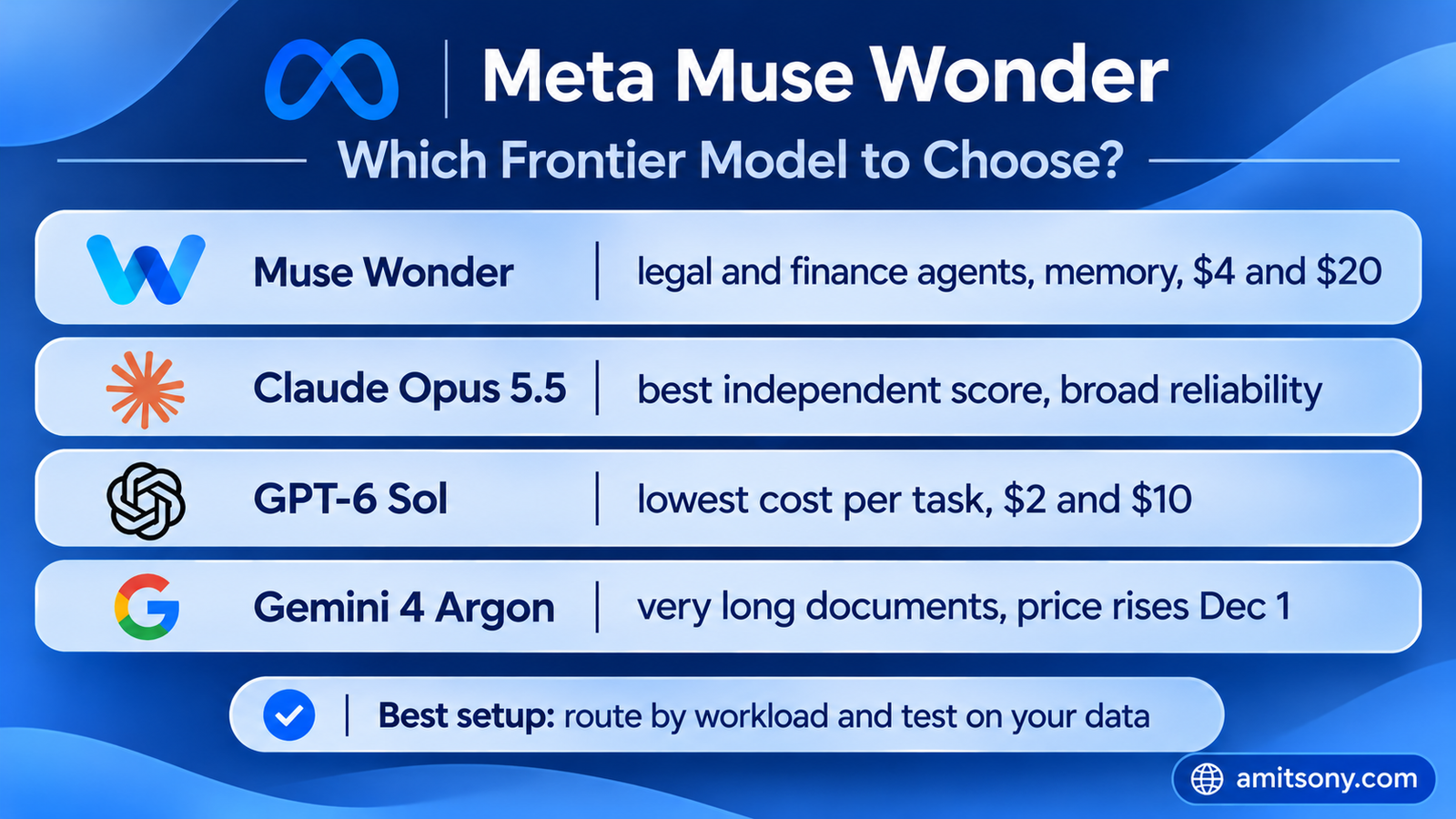
All four are close, so choose by task and price.
Pick Muse Wonder for legal and finance agents and memory-heavy assistants, at the same price as Opus. Pick Claude Opus 5.5 for the best independent score and broad reliability. Pick GPT-6 Sol when cost per task is the main concern. Pick Gemini 4 Argon for very long documents, but note that its introductory price ends on November 30.
The sensible setup is a router. Send each workload to the model that wins on your own tests, and keep a cheaper model for routine work. Do not choose on a vendor scorecard alone.
Is Muse Wonder worth testing, and how?
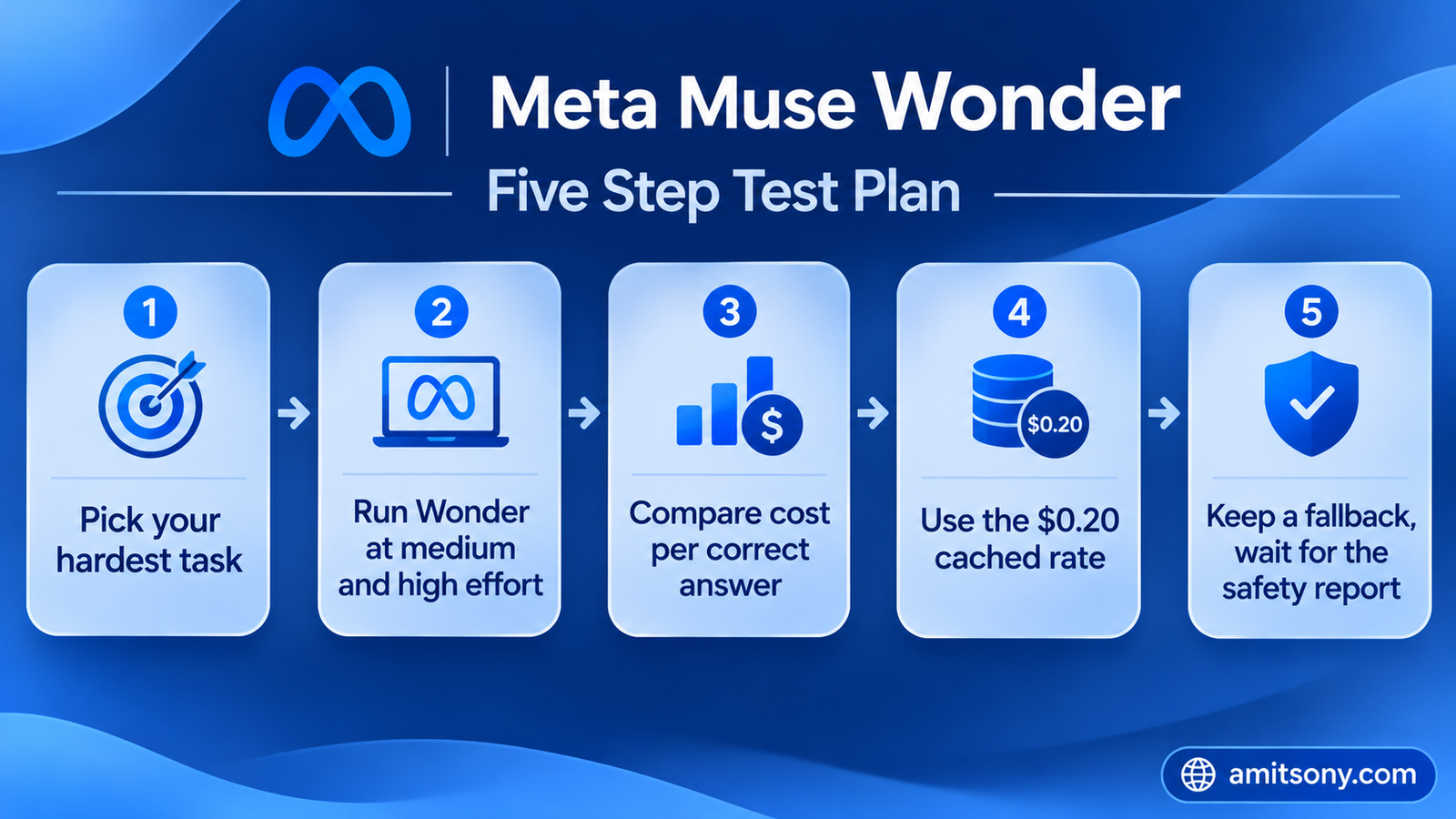
Yes, if your workload is legal, finance, long coding or memory-heavy, and you can accept preview status.
Step 1. Pick your hardest task, the one your current model gets right only after two or three attempts.
Step 2. Run it on Wonder at medium and high effort, and on your current model.
Step 3. Compare cost per correct answer, counting reasoning tokens at $20.
Step 4. Check the cached rate, since an agent that reuses context pays $0.20 rather than $4 for those tokens.
Step 5. Keep a fallback model in case a preview model changes. Wait for the full safety report before you use it for sensitive work.
Frequently Asked Questions
What is Meta Muse Wonder?
It is Meta's first frontier-class model family, released on October 12, 2026 by Meta Superintelligence Labs, in two versions: Muse Wonder and Muse Wonder Full.
How much does Muse Wonder cost?
$4 per million input tokens and $20 per million output tokens on the API, with cached input at $0.20. That equals Claude Opus 5.5.
Is Muse Wonder Full available on the API?
No. It is only available through Muse Code subscriptions at $50 or $200 per month.
Is Muse Wonder better than Claude Opus 5.5?
Not overall. On independent tests Opus 5.5 scores higher, while Wonder wins on legal, finance and memory tests.
What is the context window of Muse Wonder?
1,048,576 tokens, with no long-context price premium.