

Claude Haiku 5.5 is worth using for high-volume work like classification, extraction and short agent tasks. It costs $0.10 per million input tokens, scores 43 on a leading independent index, and runs at roughly twice rival speeds. Skip it for coding agents, factual recall and prompts over 100,000 tokens.

Small models used to be the ones you tolerated. Haiku 5.5 is Anthropic's attempt at a small model you would actually choose. It matches the cheapest rival on price and beats it on most independent scores.
This review covers the price, the benchmarks, the token catch that eats into the saving, and the jobs where it is and is not worth using. The verdicts rest on published pricing and independent evaluations, not on my own load tests.
What is Claude Haiku 5.5?
Claude Haiku 5.5 is Anthropic's smallest and cheapest current model, released on October 7, 2026 under the API name claude-haiku-5-5. It accepts text and images and returns text.
The specs are a big jump. The context window grows from 200K tokens on Haiku 4.5 to 1 million, and maximum output rises from 64K to 128K tokens. It adds five effort levels, from low to max, and has a June 2026 knowledge cutoff. Anthropic says it costs around 75 percent less to run than Haiku 4.5 on average.
It is built for work that repeats thousands of times: classification, extraction, routing, short summaries and small steps inside agent pipelines.
How much does Claude Haiku 5.5 cost?
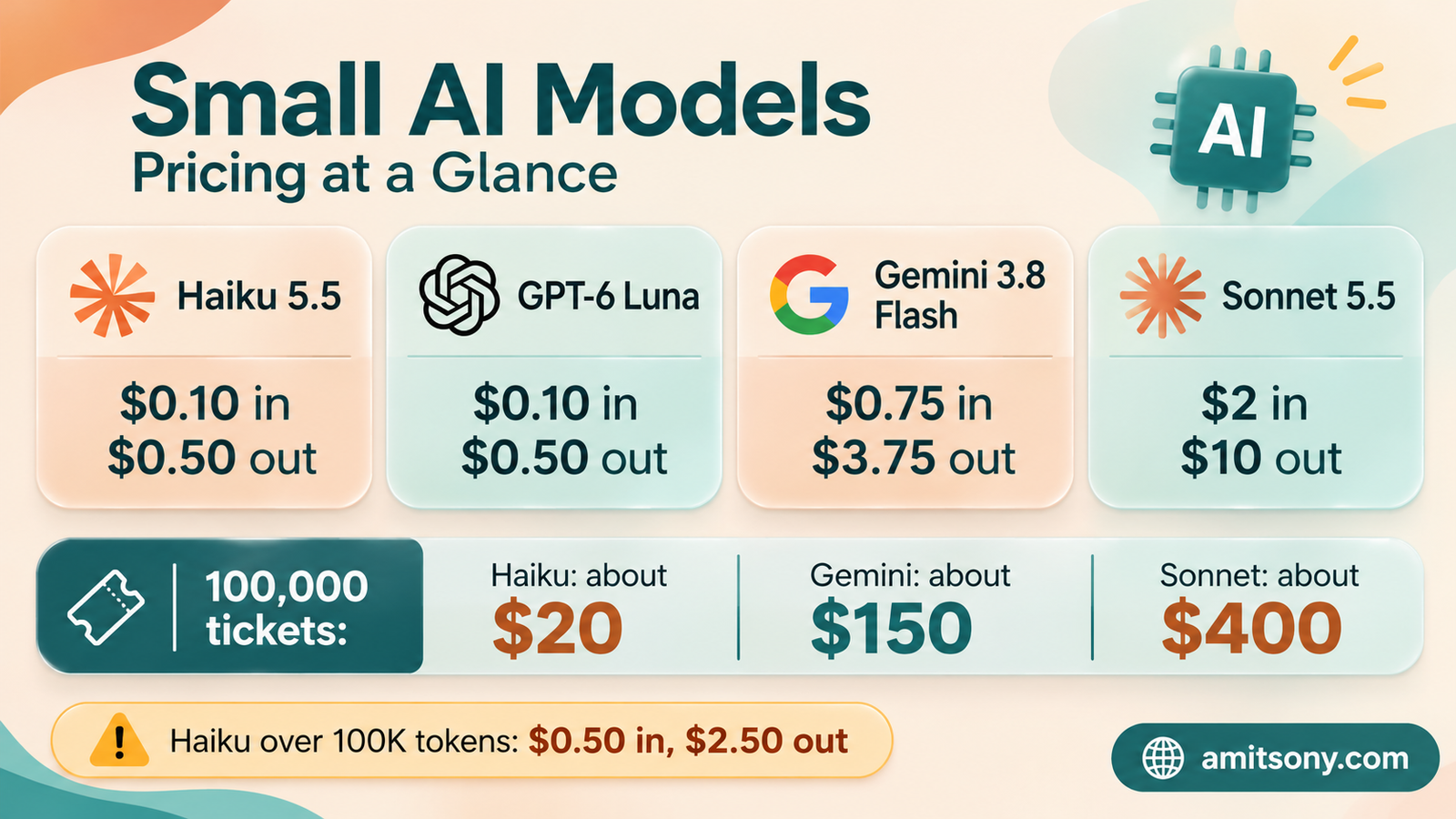
On the Claude API Haiku 5.5 costs $0.10 per million input tokens and $0.50 per million output tokens, roughly ₹9 and ₹44. Cache reads cost $0.01, and the batch API takes 50 percent off for work that can wait.
Compare that with Sonnet 5.5 at $2 and $10, a twentieth of the price on both sides. OpenAI's GPT-6 Luna has exactly the same sticker price. Google's Gemini 3.8 Flash is listed at $0.75 and $3.75, an introductory rate that runs until December 31, 2026.
Here is a worked example. Say you classify 100,000 support tickets a month, each with 1,500 input tokens and 100 output tokens. Haiku 5.5 costs about $20, or around ₹1,760. Gemini 3.8 Flash costs about $150, or around ₹13,200. Sonnet 5.5 costs about $400, or around ₹35,200.
There is a catch at the top end. Once a prompt passes 100,000 tokens, Haiku 5.5 charges $0.50 input and $2.50 output, and the higher rate applies to the whole request. Luna only steps up above 272,000 tokens.
How good is Claude Haiku 5.5 on benchmarks?
Artificial Analysis gives Haiku 5.5 a score of 43 on its Intelligence Index at max effort. That is 26 points above Haiku 4.5. It is also ahead of GLM-5.3 Flash at 42, Gemini 3.8 Flash at 41 and GPT-6 Luna at 38, though behind Sonnet 5.5 at 56.
Anthropic's own launch table goes further. It shows Haiku 5.5 ahead of Luna on every shared test, including 72.4 percent against 48.9 percent on OSWorld 2.1, a computer-use benchmark.
Treat the vendor table with some caution. A company picks the tests it shows. The independent index is the better reference, and it still puts Haiku 5.5 on top of its class by a modest margin of a few points.
How fast is Claude Haiku 5.5?
Very fast. Anthropic calls it its fastest model to date. Independent measurements put output at roughly 137 to 243 tokens per second, depending on the effort level, against about 126 for Luna at max, 117 for Gemini 3.8 Flash and 90 for Haiku 4.5.
Speed matters most for live products. A chat reply, a voice agent or an autocomplete feature feels very different at 200 tokens per second than at 90.
One caution applies. Speed figures depend on the effort setting and on how many tokens the model chooses to write. Measure it on your own workload before you promise a latency target.
What is the catch with Haiku 5.5's token usage?
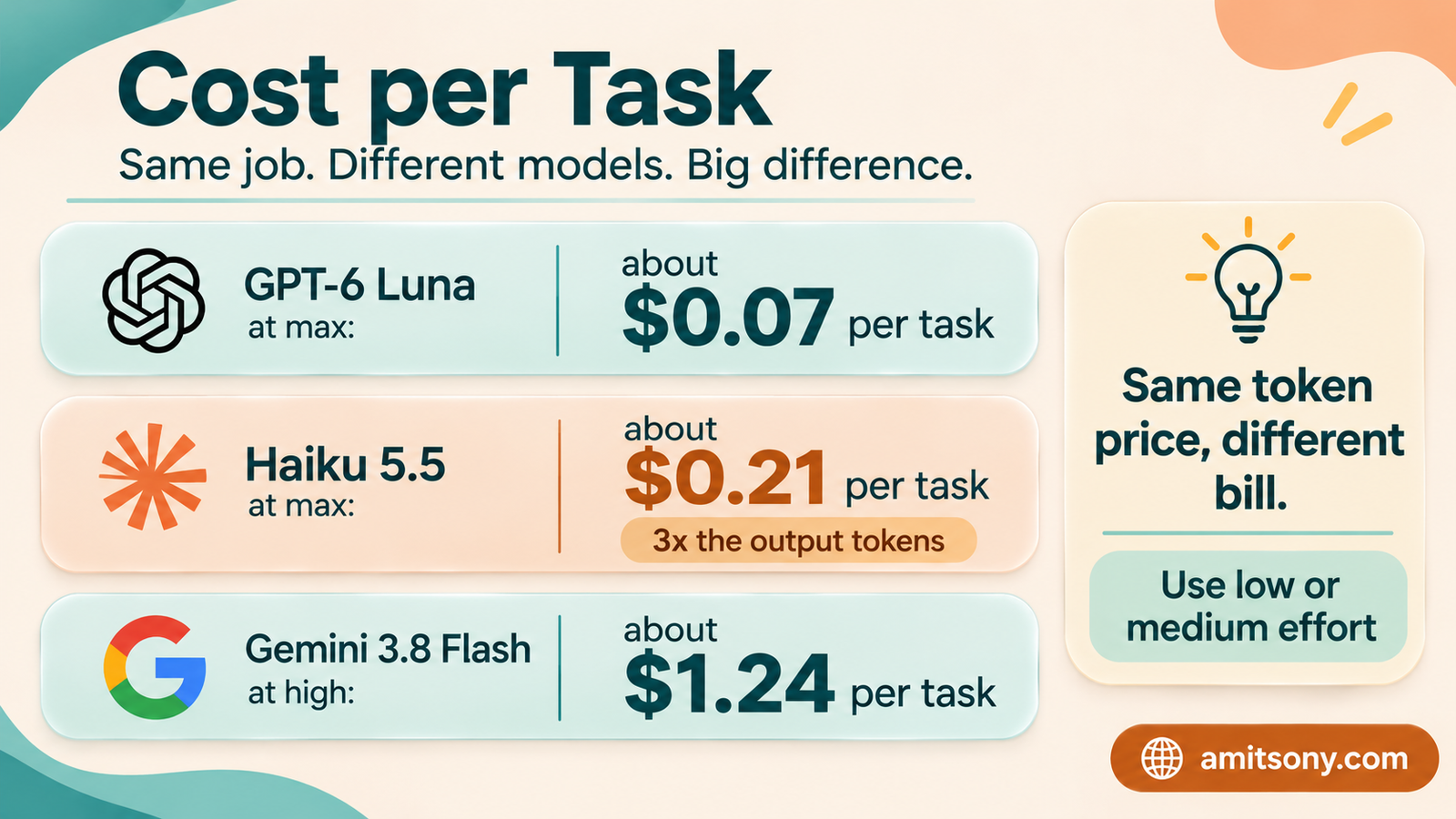
The sticker price hides a trap. Haiku 5.5 thinks more at high effort, and thinking tokens are billed as output.
At max effort, Artificial Analysis found it used around 162,000 output tokens per Intelligence Index task, about three times Luna at max. Per task, that makes Haiku about $0.21 at max, against about $0.07 for Luna. Gemini 3.8 Flash comes in at about $1.24, so Haiku still wins that comparison.
A hands-on comparison of the two cheapest models found both made all 24 correct tool calls in a test, but Luna did it for roughly half the cost, about $0.005 against $0.0095. Same price per token does not mean the same bill.
My verdict: run Haiku 5.5 at low or medium effort for simple jobs, and only raise it when quality demands it. Going from xhigh to max reportedly adds 2 points of score for about 1.8 times the tokens, which is rarely worth it.
Where does Claude Haiku 5.5 fall short?
Agentic coding. On Terminal-Bench 4.0 it scores 39.2 percent, against 70.6 percent for Sonnet 5.5. Use a bigger model when the model must plan and fix code over many steps.
Factual recall. On a knowledge test, Haiku 5.5 answered 36 percent of questions correctly, against 55 percent for Gemini 3.8 Flash and 44 percent for Luna. It knows less than its rivals. The upside is that it makes things up less often, with a hallucination rate around 40 percent against roughly 77 percent for Luna in the same test.
Chained business workflows. On one automation benchmark it scored 35 percent, against 53 to 60 percent for its rivals. A pre-release safety bug reportedly caused over-refusals there, and a re-run is expected, so check for an updated score before you rule it out.
Long prompts. The 100,000 token price step makes it a poor fit for big-document agent loops. And if you need audio or video input, Gemini supports a wider range.
When should you pick Haiku 5.5 over Sonnet, Luna or Gemini?
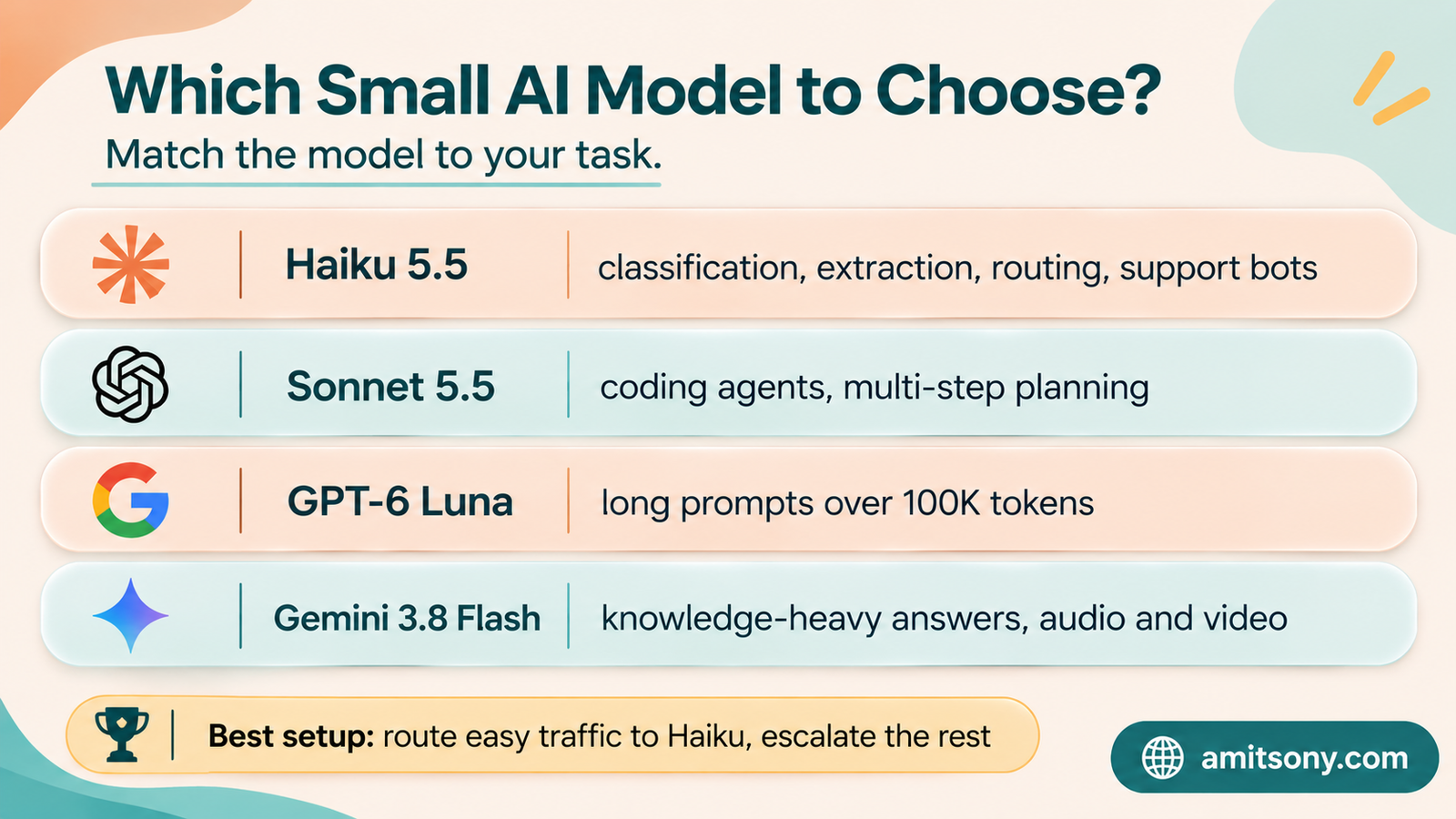
Pick Haiku 5.5 for classification, extraction, routing, tagging, short summaries and support bots where a wrong answer is costly. Its lower hallucination rate and speed suit those jobs.
Pick Sonnet 5.5 for coding agents, multi-step planning and anything where one mistake is expensive. It costs twenty times more per token, but it finishes harder jobs.
Pick GPT-6 Luna when your prompts are long. Its price only steps up past 272,000 tokens, and its per-task cost can be lower at max effort.
Pick Gemini 3.8 Flash for knowledge-heavy answers without source documents, or when you need audio and video input.
The smartest setup is a router. Send easy traffic to Haiku 5.5, escalate failures to Sonnet, and keep an eye on the escalation rate.
How do you test Haiku 5.5 in under an hour?
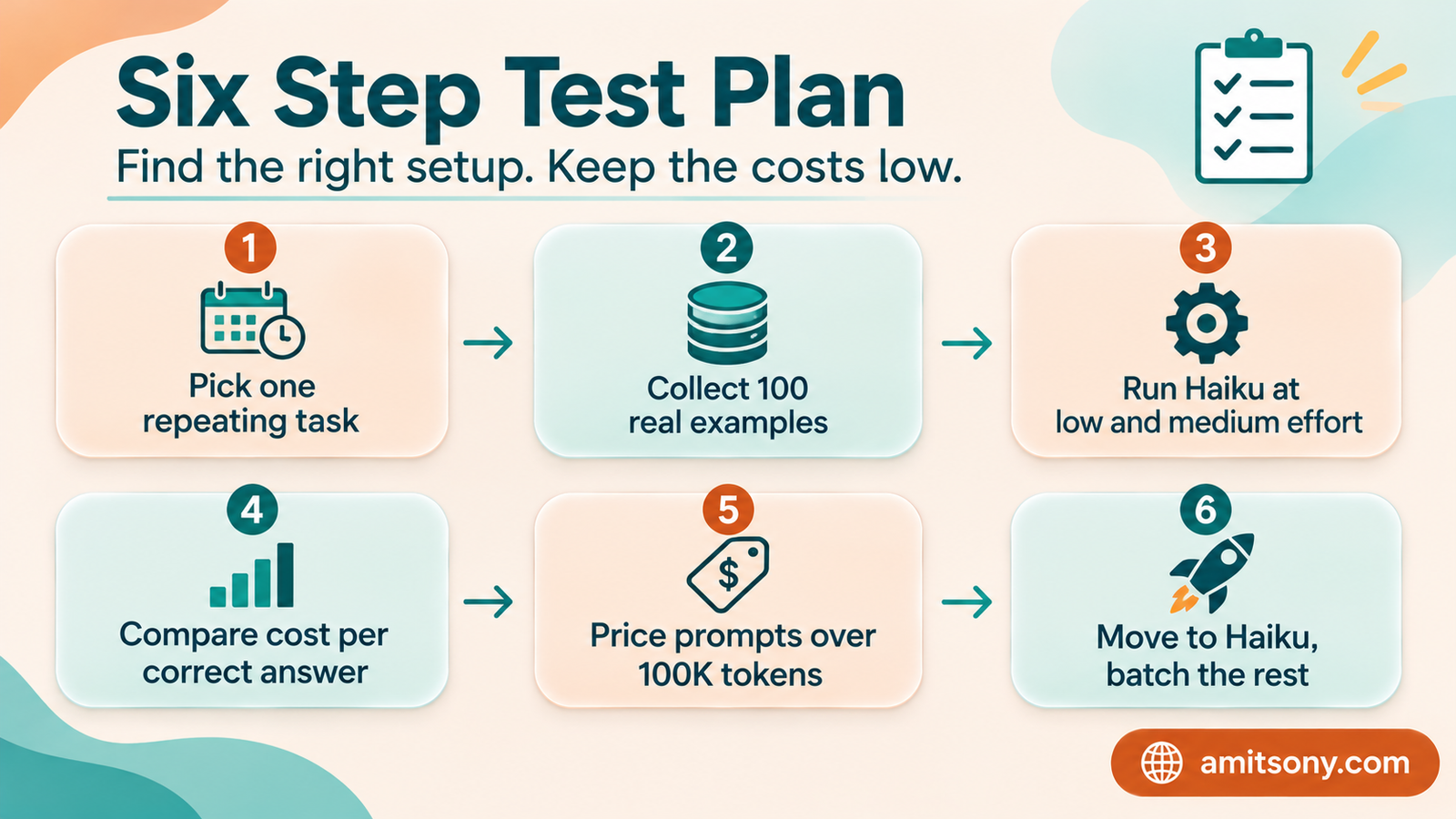
Step 1. Pick one repeating task, such as ticket tagging or invoice extraction.
Step 2. Collect 100 real examples, and write down what a correct answer looks like.
Step 3. Run them through Haiku 5.5 at low and medium effort. Run the same set through your current model.
Step 4. Compare accuracy and cost per correct answer, not just price per million tokens. Count thinking tokens.
Step 5. Check your longest prompt. If any prompt crosses 100,000 tokens, price it at the higher rate.
Step 6. If results are close, move the task to Haiku 5.5, and use the batch API for anything that can wait. That takes another 50 percent off.
Frequently Asked Questions
How much does Claude Haiku 5.5 cost?
It costs $0.10 per million input tokens and $0.50 per million output tokens for prompts up to 100,000 tokens. Above that, the rate rises to $0.50 and $2.50.
How does Claude Haiku 5.5 compare with GPT-6 Luna?
They have the same sticker price. Haiku scores higher on most independent tests, but Luna can be cheaper per task at max effort and on very long prompts.
Is Claude Haiku 5.5 good for coding?
Not for agentic coding. It scores 39.2 percent on Terminal-Bench 4.0 against 70.6 percent for Sonnet 5.5, so use a larger model for that.
What is the context window of Claude Haiku 5.5?
It has a 1 million token context window and up to 128K output tokens. Prompts above 100,000 tokens cost more.
Does Claude Haiku 5.5 hallucinate less than rivals?
In one independent test it did, at about 40 percent against 77 percent for Luna. It also knows less, so it answered fewer factual questions correctly.