
Yes, mostly. Claude Opus 5's 1M-token context window is real, it's the default and maximum on the API, not a gated beta. The catch: Pro plan users in the Claude.ai chat interface have to manually enable usage credits to actually access it, a step that's easy to miss. Pricing stayed flat at $5/$25 per million tokens.

Claude Opus 5 shipped on July 24, 2026, the fourth Claude 5-series release in under two months, following Mythos 5, Fable 5, and Sonnet 5 in June. Anthropic's pitch is specific: performance close to Fable 5, its most capable model, at half the price, with a 1 million token context window as the headline spec.
That's a big claim for what's technically a mid-cycle update rather than a full generational leap. This review is based entirely on Anthropic's own published documentation and release notes, cross-checked against multiple independent technical write-ups, no marketing fluff, just what the spec sheet actually says and where it gets more complicated than the headline number.
What Exactly Is Claude Opus 5?
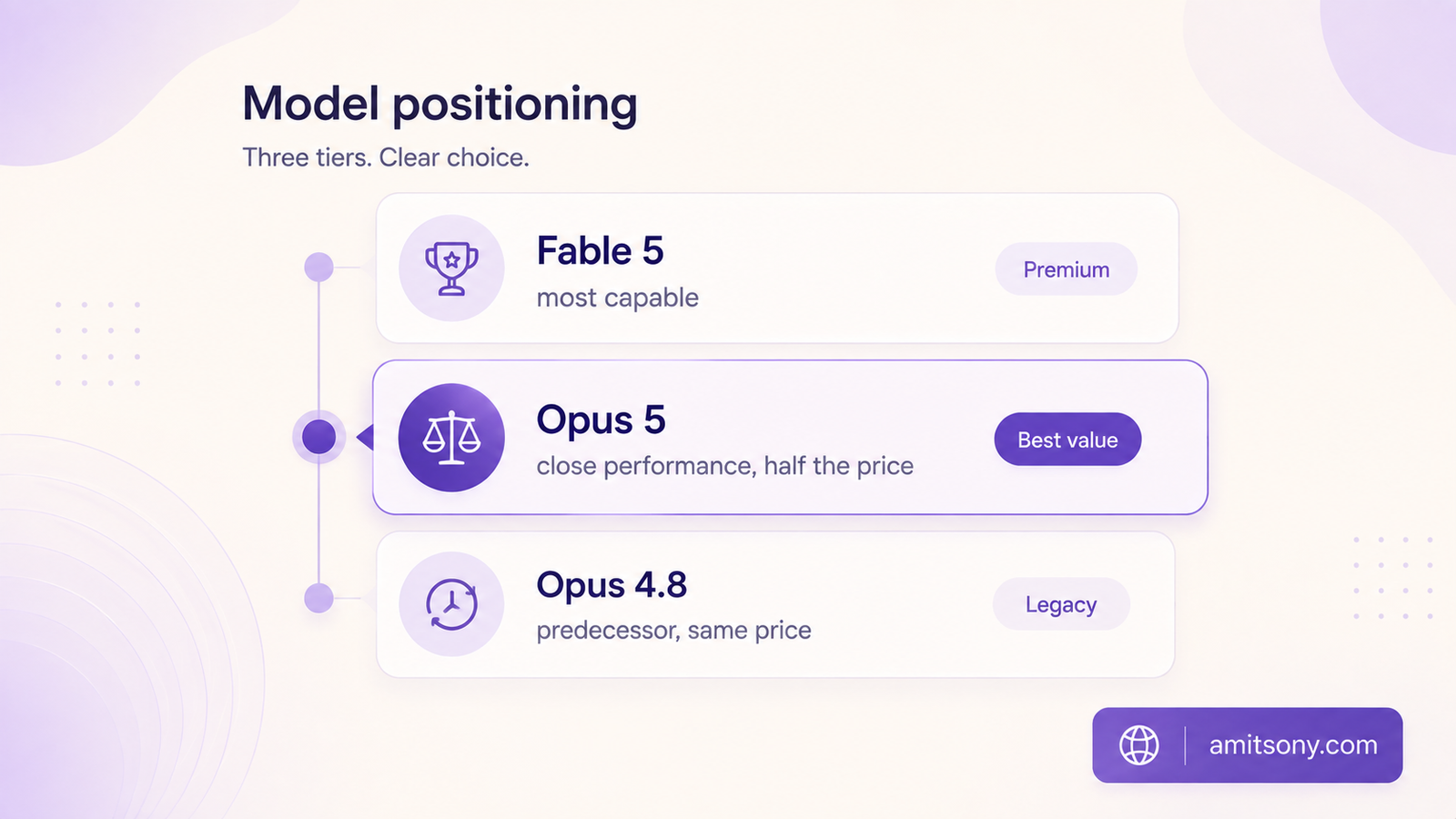
Claude Opus 5opus is the newest model in the Opus tier, Anthropic's most capable line, sitting above Sonnet 5 and Haiku 4.5. Anthropic describes it as coming close to the frontier intelligence of Fable 5 while costing about half as much per task.
It's now the default model on Claude Max and the strongest option available on Claude Pro. Pricing didn't change from its predecessor, Opus 4.8: $5 per million input tokens and $25 per million output tokens, on the API, Amazon Bedrock, Google Cloud, and Microsoft Foundry alike.
On benchmarks Anthropic points to, Frontier-Bench and GDPval-AA, Opus 5 leads its own lineup, though it still trails the restricted-access Mythos 5 on certain cybersecurity evaluations. Anthropic also describes it as its most aligned Opus model to date, with lower rates of deceptive behavior in internal audits.
Is the 1M Token Context Window Actually New?
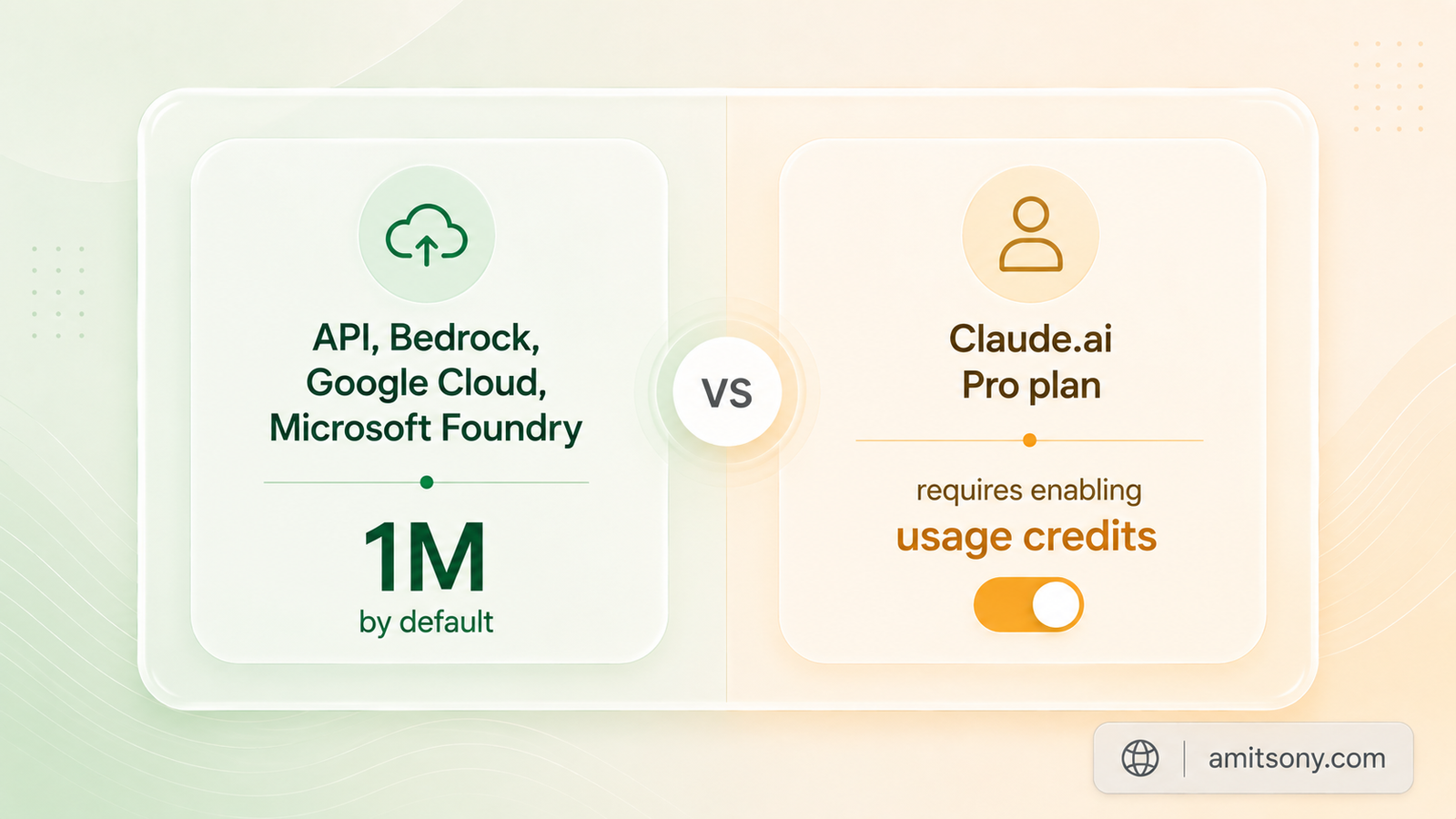
Partly. Opus 4.8 already supported a 1M token context window on the API, so the headline number itself isn't brand new to the Claude lineup. What changed with Opus 5 is that 1M tokens is now both the default and the maximum, there's no smaller context variant to opt out into, and it applies consistently across the API, Bedrock, Google Cloud, and Microsoft Foundry.
The real catch sits in the chat interface, not the API. According to Anthropic's own support documentation, Pro plan users need to specifically enable usage credits to unlock the 1M window for Opus models inside Claude.ai. Skip that toggle and you're working with a smaller default window without necessarily realizing it. Max, Team, and Enterprise plans don't have this restriction.
This is the detail every other review of this launch buried or missed entirely. If you're a Pro subscriber wondering why long documents seem to get compacted or forgotten mid-conversation, check that toggle before assuming the model is at fault.
What Can You Actually Do With 1M Tokens?
In practical terms, 1 million tokens works out to somewhere around 2,000 to 3,000 pages of text, or a complete mid-sized codebase, source, tests, and configuration together, inside a single request. That's enough for several years of company documents, an entire API's documentation plus your integration code and failing logs, or fifty-plus research papers cross-referenced in one session.
Max output sits at 128,000 tokens through the standard API, extending to 300,000 tokens through the Message Batches API in beta. For long-form generation, like a full report drafted from a large source corpus, that ceiling matters as much as the input side does.
Does the Bigger Context Come at a Cost?
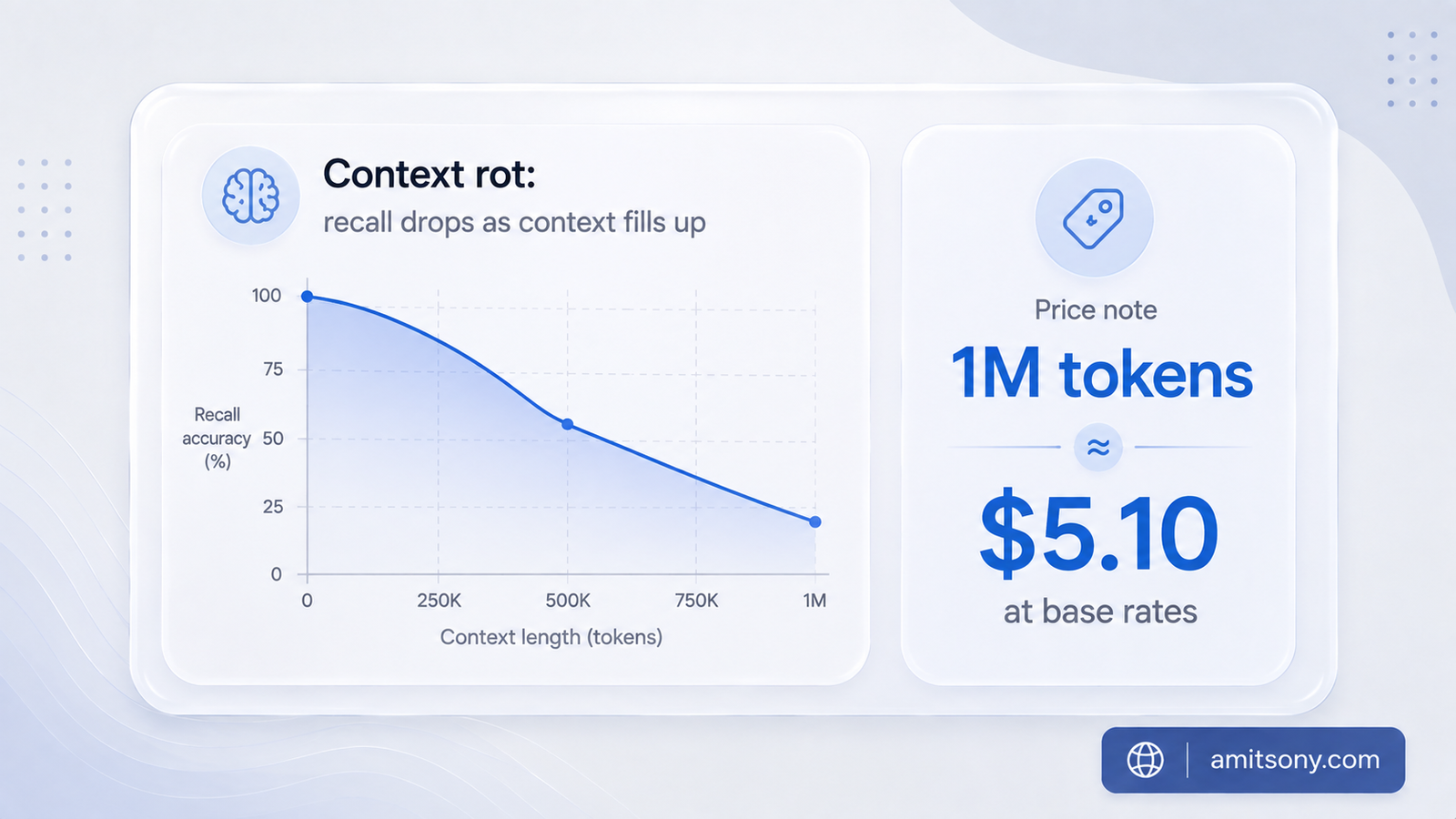
Financially, not really, there's no long-context surcharge on Opus 5, Sonnet 5, or Fable 5. A request using the full 1M uncached input tokens plus a modest output costs roughly $5.10 at base rates, input and output combined, before any platform-specific fees.
The more important cost is accuracy, not money. Anthropic's own context window guidance still warns about context rot, the tendency for recall and precision to degrade as a conversation grows, regardless of how large the technical limit is. Independent research from NVIDIA and Adobe on long-context benchmarks backs this up: advertised context and effectively usable context are not the same number.
Don't treat 1M tokens as an invitation to dump everything you have into a single prompt. The goal is relevant, non-duplicated evidence, not maximum volume, a smaller and cleaner context frequently outperforms a larger, noisier one.
What Else Changed Beyond Context Length?
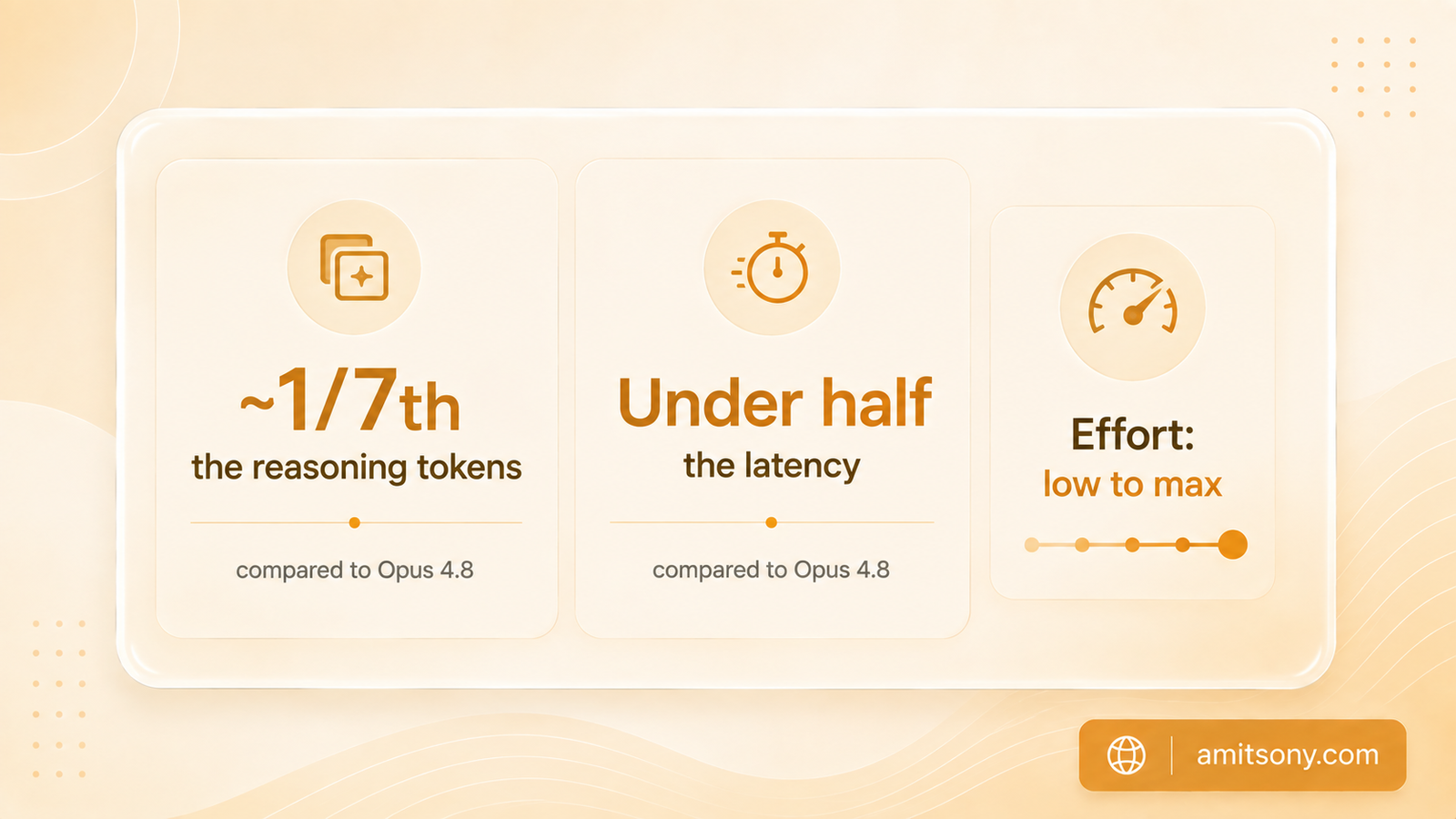
Extended thinking is on by default now, a genuine breaking change if you're migrating from an earlier model where it was optional. Alongside that, Opus 5 ships with an effort dial, low, medium, high, xhigh, and max, that lets you trade reasoning depth for speed and cost directly, rather than accepting one fixed behavior.
Two features landed in beta alongside the model: mid-conversation tool changes, which let you add or remove tools between turns without invalidating the prompt cache, and automatic fallbacks, where requests flagged by safety classifiers can route to another model automatically instead of simply getting blocked.
On efficiency, Anthropic reports Opus 5 using roughly a seventh of the reasoning tokens and under half the latency of Opus 4.8 on an internal trading benchmark, a meaningfully large efficiency jump if it holds up across other real workloads.
How Does This Compare to the Rest of the Claude Lineup?
Sonnet 5 and Fable 5 also carry the 1M token context window at standard pricing now, so Opus 5 isn't unique within Anthropic's own lineup on this spec, it's Anthropic extending a feature across its top models rather than reserving it for the flagship. Haiku 4.5, the fastest and cheapest tier, still caps at 200,000 tokens.
Fable 5 remains the more capable, more expensive option for the hardest reasoning and cybersecurity work, and it carries a 30-day data retention requirement that Opus 5 does not. Opus 5's pitch is specifically the everyday middle ground, most of Fable 5's capability, without that retention requirement, at roughly half the cost.
Is Opus 5 a Genuine Game Changer or Just an Incremental Update?
The context window itself is evolutionary, not revolutionary, Opus 4.8 already had 1M tokens on the API. What's genuinely new is consistency: no smaller variant to fall back into, no beta header to remember, and the same ceiling across every major cloud platform Anthropic supports.
The bigger story is the efficiency gain alongside unchanged pricing, better results using fewer reasoning tokens and less latency than its predecessor, plus the effort dial that puts cost control directly in the user's hands. That combination matters more day to day than the context number on its own.
Call it a meaningful, well-executed update rather than a category-redefining leap. Worth upgrading to if you're already on Opus 4.8, but check that usage credits toggle first if you're on Claude Pro, or you won't actually get the headline feature you upgraded for.
Frequently Asked Questions
Does Claude Opus 5 really have a 1 million token context window?
Yes, it's the default and maximum on the API, Bedrock, Google Cloud, and Microsoft Foundry. In the Claude.ai chat interface, Pro plan users need to manually enable usage credits to access it for Opus models.
How much does Claude Opus 5 cost?
$5 per million input tokens and $25 per million output tokens, unchanged from Opus 4.8. A request using the full 1M input tokens plus a small output costs roughly $5.10 at base rates.
Is Claude Opus 5 better than Opus 4.8?
Anthropic reports Opus 5 using about a seventh of the reasoning tokens and under half the latency of Opus 4.8 on an internal benchmark, at the same price, making it a meaningful efficiency upgrade rather than a full generational leap.
What's the difference between Claude Opus 5 and Claude Fable 5?
Fable 5 is Anthropic's most capable model overall and carries a 30-day data retention requirement. Opus 5 comes close to Fable 5's performance on many tasks at about half the cost, without that retention requirement.
Does a bigger context window mean Claude Opus 5 gives better answers on long documents?
Not automatically. Anthropic's own documentation warns about context rot, where recall and accuracy can degrade as context grows regardless of the technical limit, so relevant, non-duplicated input still matters more than raw volume.