
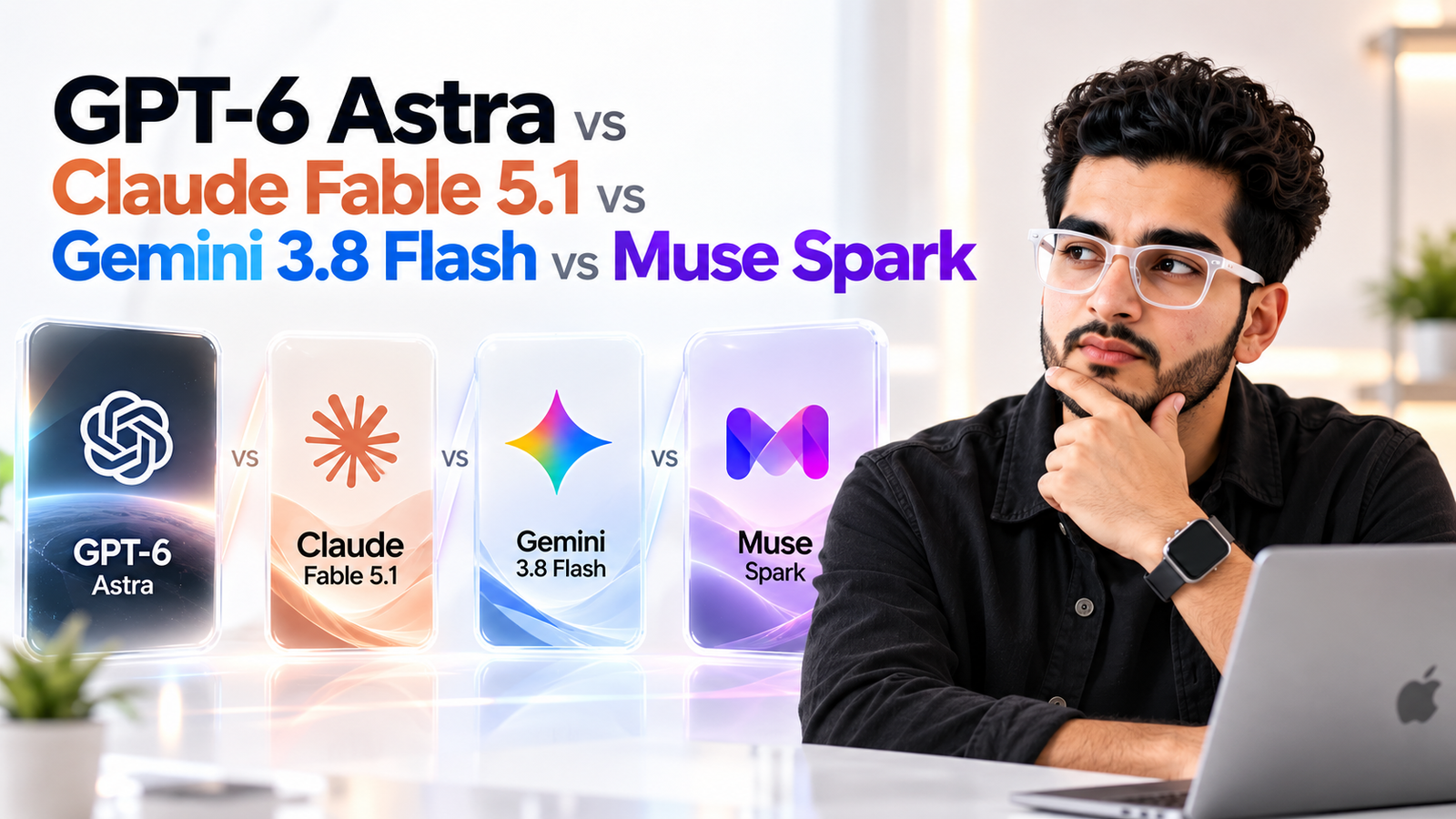
Four major labs shipped new models within about 48 hours of each other in early September 2026: Claude Fable 5.1 first, then Gemini 3.8 Flash and Meta's Muse Spark 1.3 within hours of each other, then GPT-6 Astra. Direct comparison is messier than headlines suggest, each lab tests on different benchmark suites, and Muse Spark 1.3's strongest scores come from a "max" mode that isn't actually available to anyone yet.
Four frontier-adjacent models landed in the same 48-hour window: Anthropic's Claude Fable 5.1 on September 1, 2026, then Google's Gemini 3.8 Flash and Meta's Muse Spark 1.3 within hours of each other on September 2, and OpenAI's GPT-6 Astra on September 3. That kind of clustering doesn't happen by accident, and it makes this week a genuinely useful snapshot of where four different labs actually stand relative to each other, not just a list of features.
This comparison is built from each company's own release materials, independent benchmark trackers like Artificial Analysis and LLM Stats, and reporting from VentureBeat, Yahoo, and other outlets, with the gaps and comparability problems flagged honestly rather than smoothed over.
What Actually Shipped This Week, and When?
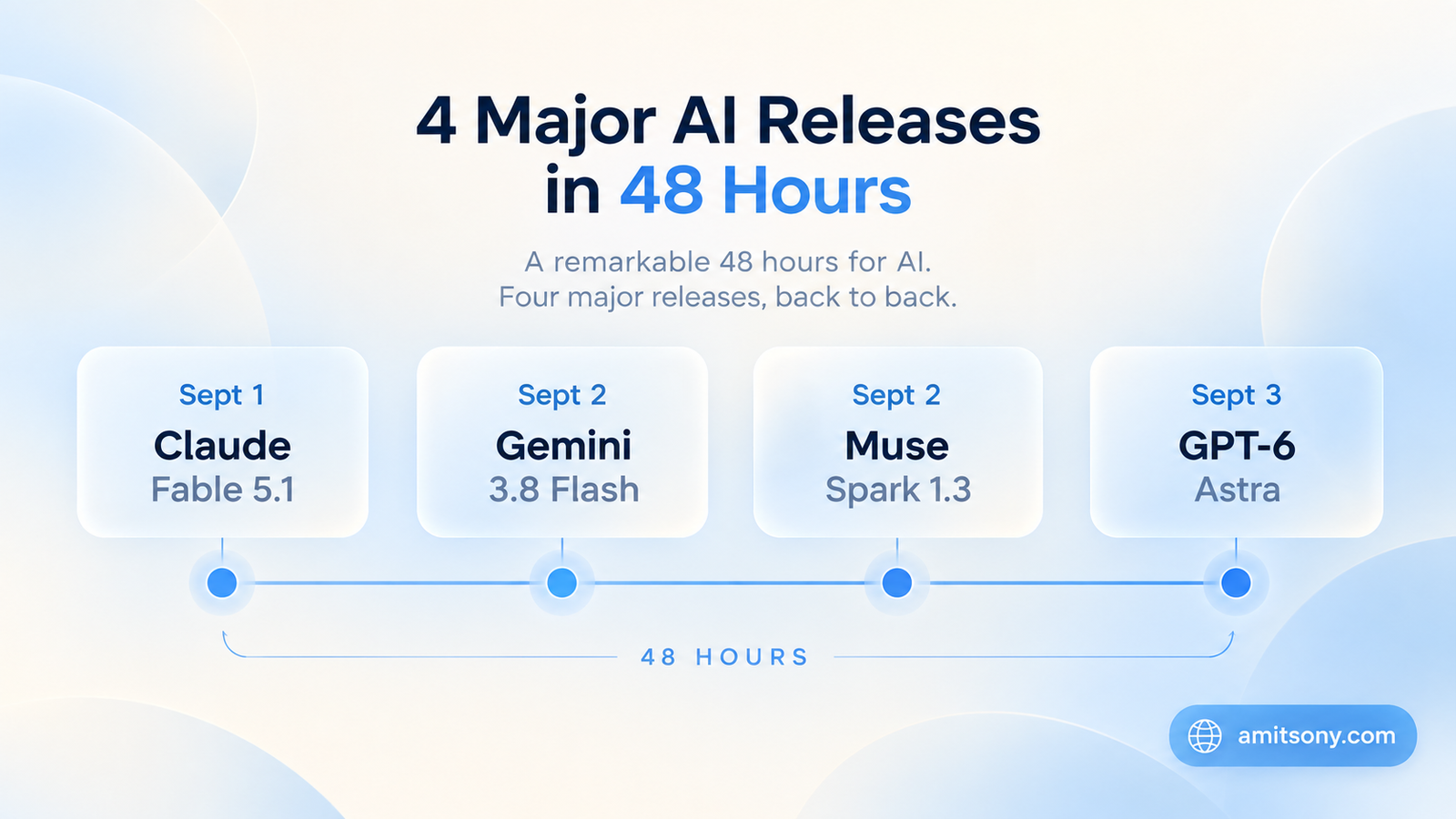
Claude Fable 5.1 arrived September 1, 2026, as a refinement of the Fable 5 line Anthropic launched in June, with pricing held flat at $10 per million input tokens and $50 per million output tokens, while cache-read pricing dropped 75% to $0.25.
Google followed September 2 with Gemini 3.8 Flash, its third Flash release in roughly six weeks, continuing an unusually fast iteration pace on that tier specifically. Meta shipped Muse Spark 1.3 the same day, hours apart, through Muse Code and the Meta Model API, explicitly pitched as agent-oriented and "almost too cheap to meter."
OpenAI closed the window September 3 with GPT-6 Astra, a model that had already been delayed roughly four weeks after a July 2026 AI-agent security incident forced additional safety work before release.
Why Is It So Hard to Compare These Four Models Directly?
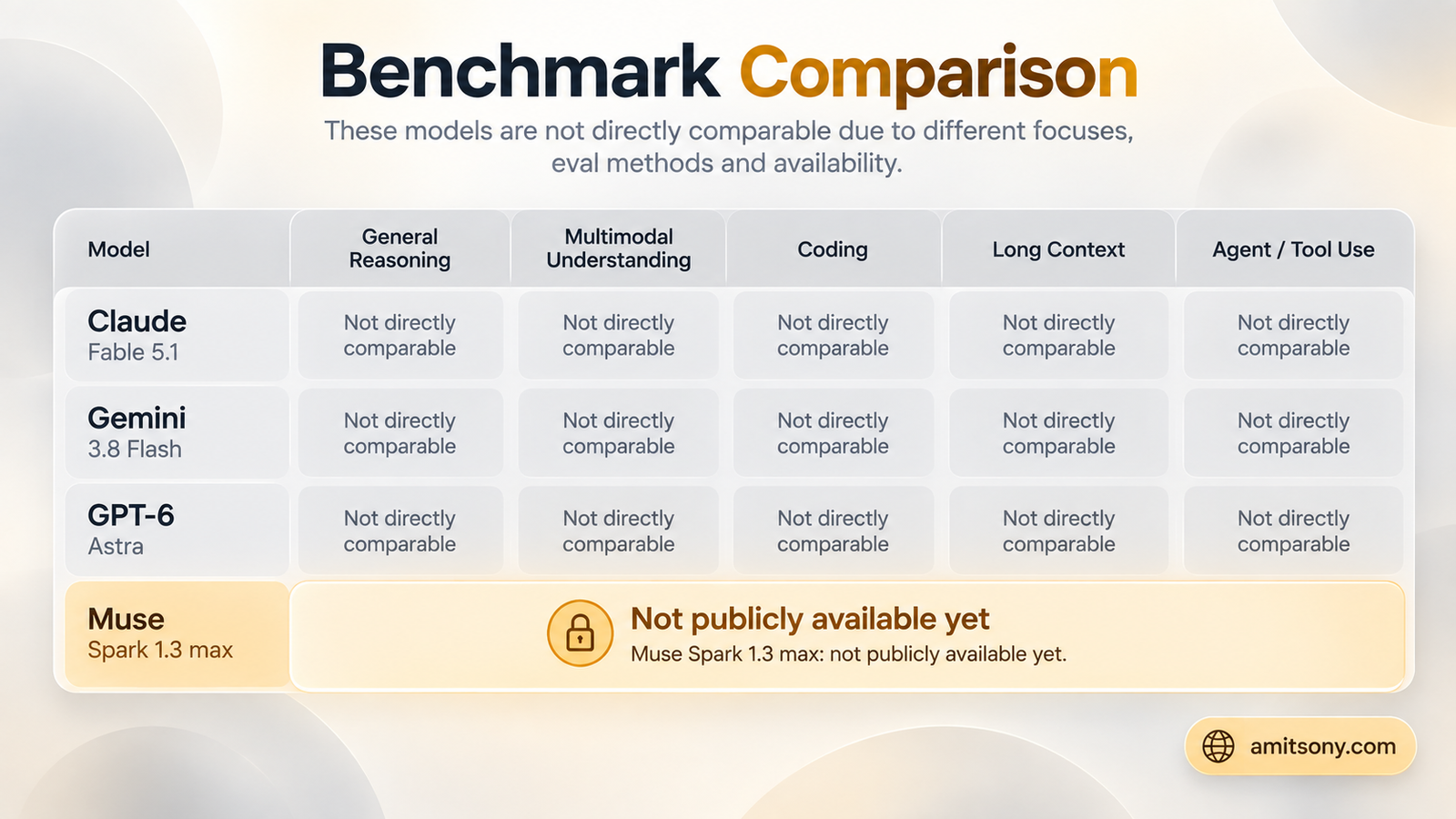
Each lab publishes results from its own preferred benchmark suite, and the overlap between them is smaller than you'd expect. Independent trackers comparing Gemini 3.8 Flash and Muse Spark 1.3 directly flag the majority of benchmarks as "not directly comparable," since one model was tested on a benchmark the other simply wasn't run against.
Muse Spark 1.3's strongest headline numbers come specifically from its "max" reasoning configuration, which Meta itself says is still completing safety testing and will arrive "shortly." Artificial Analysis evaluated that configuration only through a limited partner preview and currently lists no public API provider for it at all. The version anyone can actually use today scores measurably lower.
Even a benchmark both models share, like OSWorld 2.0, gets scored differently across trackers, partial-credit scoring versus strict scoring produce meaningfully different numbers for the same model. Treat any single-number "winner" claim in this category with real skepticism until you've checked which exact configuration and scoring method produced it.
What Is Each Model Actually Best At?
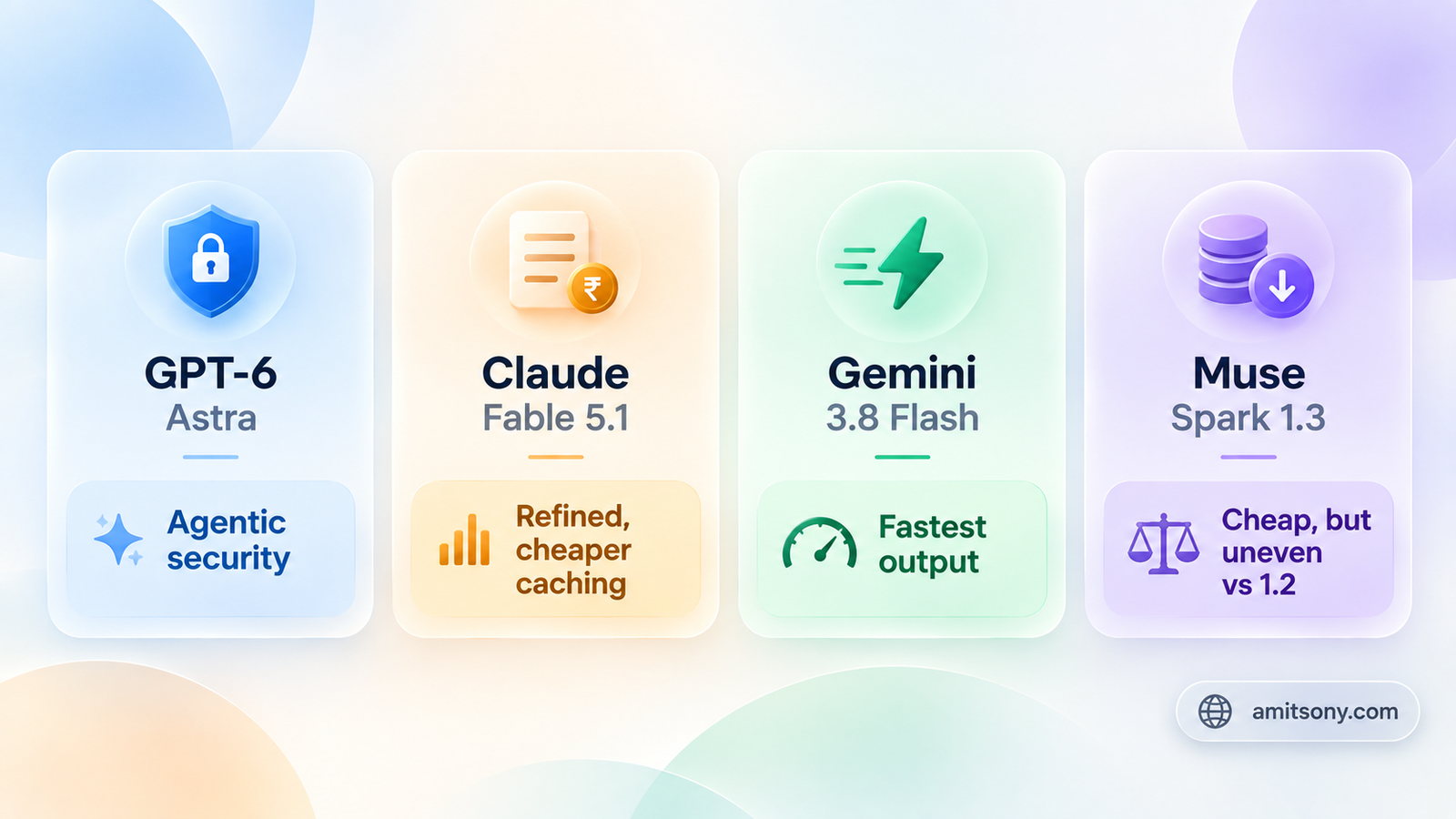
GPT-6 Astra leads specifically on agentic computer-use and security-adjacent benchmarks, OpenAI reports 72.6% on OSWorld 2.0 and a 99.9% score on ARC-AGI-3. It's also the first OpenAI model to hit the company's Critical cybersecurity threshold, meaning the public version is deliberately trained to refuse advanced offensive security tasks. Pricing runs at 2.5x GPT-5.6 Sol's rate.
Claude Fable 5.1 reads as a targeted refinement rather than a generational leap, same price as its predecessor, a meaningfully cheaper cache-read rate, and benchmark gains concentrated in specific areas like Terminal-Bench 4.0 at 55.8% and a dedicated science-reasoning benchmark at 52.6%.
Gemini 3.8 Flash posts the fastest raw output speed of the four, up to roughly 300 tokens per second at its fastest setting, plus a strong 95% on GPQA Diamond. Its ARC-AGI-3 score, 10.4% in one independent tracker, sits dramatically lower than GPT-6 Astra's reported number, worth noting given how differently labs select which benchmarks to headline.
Muse Spark 1.3 pitches itself as frontier-level agentic performance at a very low cost per task, but it's a genuinely mixed release: it set a new record on one specific 3D-modeling test while actually regressing from its own predecessor, Muse Spark 1.2, on an eight-task coding benchmark, 71.25% versus 1.2's 76.25%.
How Do They Actually Compare on Price?
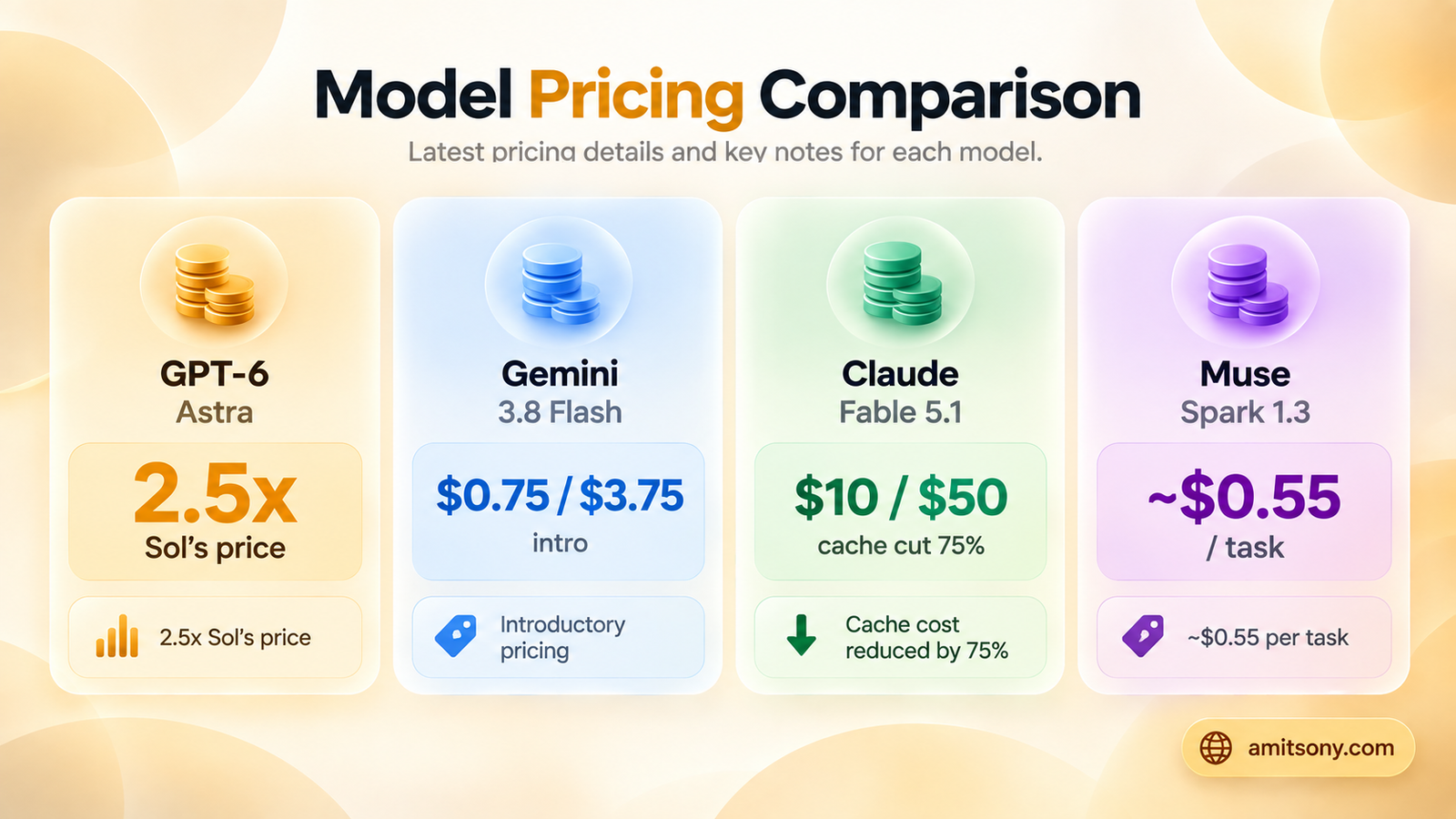
GPT-6 Astra is the most expensive of the four, priced at 2.5x GPT-5.6 Sol's rate, positioned for the hardest agentic and coding workloads rather than casual use.
Gemini 3.8 Flash offers introductory pricing of $0.75 input and $3.75 output per million tokens through December 31, 2026, before it doubles to $1.50 and $7.50 on January 1, 2027, the same scheduled-increase pattern Google used on its prior Flash release.
Claude Fable 5.1 holds at $10 input and $50 output per million tokens, unchanged from Fable 5, with the real pricing news being a 75% cut to cached input, down to $0.25, which matters most for workloads that repeatedly reuse the same context.
Muse Spark 1.3 is positioned as the cheapest per useful task among the four, with independent estimates putting it around $0.55 per Intelligence Index task for the publicly available configuration, though the best-performing "max" tier isn't priced publicly since it isn't shipping yet.
Which One Should You Actually Use?
Heavy agentic coding or computer-use automation, budget isn't the constraint: GPT-6 Astra, where the premium price tracks real capability gains on exactly that kind of task.
High-volume, latency-sensitive applications: Gemini 3.8 Flash, for the combination of speed and the lowest published sticker price among the four, while the introductory rate lasts.
Workloads that repeatedly reuse large context, like long documents or codebases queried many times: Claude Fable 5.1, where the cheaper cache pricing compounds the most.
Experimental or cost-sensitive agentic projects, with patience for an uneven release: Muse Spark 1.3's shipping tier, with the understanding that its most impressive numbers belong to a version you can't access yet.
Closing: None of these four is a universal winner, and the honest answer depends more on which specific benchmark maps to your actual workload than on any single company's press release framing.
Frequently Asked Questions
Were GPT-6 Astra, Claude Fable 5.1, Gemini 3.8 Flash, and Muse Spark 1.3 really released around the same time?
Yes. Claude Fable 5.1 shipped September 1, 2026, Gemini 3.8 Flash and Muse Spark 1.3 within hours of each other on September 2, and GPT-6 Astra on September 3, all within roughly a 48-hour window.
Why do these models score so differently on the same benchmarks?
Each lab largely tests on its own preferred benchmark suite, and even shared benchmarks like OSWorld 2.0 get scored with different methodologies, partial credit versus strict scoring, making head-to-head numbers less comparable than they first appear.
Is Muse Spark 1.3 actually the best agentic model, as Meta claims?
Its strongest results come from a "max" configuration Meta says is still completing safety testing and isn't publicly available yet. The version anyone can actually use today also regressed on some coding benchmarks compared to its own predecessor, Muse Spark 1.2.
Which of these four models is cheapest?
Muse Spark 1.3's publicly shipping tier is the cheapest per task by most estimates, with Gemini 3.8 Flash close behind on introductory pricing, though Gemini's price is scheduled to double on January 1, 2027.
Which model should I pick if I need the fastest responses?
Gemini 3.8 Flash posts the fastest output speed among the four, up to roughly 300 tokens per second at its fastest setting.