
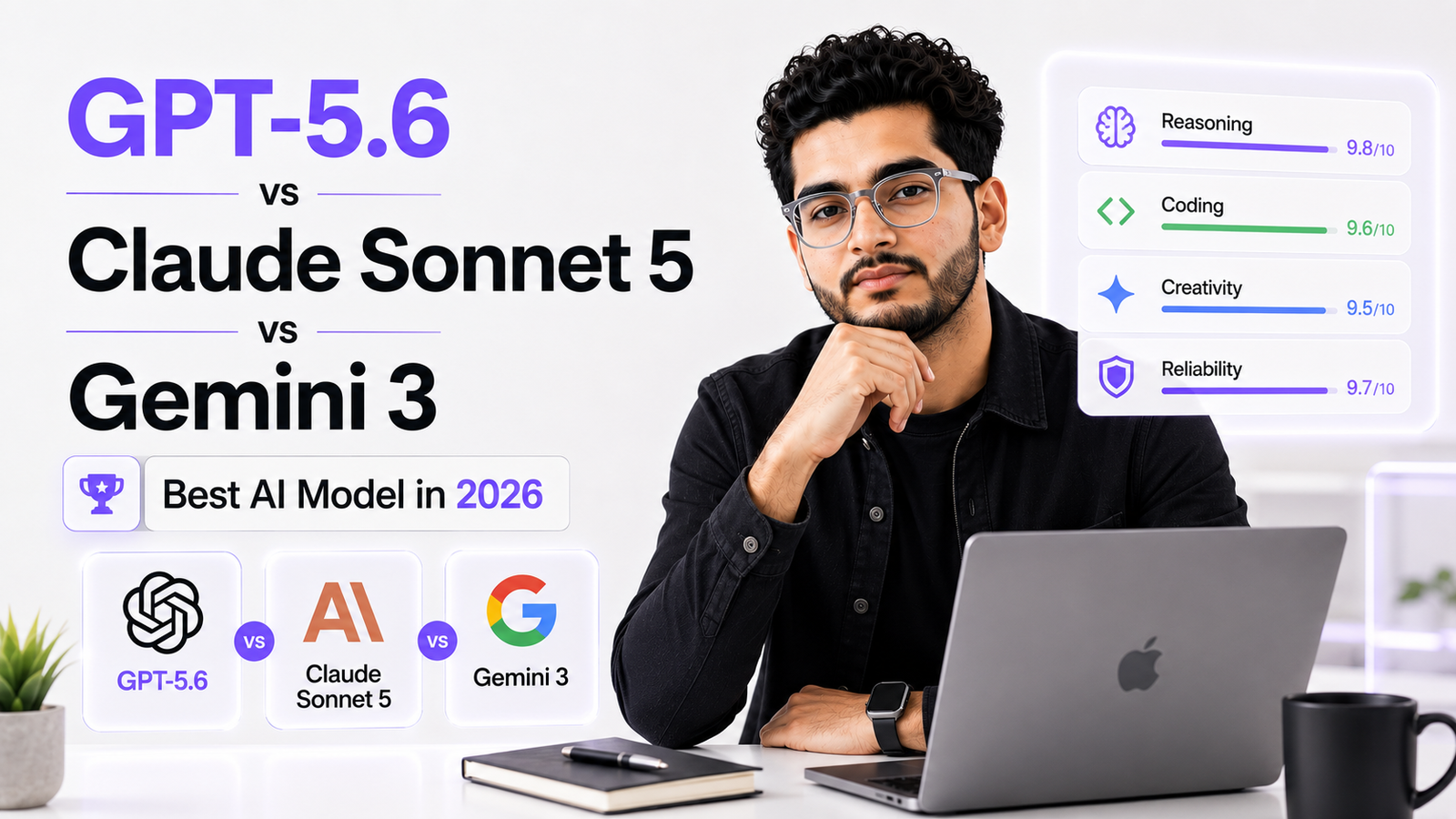
There's no single winner. GPT-5.6 Sol leads on terminal-agent tasks and abstract reasoning, Claude Sonnet 5 wins on coding value at its price point, and Gemini 3.1 Pro leads long-context and multimodal work. Most "best model" tables online compare stale snapshots, so the honest answer depends entirely on which specific task you're weighing.
Search this exact comparison and you'll find a dozen tables all disagreeing with each other, some by a little, some by a lot. That's not because the models are impossible to evaluate, it's because half those tables were built against Claude Sonnet 4.6 instead of Sonnet 5, or quote GPT-5.6 Sol's high-compute Ultra mode as if it were the default experience.
This comparison sticks to what each vendor has actually published, flags exactly where a number is a third-party estimate rather than a confirmed rate, and skips crowning an artificial single winner where the honest answer is "it depends on the job."
Why Do So Many Comparisons Get This Wrong?
Three specific mistakes show up constantly in this comparison, and knowing them will save you from bad tables faster than any benchmark score will.
The first is stale snapshots. Claude Sonnet 5 launched June 30, 2026, replacing Sonnet 4.6 as the recommended default. A huge share of "Sonnet vs Gemini" content circulating online was written before that date and never updated, meaning it's quietly comparing you against a model that's no longer current.
The second is mode confusion. GPT-5.6 Sol posts 88.8% on Terminal-Bench 2.1 in its standard configuration, but 91.9% in Ultra mode, a separate high-compute setting, not a different pricing tier. Tables that quote the Ultra number as Sol's baseline performance are overstating what you'll actually get by default.
The third is treating estimates as confirmed figures. Google hasn't published official per-token pricing for the Gemini 3.1 Pro preview as of this writing. Numbers you'll see quoted for it are third-party tracker estimates based on the prior Gemini 3 Pro generation's rate card, reasonable, but not the same thing as a locked, vendor-confirmed price.
What Are the Actual Launch Dates and Access Status?
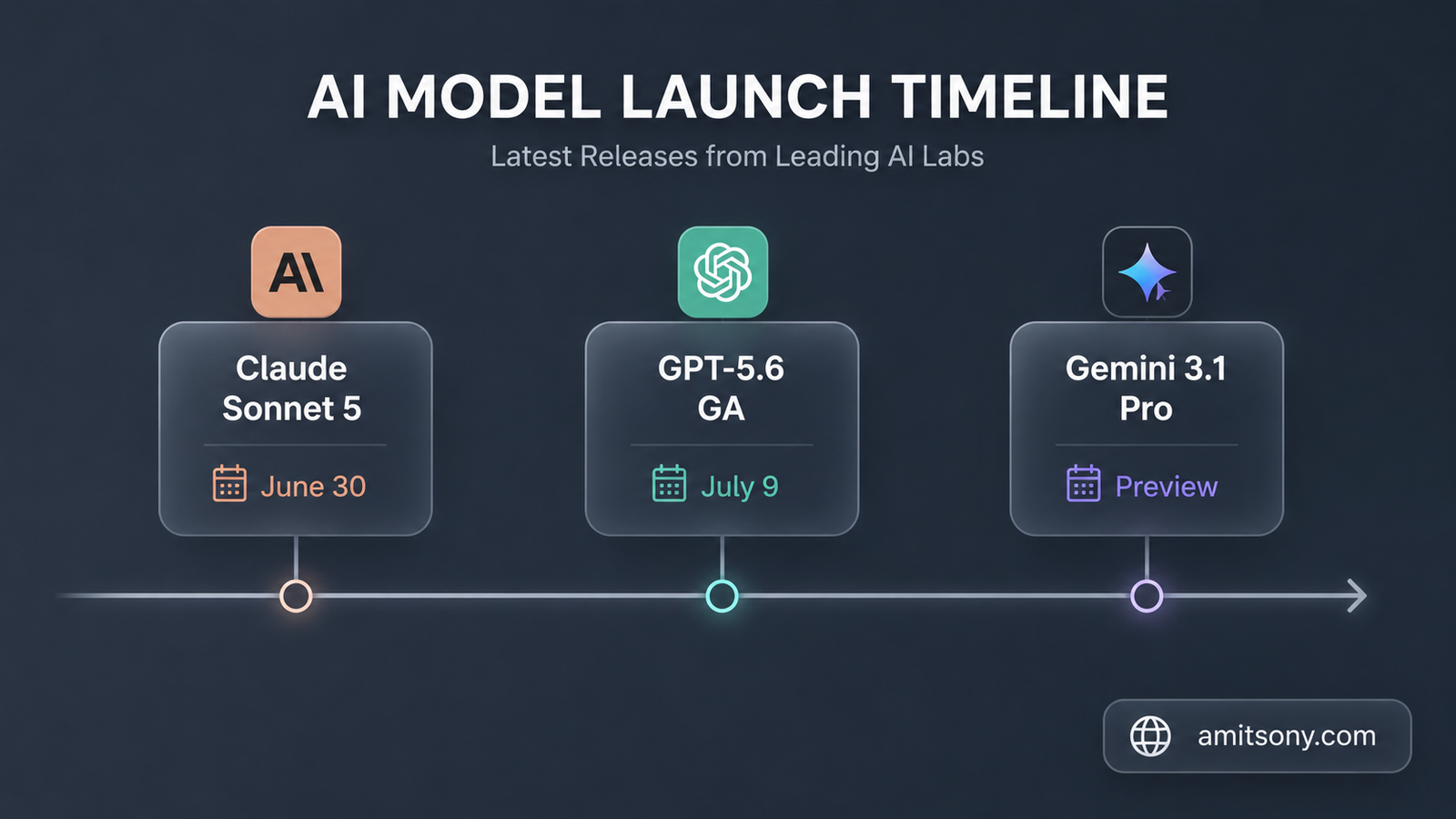
Claude Sonnet 5 is generally available as of June 30, 2026, positioned by Anthropic as a mid-tier agentic coding model that approaches Opus 4.8's quality at a meaningfully lower price. Opus 4.8 remains Anthropic's actual flagship above it.
GPT-5.6's three tiers, Sol, Terra, and Luna, were previewed June 26, 2026, and reached general availability July 9, 2026, with public API access and GitHub Copilot support. Sol replaced GPT-5.5 as ChatGPT's default model. Terra is positioned as matching GPT-5.5's performance at roughly half the cost, and Luna is the fastest, cheapest tier of the three.
Gemini 3.1 Pro's availability depends on which Google access path you're using, and it's still labeled Public Preview months after its initial appearance. Gemini 3.5 Flash, a separate and faster tier, is the one Google positions for tool use, agents, and multimodal work specifically.
Which Model Wins on Coding Benchmarks?
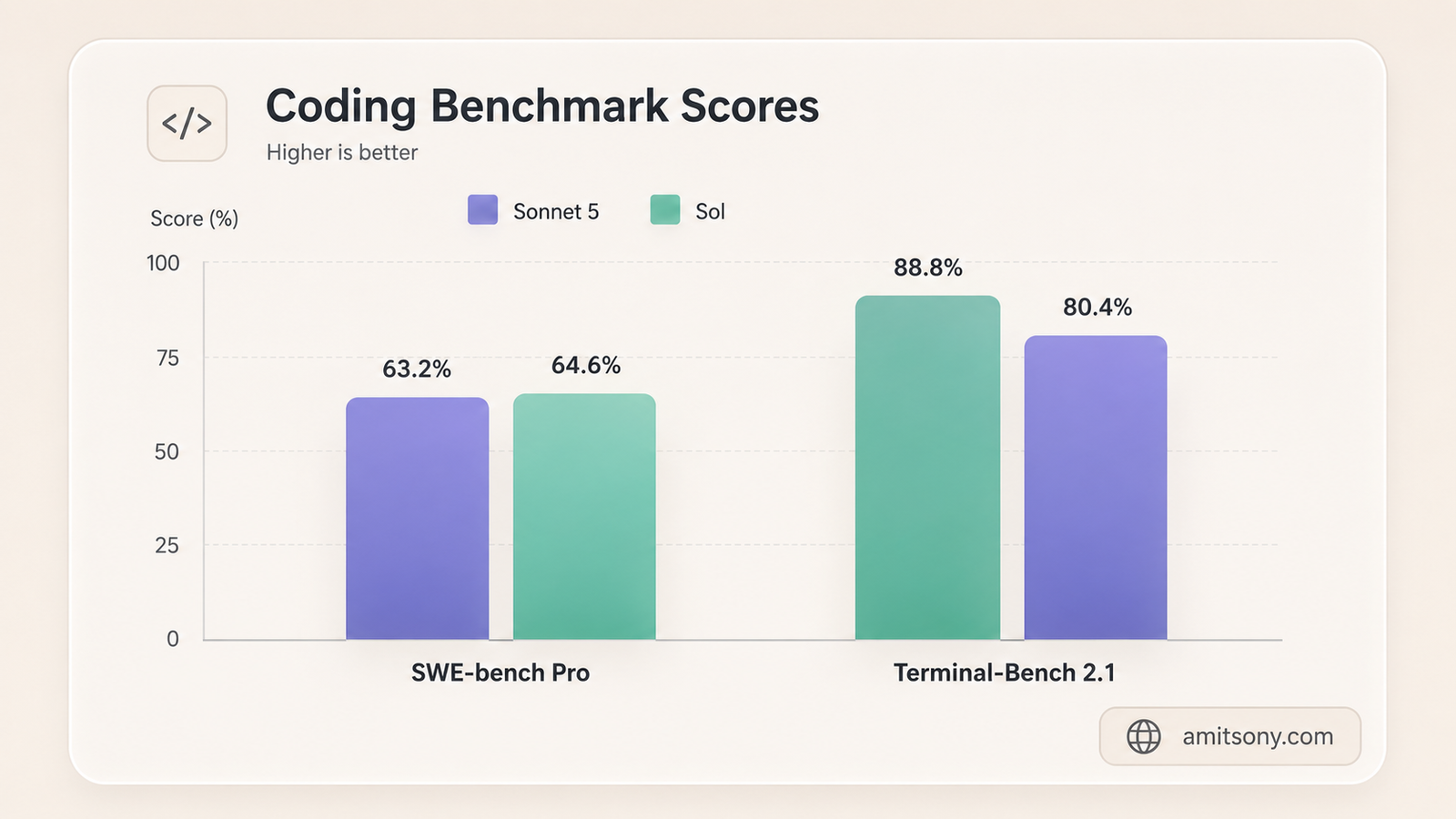
On SWE-bench Pro, the one benchmark where independent sources most consistently cite numbers for both, Claude Sonnet 5 scores 63.2% against GPT-5.6 Sol's 64.6%, close enough to call essentially tied. Anthropic's own Opus 4.8 sits above both at 69.2%, and Claude Fable 5 leads the entire field at roughly 80%.
On Terminal-Bench 2.1, GPT-5.6 Sol pulls ahead more clearly, 88.8% in standard mode against Claude Sonnet 5's 80.4%. That's a real gap for shell-heavy, command-line agentic work specifically, not a rounding difference.
Worth repeating the caveat from earlier: no vendor has run all three models through an identical, cross-checked harness on the same date. Treat any table showing precise head-to-head percentages across all three as a directional estimate stitched from separate disclosures, not a controlled experiment.
One more honest wrinkle. OpenAI published its own audit in July 2026 finding that roughly 30% of SWE-bench Pro tasks contain flawed or misleading test cases. Every model here was scored on the same flawed benchmark, so the relative ranking still means something, but no single percentage should be treated as precise.
Which Model Wins on Long Context and Multimodal Work?
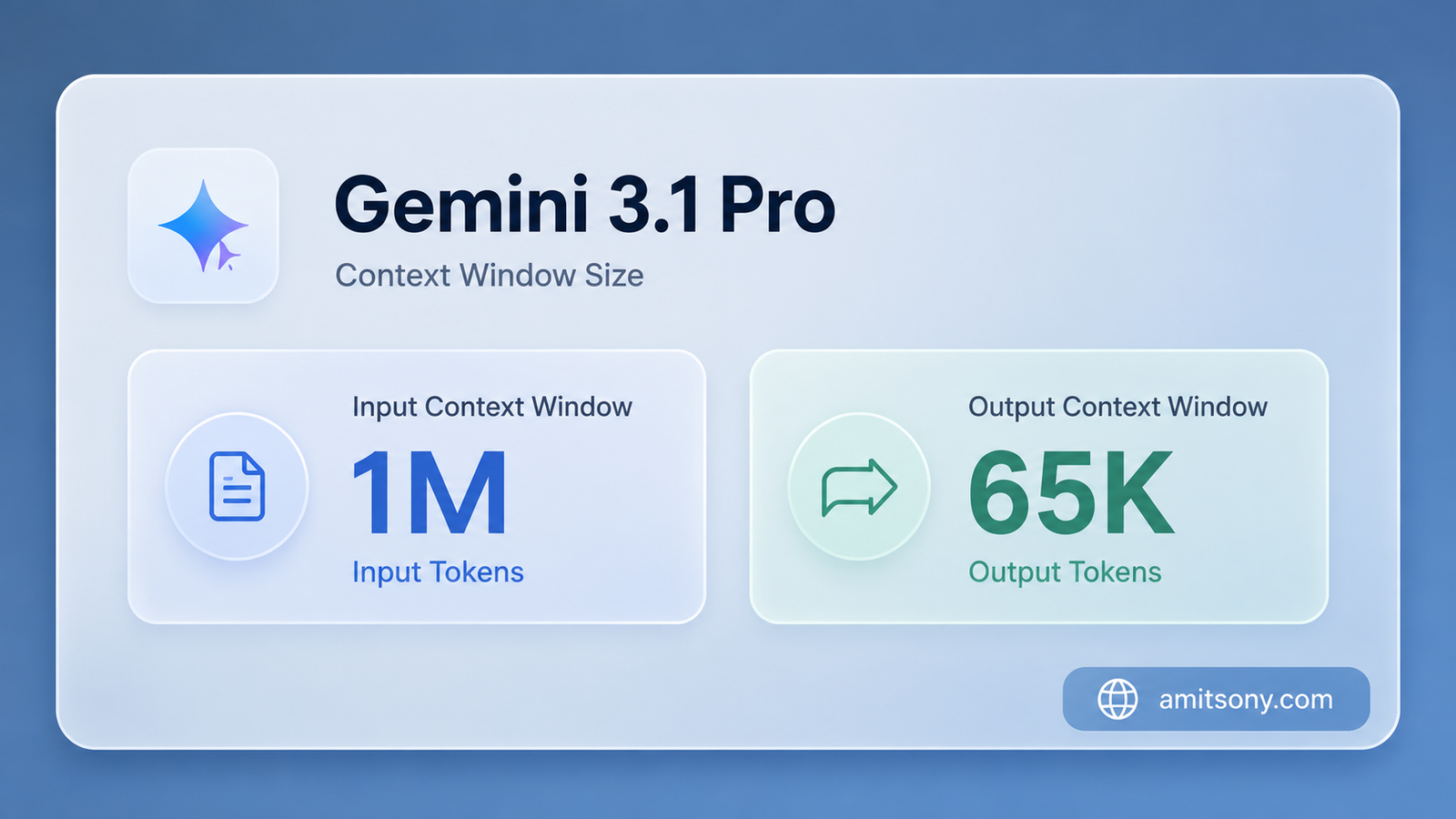
Gemini 3.1 Pro is the clearest specialist here. Its 1 million token input context window paired with a 65,000 token output limit makes it the model built specifically for large documents, full codebases, and multimodal pipelines that need to reason across huge amounts of material in one pass.
Independent testing comparing the OpenAI and Google sides found a genuinely large gap in long-context recall specifically, with the OpenAI family scoring around 94.8% against roughly 77.3% for the comparison model, a difference big enough to matter for any agent that needs to hold onto details across a long conversation or document without losing the thread.
On the multimodal and tool-use side specifically, Gemini 3.5 Flash, not 3.1 Pro, was the one independent testers found winning that particular category, alongside strong grounding for search-connected tasks. If your workload is multimodal input at speed rather than raw context length, that's the more relevant Gemini tier to test.
How Do the Three Actually Compare on Price?
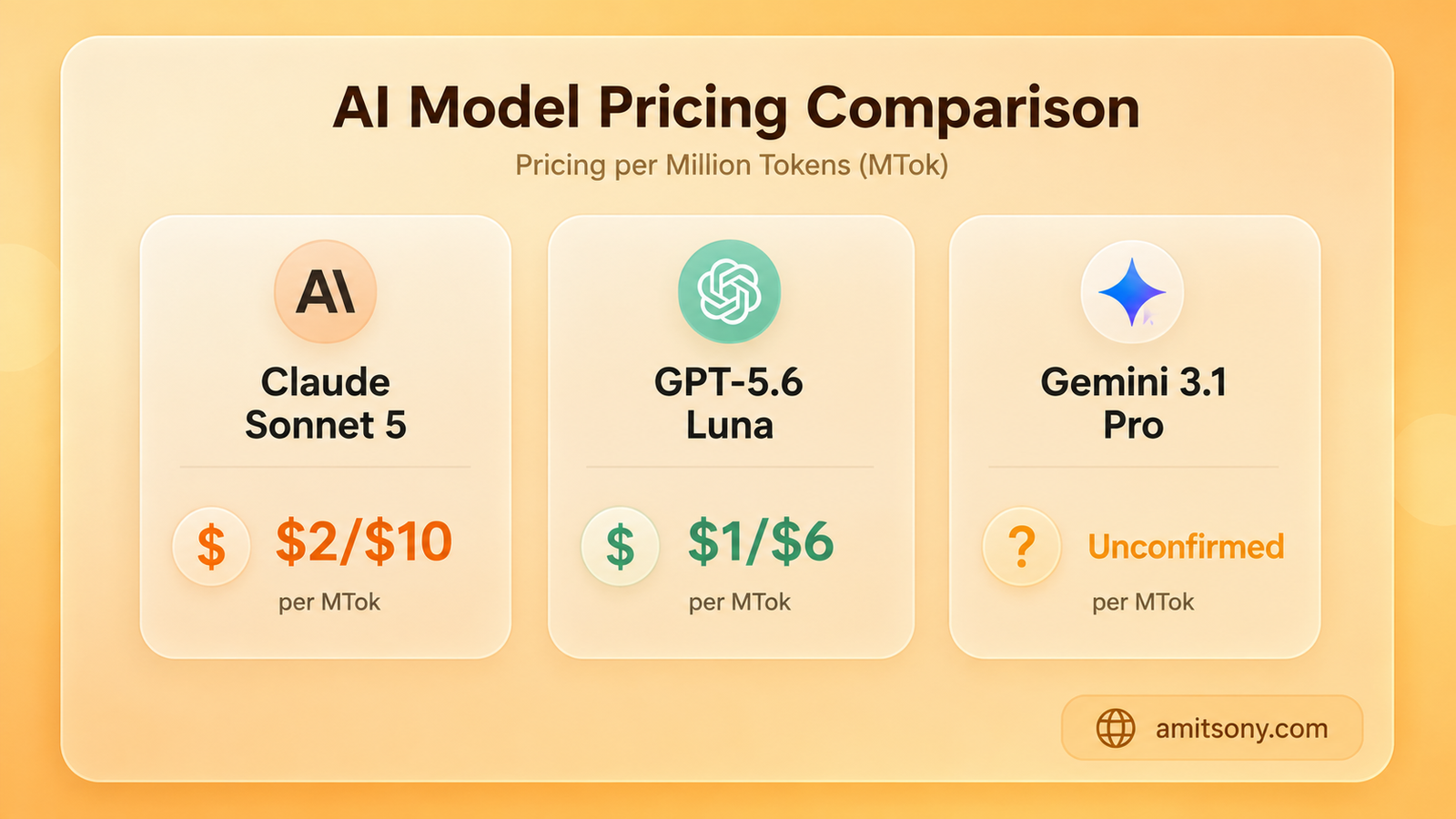
Claude Sonnet 5's introductory pricing is $2 per million input tokens and $10 per million output tokens through August 31, 2026, rising to $3 and $15 after that. There's a real nuance worth knowing here: Sonnet 5's updated tokenizer uses roughly 30% more tokens to represent the same text compared to Sonnet 4.6, so the lower sticker price is closer to cost-neutral in practice than it first appears.
GPT-5.6 Luna, the cheapest of OpenAI's three new tiers, runs $1 per million input tokens and $6 per million output tokens. Sol's exact published rate wasn't consistently available across sources at the time of writing, and Terra is positioned as roughly half of GPT-5.5's cost for comparable performance.
Gemini 3.1 Pro is the least certain of the three on price. Google hasn't published an official per-token rate for the preview, and figures circulating online are third-party estimates based on the previous Gemini 3 Pro generation, treat those as a reasonable guess, not a confirmed number, until Google publishes its own rate card.
Which Model Should You Actually Use for Your Workload?
For sustained, in-repo coding agent work where cost per token matters at scale, test Claude Sonnet 5 first. It's not the outright leader on every coding benchmark, but the combination of price and consistency is what teams building production coding agents keep landing on.
For terminal-heavy agentic tasks, shell scripting, DevOps automation, and raw abstract reasoning, GPT-5.6 Sol currently has the clearer edge, backed by its Terminal-Bench and ARC-AGI-2 scores.
For anything genuinely long-context or multimodal, huge documents, large codebases analyzed in one pass, or mixed media input, Gemini 3.1 Pro or 3.5 Flash is the more natural starting point depending on whether you need maximum context or maximum speed.
For routine, high-volume traffic where cost dominates the decision, GPT-5.6 Luna or Terra are worth testing before defaulting to a flagship tier you don't actually need for simple requests.
So Which One Is the Best AI Model in 2026?
There isn't one, and every source that actually ran hands-on comparisons rather than just repeating vendor claims arrived at the same conclusion. The three families trade wins depending on which specific evaluation you weight, and locking your entire workflow to a single provider based on one benchmark table is a bet you don't need to make.
The genuinely useful next step isn't reading a fourteenth comparison article, it's running your own small pilot with your actual prompts, your pass criteria, and your concurrency needs. A model that wins on a public benchmark can still lose on your specific task, and the only way to know is to test it directly.
Frequently Asked Questions
Is Claude Sonnet 5 better than GPT-5.6 for coding?
They're essentially tied on SWE-bench Pro, 63.2% versus 64.6%, though GPT-5.6 Sol leads more clearly on Terminal-Bench 2.1 for shell-heavy agentic tasks.
Which model has the largest context window?
Gemini 3.1 Pro, with a 1 million token input window and 65,000 token output limit, built specifically for large documents and codebases.
Is Gemini 3.1 Pro's pricing confirmed?
No, Google hasn't published an official per-token rate for the preview as of this writing. Circulating figures are third-party estimates, not confirmed pricing.
What's the cheapest of these three model families?
GPT-5.6 Luna, at $1 per million input tokens and $6 per million output tokens, is the lowest published rate among the three families covered here.
Why do online comparison tables for these models disagree so much?
Many were built before Claude Sonnet 5 launched and never updated, or they quote GPT-5.6 Sol's high-compute Ultra mode as if it were the default performance level.