
DeepSeek wins on price, running as low as $0.14 per million input tokens with a 1M context window under an MIT license. Kimi leads on autonomous agent orchestration, Qwen offers the most commercially permissive Apache 2.0 licensing, and Llama still holds the longest context window at roughly 10M tokens, though it now trails the others on coding benchmarks.
Nine frontier-class open-weight models shipped in roughly six weeks this spring. That pace is the actual story here, not any single model's benchmark score, because whatever tops this list in July won't necessarily be leading it by October.
What has changed is the calculus. A year ago, open models were interesting experiments you tested and then went back to a closed API for real work. In 2026, DeepSeek, Kimi, Qwen, and Llama are running inside actual production engineering pipelines. Here's how the four actually compare, and what to check before you build on any of them.
What Does "Open Source" Actually Mean for an AI Model?
Most models on this list, including all four covered here, are technically open-weight rather than open-source in the strict sense. The distinction matters. Open-weight means the trained model files are downloadable and usable, but the full training data and pipeline usually aren't published. True open-source, under the original software definition, would require both.
This isn't a minor pedantic point. It affects what you're actually allowed to do with a model, how reproducible its behavior is, and whether you can meaningfully audit what it was trained on. When people say "best open-source AI models" in 2026, they almost always mean this looser, weights-available definition, and this guide uses the term the same way.
Licensing terms vary sharply between these four, and that's often the deciding factor for companies, not the benchmark score. More on that shortly.
Which Open Model Is Best for Coding and Agentic Work?
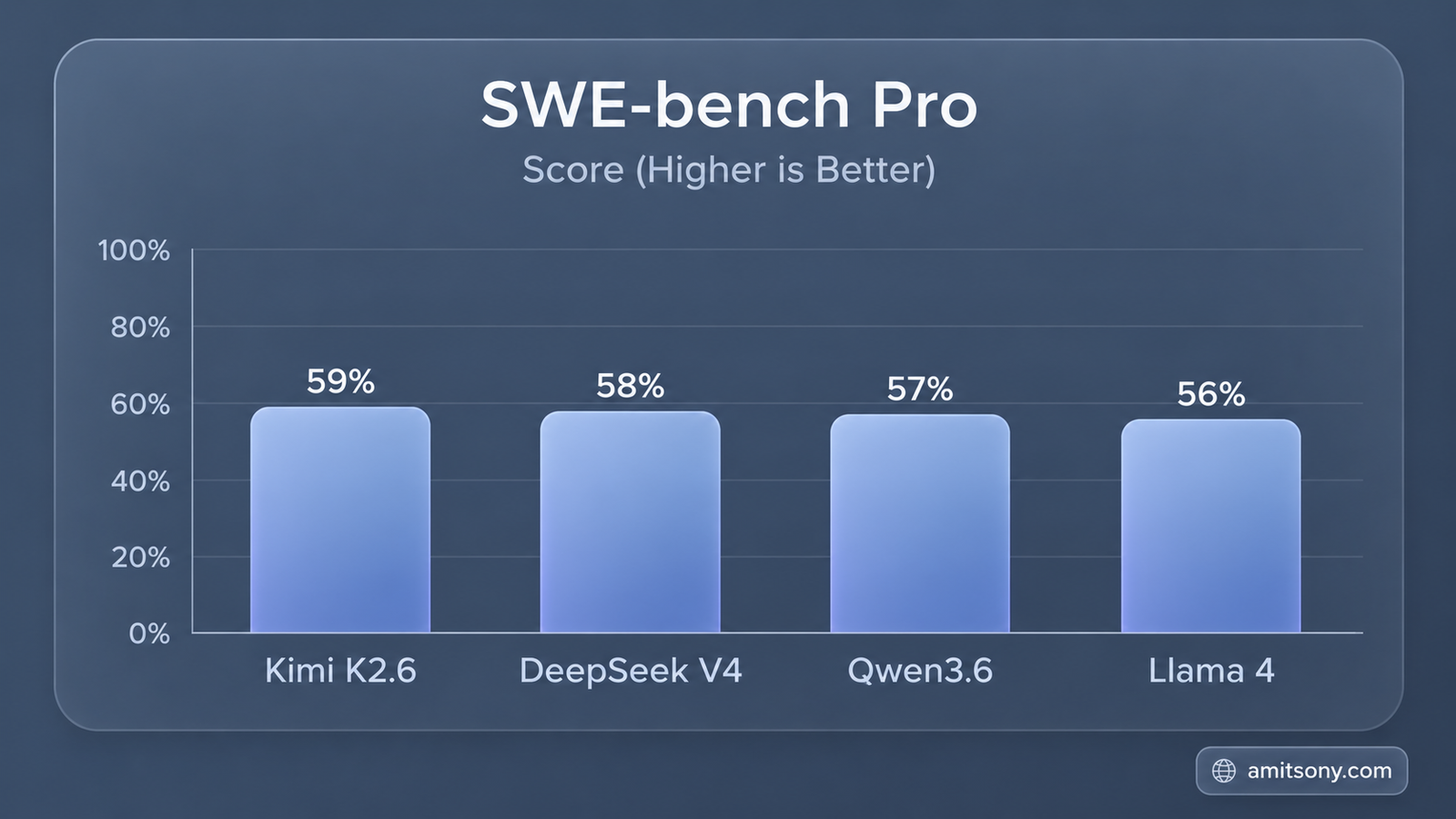
This is where the field has moved the most, and where Llama has fallen behind the others. On SWE-bench Pro, a harder real-world coding benchmark, DeepSeek, Kimi, and Qwen variants all cluster tightly between roughly 58% and 60%, essentially trading the top spot month to month.
Kimi, built by Moonshot AI, has a genuinely distinct feature here rather than just a higher score. Its native swarm orchestration lets the model internally spawn up to 300 sub-agents coordinating across thousands of steps, all inside a single API call, without you building external orchestration logic yourself. For complex, multi-file coding tasks, that collapses work that would otherwise need expensive multi-turn coordination with other models.
DeepSeek's V4 Pro ties the closed frontier on several agentic coding benchmarks while remaining dramatically cheaper per token, which is arguably the bigger headline than any single score. Qwen's smaller coding-focused variants, released under Apache 2.0, post some of the highest SWE-bench Verified scores in the entire open field, competitive with models many times their size.
Llama's strength was never really coding leadership, and that hasn't changed. It's not a bad choice here, it's just not the one to reach for first if agentic coding is the primary job.
Which Open Model Is Cheapest to Run?
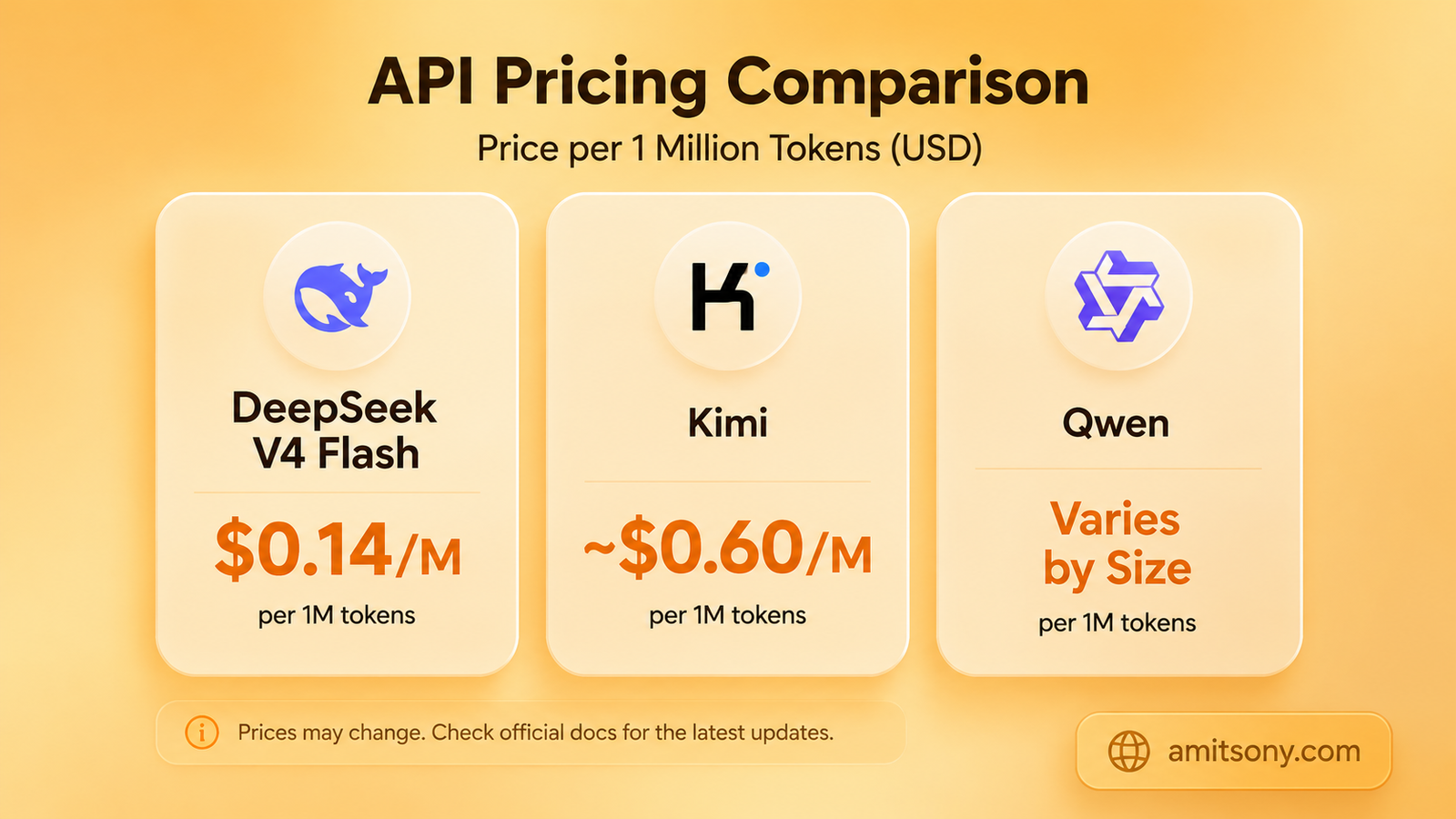
DeepSeek isn't close on this one. V4 Flash runs $0.14 per million input tokens and $0.28 per million output tokens through the official API, with cached input hitting as low as a fraction of a cent per million tokens on repeated prompts. That combination makes it roughly 10 to 35 times cheaper than Western flagship models per token.
The catch, if you can call it that, is that Flash trades some capability for that price. The Pro variant costs more, $0.435 per million input and $0.87 per million output, but still undercuts most closed alternatives by a wide margin while staying competitive on coding benchmarks.
Kimi sits in the mid-range, roughly $0.60 per million tokens blended on hosted providers, which is reasonable given what its agentic orchestration collapses into a single call. Qwen's smaller variants are frequently available free or near-free through certain hosted platforms, though pricing varies significantly depending on which specific model size and provider you pick.
Self-hosting any of these isn't actually free either, it just moves the cost from a token bill to GPU rental or ownership, plus the engineering time to run it well. Budget for that trade-off honestly before assuming self-hosting automatically saves money.
Which Open Model Has the Longest Context Window?
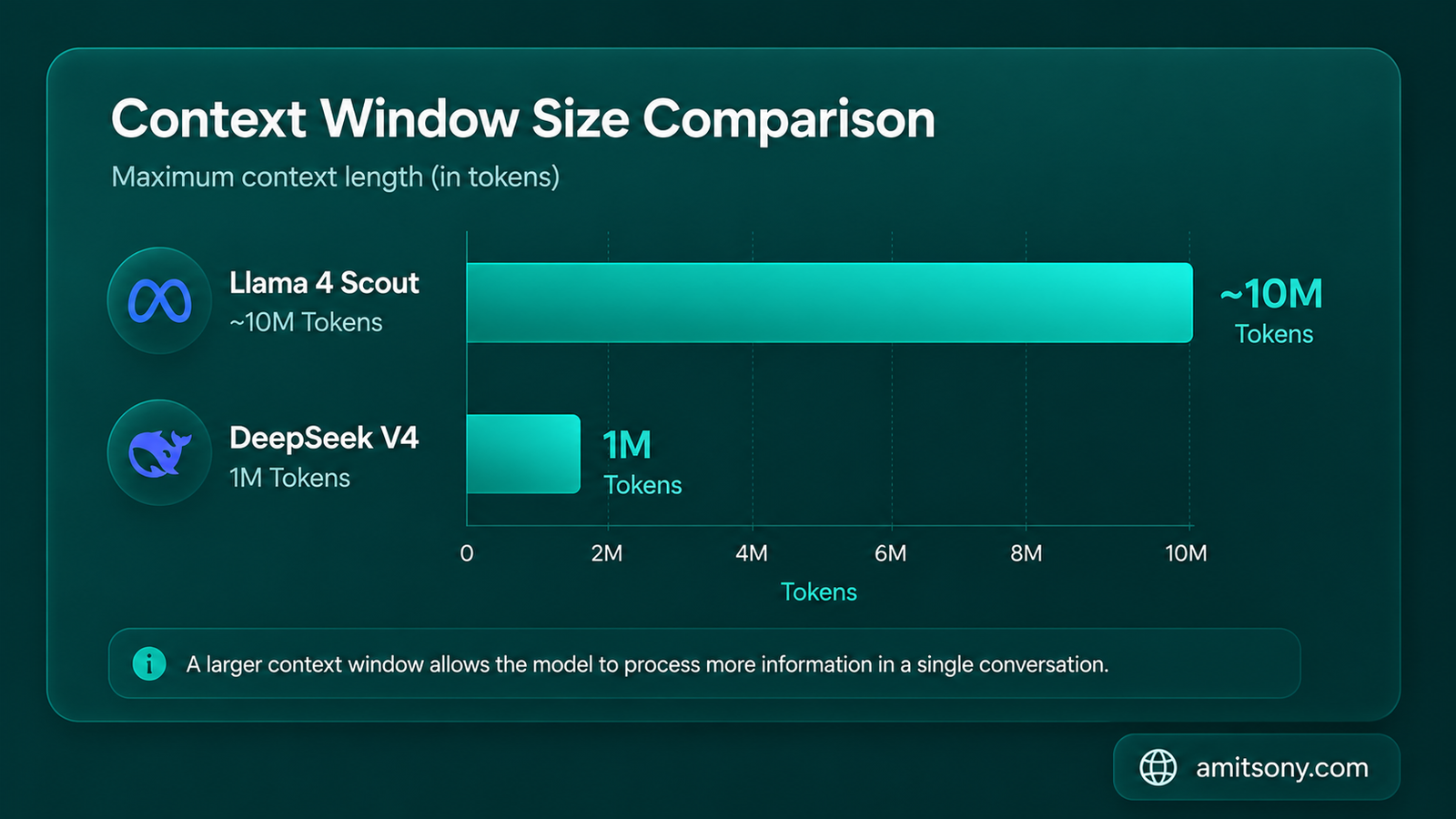
Llama 4 Scout still wins this category outright, with a vendor-claimed context window reaching roughly 10 million tokens, well beyond anything else in this comparison. If your actual workload needs to reason across an entire large codebase or a genuinely massive document set in one pass, this is still the model to test first.
DeepSeek V4 offers a full 1 million token window, a tenth of Scout's claimed maximum but paired with much stronger coding and reasoning benchmarks, plus dramatically lower cost per token. For most real workloads, 1M tokens is already more than enough headroom.
Worth flagging honestly: a large advertised context window doesn't guarantee the model stays coherent across all of it. Several sources testing these models note that quality can degrade well before the stated maximum, particularly past the 100K to 200K token range. Test your actual use case at the length you need rather than trusting the headline number alone.
Which Open Model Has the Most Commercial-Friendly License?
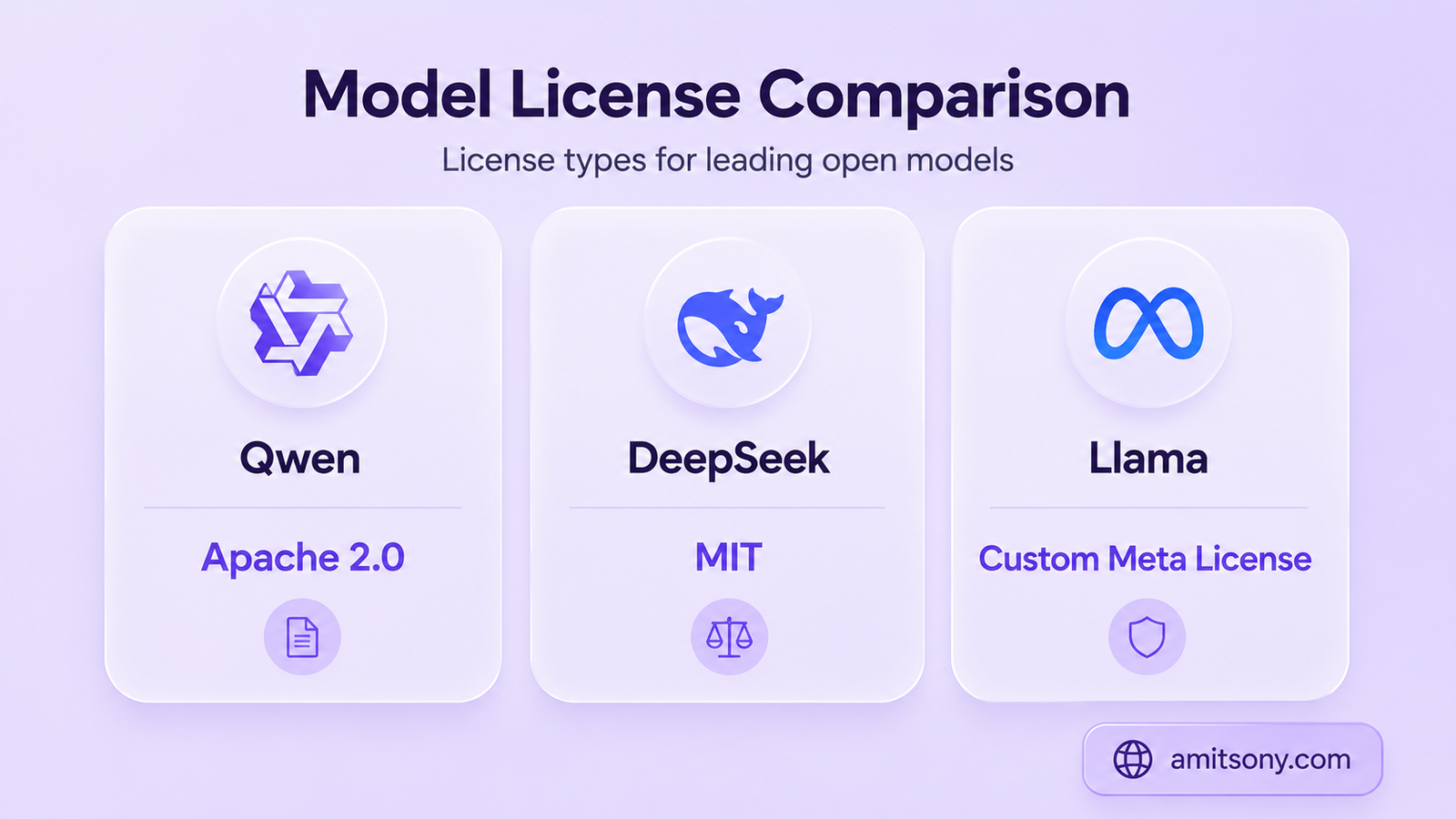
Qwen leads clearly here. Most of its recent releases ship under Apache 2.0, a genuinely permissive license with minimal restrictions on commercial use, modification, or redistribution. If licensing simplicity is your top concern, start your evaluation with Qwen.
DeepSeek's V4 line also ships under MIT, similarly permissive and straightforward for commercial deployment. Between Qwen and DeepSeek, you're mostly choosing based on performance and cost rather than legal risk.
Llama is the one to read carefully before committing. Meta uses a custom license rather than a standard open-source license like Apache or MIT, and it carries specific usage conditions, including restrictions tied to company size, that don't apply to the other three models here. It's not automatically a dealbreaker, but it's a genuinely different legal posture, and skipping that review before a production deployment is a real risk.
How Do You Actually Access These Models?
You don't have to self-host to use any of these. Hosted API providers, OpenRouter, Fireworks, and Together among the most common, serve all four models through OpenAI-compatible endpoints, meaning you can often swap models with a single config change rather than rewriting integration code.
Self-hosting makes sense once volume justifies the fixed cost of GPUs, or when data residency and privacy requirements rule out sending anything to a third-party API at all. DeepSeek V4 Flash and Qwen's smaller dense variants are the more realistic self-hosting targets for teams without a large GPU budget, since the larger Mixture-of-Experts models still require substantial VRAM regardless of how few parameters activate per token.
Whichever route you pick, re-check current pricing and benchmark standing before committing to a long-term integration. Every source used to research this comparison flagged the same thing: this field has changed leadership more than once in the past year alone.
Do Open Models Actually Rival GPT and Claude Yet?
For specific, well-defined tasks, yes, and the gap keeps closing. On coding benchmarks, several open models now sit within a couple of points of frontier closed models while costing a fraction as much per token. That's a genuinely different situation than a year ago, when the honest advice was to treat open models as experiments rather than production choices.
The gap hasn't disappeared entirely though. Closed frontier models still generally hold a lead on the hardest, most ambiguous reasoning tasks, and on the kind of polished, safety-tuned conversational experience that a general consumer product needs. Open models are strong enough for many production workloads now, not automatically strong enough for all of them.
The honest framing: it's no longer a question of whether an open model can be good enough. It's a question of which specific job you're hiring it for, and whether paying frontier prices is a genuine requirement for that job or just the safer default.
Frequently Asked Questions
What's the cheapest open-source AI model to run through an API?
DeepSeek V4 Flash, at $0.14 per million input tokens and $0.28 per million output tokens, is currently the cheapest production-grade option among the major open models.
Which open model has the longest context window?
Llama 4 Scout, with a vendor-claimed context window of roughly 10 million tokens, well ahead of DeepSeek's 1 million token window.
Is Qwen or DeepSeek better for commercial use?
Both use permissive licenses, Qwen under Apache 2.0 and DeepSeek under MIT, so the choice mostly comes down to performance and cost rather than licensing risk.
What makes Kimi different from the other open models?
Kimi's native swarm orchestration lets it spawn and coordinate up to 300 sub-agents inside a single API call, handling complex multi-step tasks without external orchestration.
Are these models actually open-source or just open-weight?
Technically open-weight in almost every case, the trained model files are downloadable, but the full training data and pipeline usually aren't published.