

A Copilot Credit costs $0.01 on pay-as-you-go or $0.008 in a $200 pack of 25,000. Everyday Copilot stays in the per-user licence, while Cowork, Code and Autopilot bill by credits. New Copilot Business purchases through partners get a default cap of 4,000 credits, about $40 per user a month, from early 2027.

Microsoft has quietly turned Copilot into a two-meter product. One meter is the per-user licence. The other is a unit called the Copilot Credit, and it is the one that can surprise your finance team.
This guide explains what a credit is, what burns credits, how packs compare with pay-as-you-go, what changes for Copilot Business in early 2027, and how to cap spending before the first invoice.
What is a Copilot Credit?
A Copilot Credit is Microsoft's single billing unit for agent work. Copilot Studio has used credits as its one billing currency since September 1, 2025, and the maker licence itself is free. You pay for what agents do, not for who builds them.
Each action draws a different number of credits. A classic answer, a reply you wrote ahead of time, costs 1 credit. Agent flow actions cost 13 credits per 100 actions. In general an agent spends 1 to 10 credits per answer or action, so heavier steps cost more.
Microsoft's credit estimator forecasts one agent's monthly use from user counts, interactions, knowledge sources, tools and flows. It calls the result an informational estimate, so treat it as a starting point.
How much does a Copilot Credit cost?
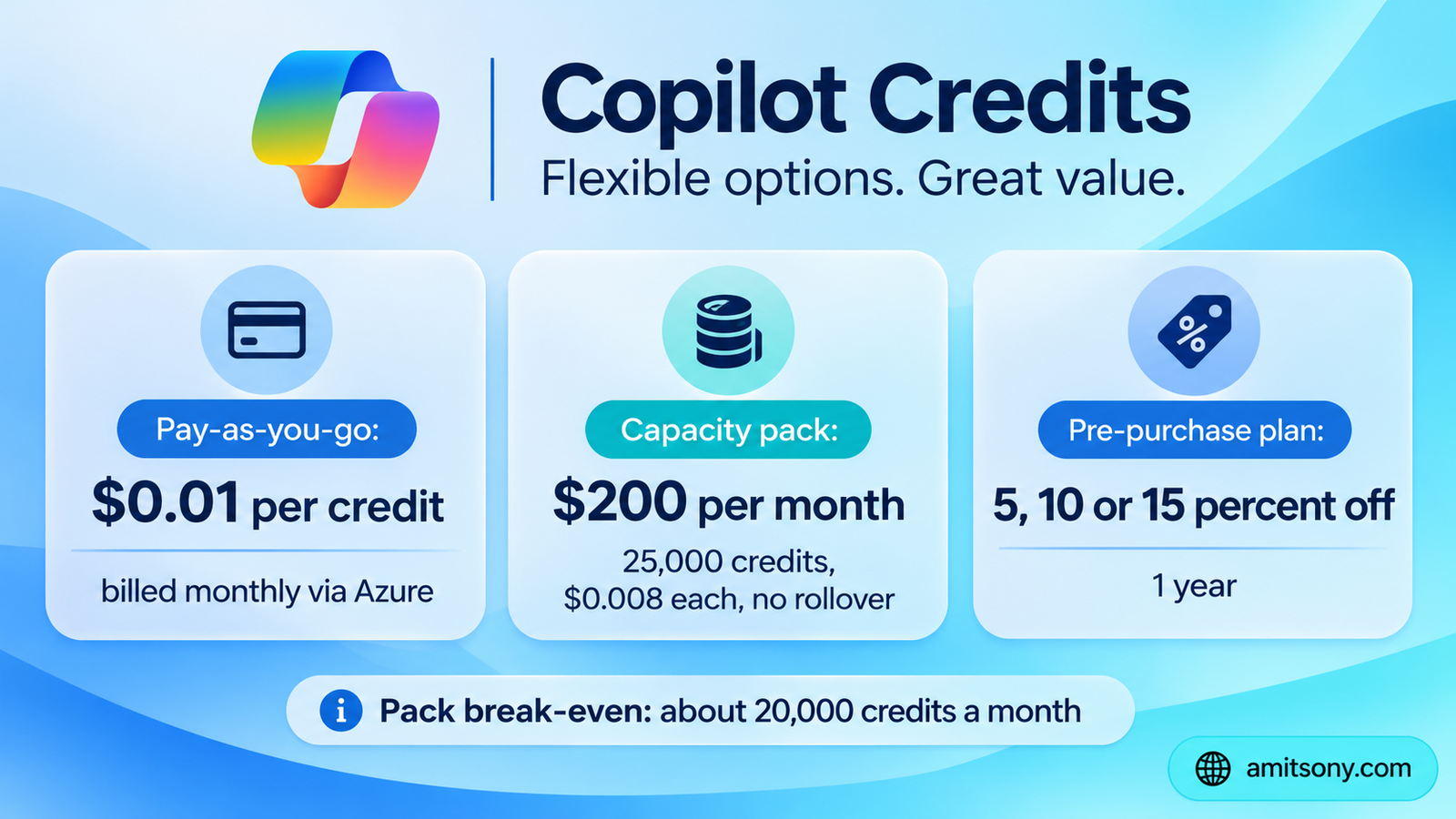
On pay-as-you-go, one credit costs $0.01, roughly ₹0.88. It is billed monthly in arrears through an Azure subscription. You switch it on with a billing policy in the Power Platform admin center, and you can unlink it at any time.
A capacity pack costs $200 per month, billed annually, for 25,000 credits. That works out to $0.008 per credit, which is 20 percent cheaper, around ₹17,600 per pack. Pack credits expire at month end with no rollover.
The pack only wins if you use most of it. Use half and your real rate becomes $0.016 per credit consumed, higher than pay-as-you-go. The break-even point is about 20,000 credits a month, or 80 percent of the pack.
There is also a pre-purchase plan. It offers 5, 10 or 15 percent off for 20,000, 100,000 or 500,000 Agent Commit Units, bought for one year. Each unit is $1 of usage, or 100 credits, with pay-as-you-go cover when credits run out.
What uses Copilot Credits, and what is included?
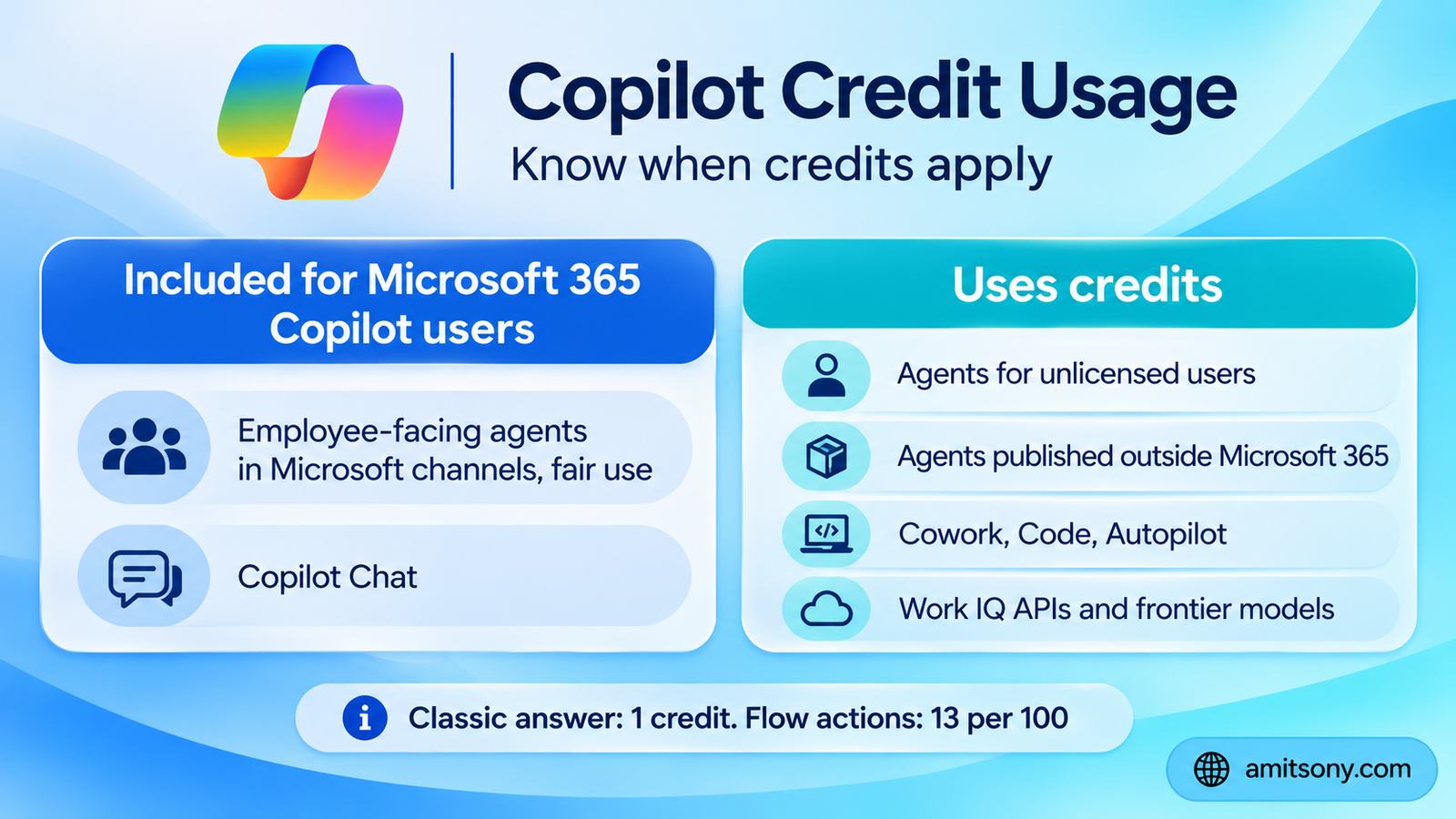
Licensed employees get a lot included. If a user has a Microsoft 365 Copilotcopilot licence, employee-facing use of Copilot Studio agents inside Microsoft channels is covered, under fair-use limits. Copilot Chat is free with Microsoft 365.
Credits pay for the rest. That includes agents used by unlicensed staff, agents published outside Microsoft 365 such as on a public website, and the newer metered features: Copilot Cowork, Code, Autopilot, Work IQ APIs and frontier models. Cowork charges come from four inputs, which are model use, context retrieval, tool calls and runtime.
Here is a worked example using classic answers only. A customer-facing agent handles 10,000 conversations a month with 3 answers each, which is 30,000 credits. On pay-as-you-go that costs $300, around ₹26,400. With one $200 pack plus 5,000 extra credits at pay-as-you-go, it costs $250, around ₹22,000. Heavier generative answers use more credits, so real bills will run higher.
What is the new usage-based billing for Copilot Business?
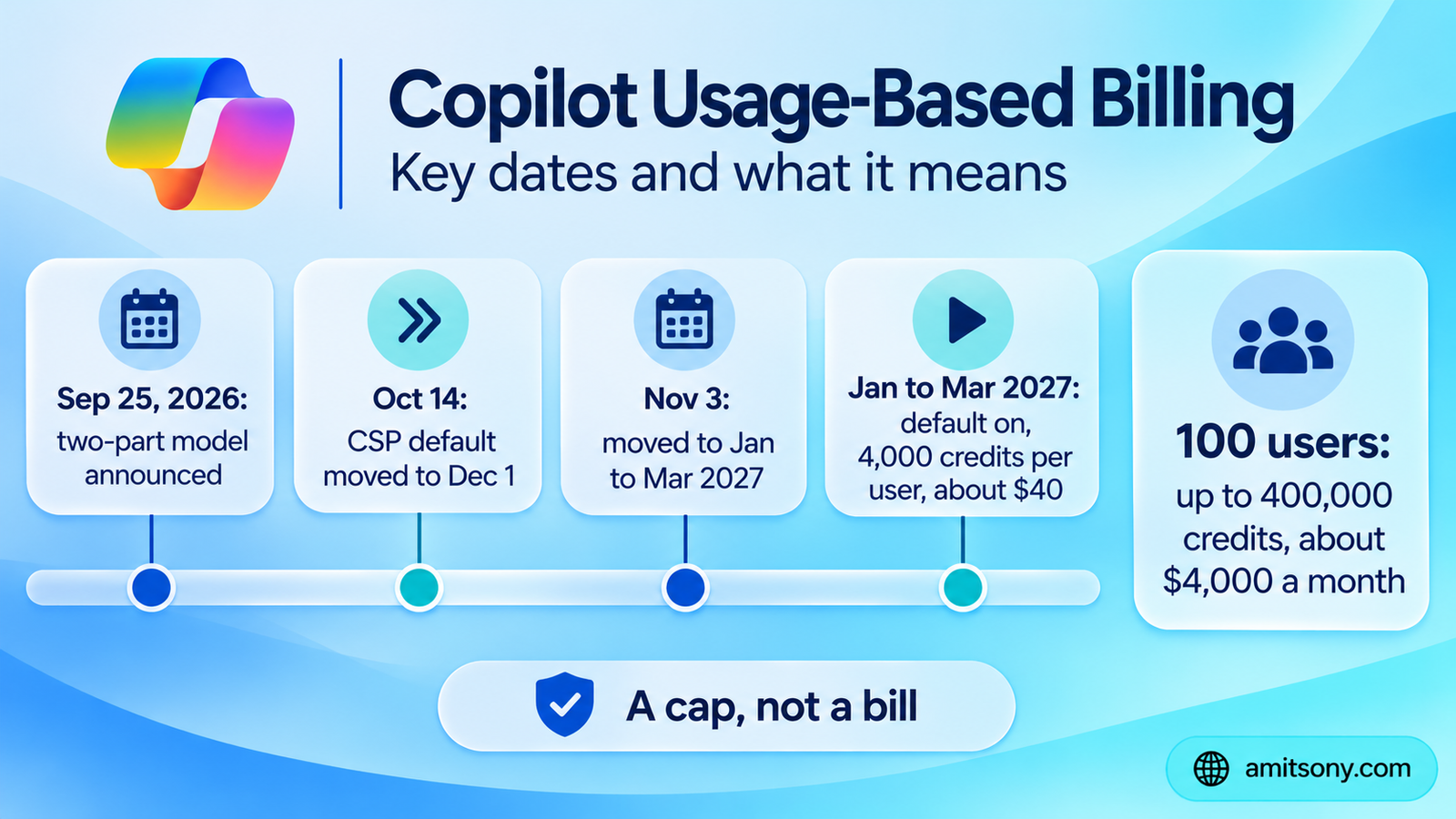
Microsoft laid out a two-part model on September 25, 2026. A per-user licence covers everyday AI in Chat, Word, Excel, PowerPoint, Outlook and Teams. Usage-based billing with credits covers advanced work such as Cowork, Code and Autopilot, at $0.01 per credit.
Licence prices matter too. Microsoft 365 Copilot is $30 per user per month. Copilot Business is $21, or $18 until December 31, 2026 for existing Microsoft 365 customers.
New Copilot Business purchases carry a default limit of 4,000 credits per user per month, roughly $40. Microsoft's own example says 100 users could consume up to 400,000 credits a month, a ceiling of about $4,000. It is a cap, not a bill, and charges arise only when people use the metered features.
The date has moved twice. On October 14 the default shifted to December 1, 2026, and on November 3 Partner Center moved it to January to March 2027 for licences bought through partners. One source says direct purchases from Microsoft started getting pay-as-you-go by default in mid-November. A new purchase also switches billing on for existing Copilot Business licences in the same tenant, and the limit can be set to zero but not fully removed. For Microsoft 365 Copilot, Cowork works only after an admin activates usage-based billing.
How much could your team really pay?
Start with the ceiling, then estimate real use.
At the default cap, a 20-person team could draw 80,000 credits, about $800 a month, around ₹70,400. A 100-person team has a ceiling of about $4,000, or around ₹3.52 lakh. Per user the extra spend tops out near $40, roughly ₹3,520.
Add the licence and the ceiling per Copilot Business user becomes about $61, which is $21 plus $40, around ₹5,370. That is a worst case, not a forecast.
To estimate real spend, multiply users by tasks per user by credits per task, then by $0.01. Run a two-week pilot with 5 to 10 users, record credits used, and extrapolate.
Be careful with defaults. A 4,000-credit limit across 20 staff is 80,000 credits of possible spend that nobody chose on purpose. Set the limit deliberately.
How do you cap and monitor Copilot Credit spending?
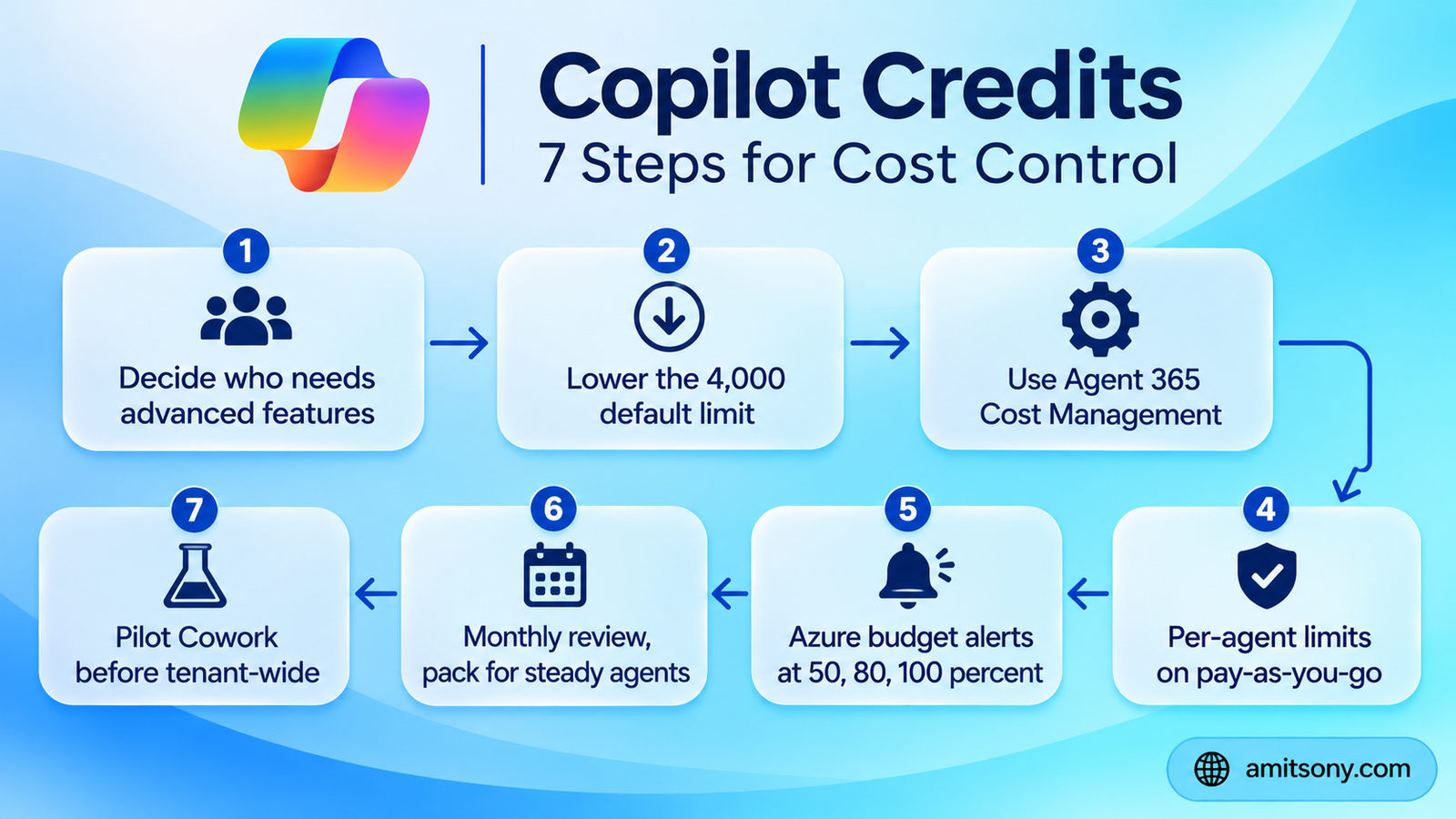
Step 1. Decide who actually needs the advanced features. Most staff do not.
Step 2. Set per-user limits lower than the 4,000 default, and set zero for users who should not run metered features.
Step 3. Use Agent 365 Cost Management in the Microsoft 365 admin center. Announced at Ignite 2026, it lets you cap Copilot Studio, Cowork, Copilot Managed Runtime and Dynamics 365 agent spending from one screen. A capped user loses access to those features until the 1st of the next month.
Step 4. On pay-as-you-go, set per-agent monthly limits for each Copilot Studio agent.
Step 5. Add Azure budget alerts at 50, 80 and 100 percent of your monthly plan.
Step 6. Review usage monthly and move heavy, steady agents to a pack once you can forecast them.
Step 7. Pilot first. Enable Cowork for a small group before you enable it tenant-wide.
Should you choose a pack or pay-as-you-go?
Choose pay-as-you-go for pilots, spiky traffic and anything you cannot yet forecast. You pay for exactly what agents use, with no commitment, and you can unlink the billing policy at any time.
Choose a pack when you reliably use at least 80 percent of 25,000 credits a month. A pack has no rollover, and annual billing means you are committed for the year.
Choose the pre-purchase plan only if you can forecast a full year. The discount is up to 15 percent, but you pay up front.
My verdict: start with pay-as-you-go, record three months of usage, and then buy a pack sized to your lowest month, not your average. That way you never pay for credits that expire.
What should smaller teams and Indian businesses check?
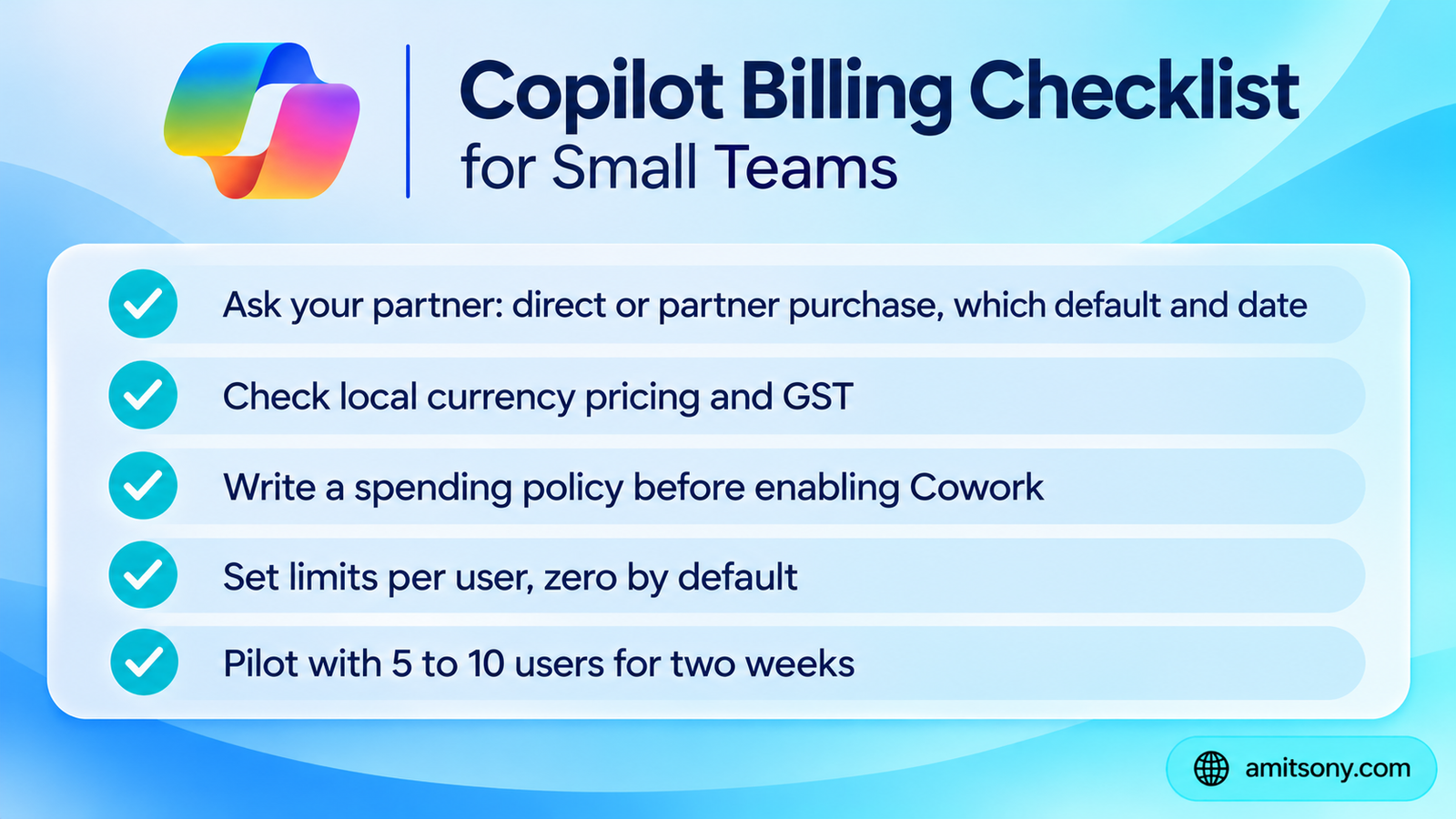
Ask your Microsoft partner whether your licence is bought through the partner programme or directly, because the billing default and date differ. Ask how billing is handled in your currency, and how GST applies, since I could not verify local pricing.
Set a written spending policy before you enable Cowork. Name who can use it, the monthly limit per user and who reviews the usage report.
For very small teams, the per-user ceiling of about ₹3,520 can be larger than a user's licence. Keep advanced features off for everyone until someone has a specific, measured need.
Frequently Asked Questions
How much does a Copilot Credit cost?
$0.01 on pay-as-you-go through Azure, or $0.008 inside a $200 pack of 25,000 credits.
Do Microsoft 365 Copilot users pay for Copilot Credits?
Usually not for everyday Copilot and employee-facing agents under fair use. Advanced features like Cowork, Code and Autopilot bill by credits.
What is the 4,000 Copilot Credit limit?
It is the default monthly cap per user on new Copilot Business purchases, roughly $40. It is a ceiling, not a free allowance, and admins can change it.
When does usage-based billing start?
For new Copilot Business licences bought through partners, Microsoft moved the default from December 1, 2026 to January to March 2027.
Do unused credits in a pack roll over?
No. Capacity pack credits expire at the end of the month.