
Gemini 4 Argon is Google's flagship model, generally available since October 13, 2026. It leads on long context and knowledge work, but trails Claude Opus 5.5 on terminal coding and slightly on independent scores. It costs $2 and $10 per million tokens until November 30, then rises to $4 and $20, so test it before December.
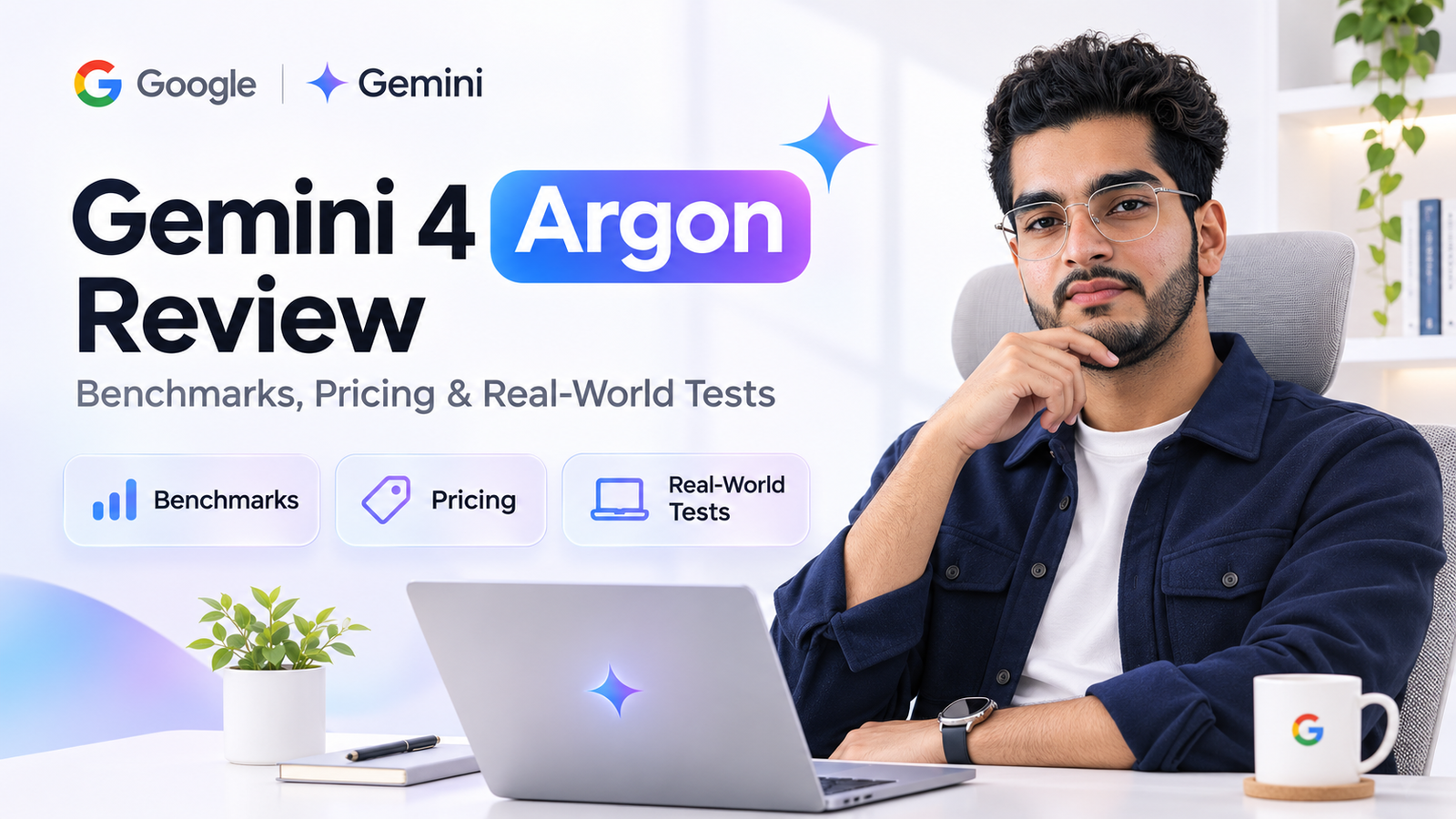
Most model launches promise the moon. Gemini 4 Argon delivers something more specific: the best long-context numbers of any flagship, at a launch price that is about to expire.
This review covers what Argon is, the price cliff on December 1, how it scores on Google's own and independent tests, where it falls short, and which job each rival model should get instead.
What is Gemini 4 Argon, and who can use it?
Gemini 4 Argon is a flagship model from Google DeepMind. It was announced on September 30, 2026 and became generally available on October 13. Google followed it with Gemini 4 Carbon on October 28, according to one report.
You can reach it three ways. Developers use the paid Gemini API , since Argon is not on the free API tier and billing must be on. Consumers get it in the Gemini app and AI Mode with a Google AI Pro or Ultra plan. Business customers can use it through Gemini for business, and it also arrives inside GitHub Copilotcopilot on its higher paid tiers.
The context window is 1,048,576 tokens, shared across input, thinking and output. Default output is 65,536 tokens, and a long decode mode can stretch a single reply toward 1 million.
How much does Gemini 4 Argon cost, and what happens on December 1?

Until November 30, 2026, Argon costs $2 per million input tokens and $10 per million output tokens, roughly ₹176 and ₹880. From December 1 the price doubles to $4 and $20, the same list price as Claude Opus 5.5.
Cached input is $0.10 now and $0.20 later. Batch and Flex processing take half off, and Priority access costs $3.60 and $18 at the intro rate. Only implicit caching is offered.
Here is a worked example. Say your team uses 10 million input tokens and 2 million output tokens a month. At the intro rate that is about $40, or around ₹3,520. From December 1 it is about $80, or around ₹7,040. GPT-6.1 Sol stays at $2 and $10, so it would remain at about $40.
The takeaway is that Argon's price advantage is a promotion, not a structural edge. Plan your budget on the December price.
How does Gemini 4 Argon score on benchmarks?

Start with Google's own table. It shows Argon ahead of GPT-6 Astra, Claude Fable 5.1 and Claude Opus 5.5 on 13 of 19 rows, with one tie. On the Vals Index it scores 68.9 percent against 67.0 for Opus 5.5, 65.8 for Fable 5.1 and 63.1 for Astra.
Vendor tables show the tests a vendor picks, so check the independent view. Artificial Analysis scores Argon 53 on its Intelligence Index, level with GPT-6 Astra and Fable 5.1. That puts it just behind Opus 5.5, which scores 54 at high effort and 58 at max, and ahead of or level with GPT-6.1 Sol at 52.
So the honest summary is that Argon is a top-tier model that is not clearly the single best one. Which is best depends on your job.
Where is Gemini 4 Argon strongest?
Long context. On GraphWalks across 256K to 1M tokens, Argon scores 84.2 percent against 66.8 for Opus 5.5, a gap of 17 points. Up to 128K tokens it reaches 99.7 percent against 90.6. If your job is to reason across very large documents, codebases or contracts, this is the headline number.
Knowledge work. It leads on legal and finance style tests, and on AutomationBench it scores 51.3 percent against 36.1 for GPT-6.1 Sol. On DeepSWE it reaches 77.9 percent against Sol's 75.2.
Output length. A single reply can run far longer than Opus 5.5's 128K ceiling, which helps for large rewrites and report generation.
My verdict: if long documents are your daily work, Argon deserves a serious test.
Where does Gemini 4 Argon fall short?
Terminal coding. On Terminal-Bench 4.0, Google's own table shows Argon at 57.4 percent against 66.4 for Opus 5.5. That test measures real command execution, not just code generation, and it matters if you run agents in a shell.
Token appetite. Argon tends to burn more output tokens per task. On the independent index, a task cost about $1.99 at the intro price. Opus 5.5 at high effort cost about $1.82 despite a price per token that is twice as high. At the December price, Argon's cost per task rises to about $3.98.
Access and caching. There is no free API tier, and only implicit caching is offered, so you cannot lock in a cache discount deliberately.
Computer use. On OSWorld 2.0, Argon scores 69.2 percent against 71.4 for GPT-6.1 Sol, a small edge for Sol on that test.
What did real-world tests show?
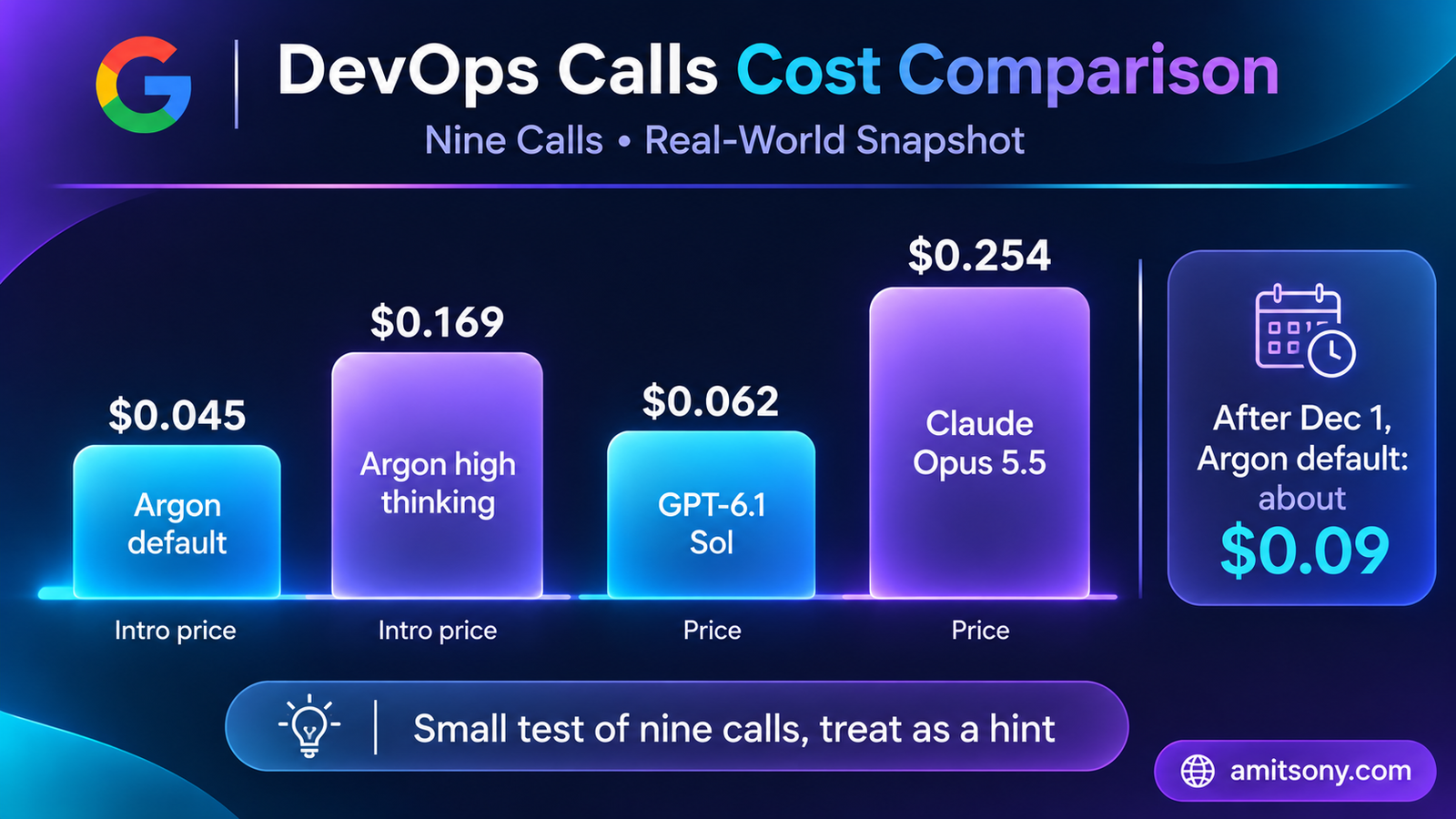
Published hands-on tests are small, so treat them as hints. In one DevOps comparison of nine calls, Argon at default thinking cost about $0.045, GPT-6.1 Sol about $0.062 and Claude Opus 5.5 about $0.254. Argon also finished each call roughly three times sooner than Sol.
The tester then repeated the maths at the December price. The same nine calls would cost about $0.09 on Argon, and Sol's $0.062 would win. That is the price cliff in miniature.
With high thinking, Argon's cost rose to about $0.169 for the nine calls. Thinking effort changes the bill a lot.
The pattern is consistent with the benchmarks. Argon is fast and cheap at default settings during the promotion, and less of a bargain once the promotion ends and once you turn thinking up.
Gemini 4 Argon vs Claude Opus 5.5 vs GPT-6.1 Sol: which should you pick?
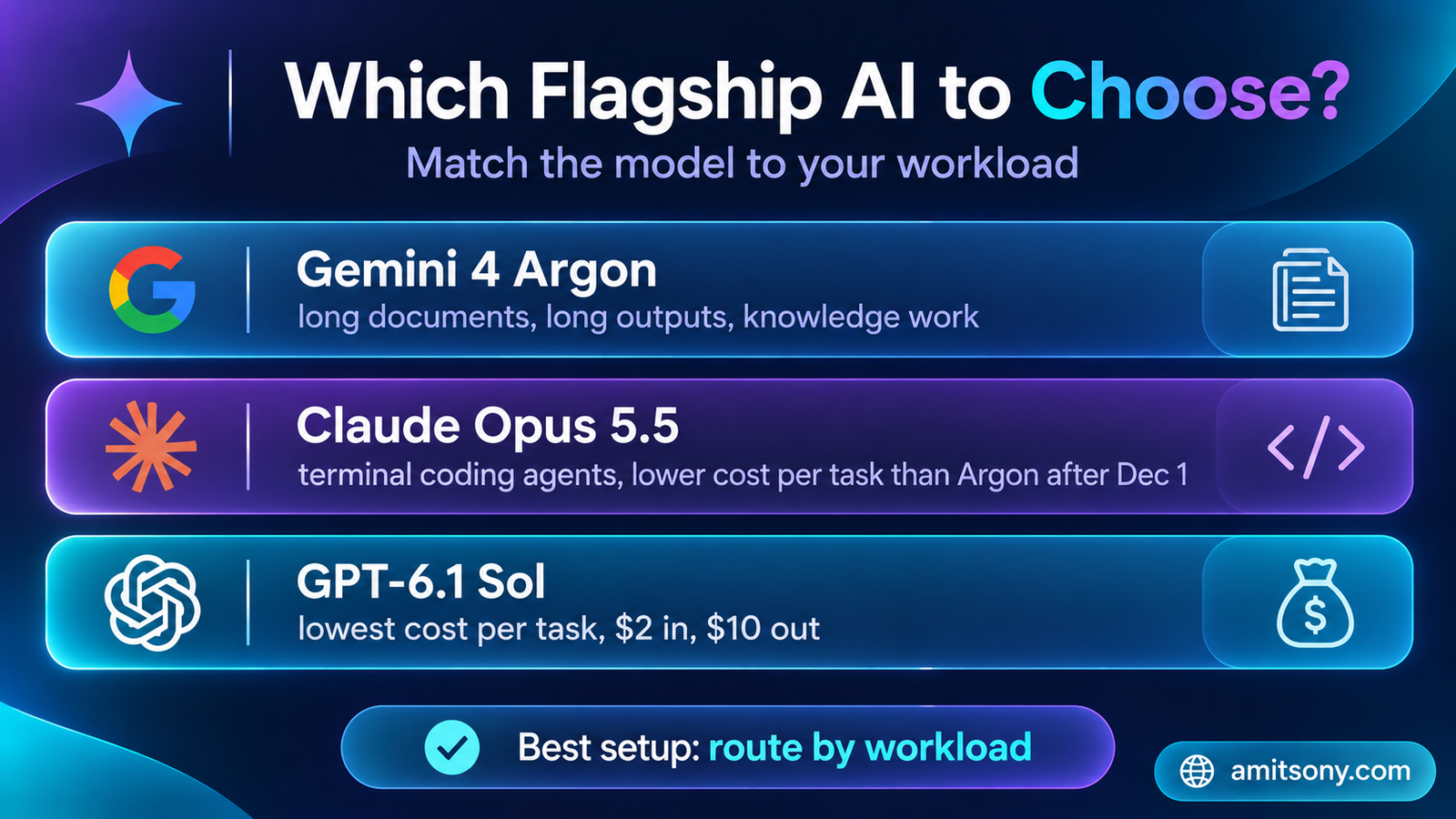
All three are close in quality, so decide by workload and price.
Pick Argon for long documents, large codebase reasoning, long outputs and knowledge work, especially while the $2 and $10 price lasts.
Pick Claude Opus 5.5 for terminal-based coding agents and tasks where the independent index leads. Its price stays at $4 and $20, and its cost per task is lower than Argon's at the December rate.
Pick GPT-6.1 Sol from OpenAI if cost per task matters most. It costs $2 and $10, scores close to Argon, and was the cheapest per index task in independent testing at about $0.72.
The sensible setup is a router. Send long-context jobs to Argon, shell-heavy coding to Opus, and routine high-volume work to whichever is cheapest after you measure it.
How should you test Gemini 4 Argon before December 1?
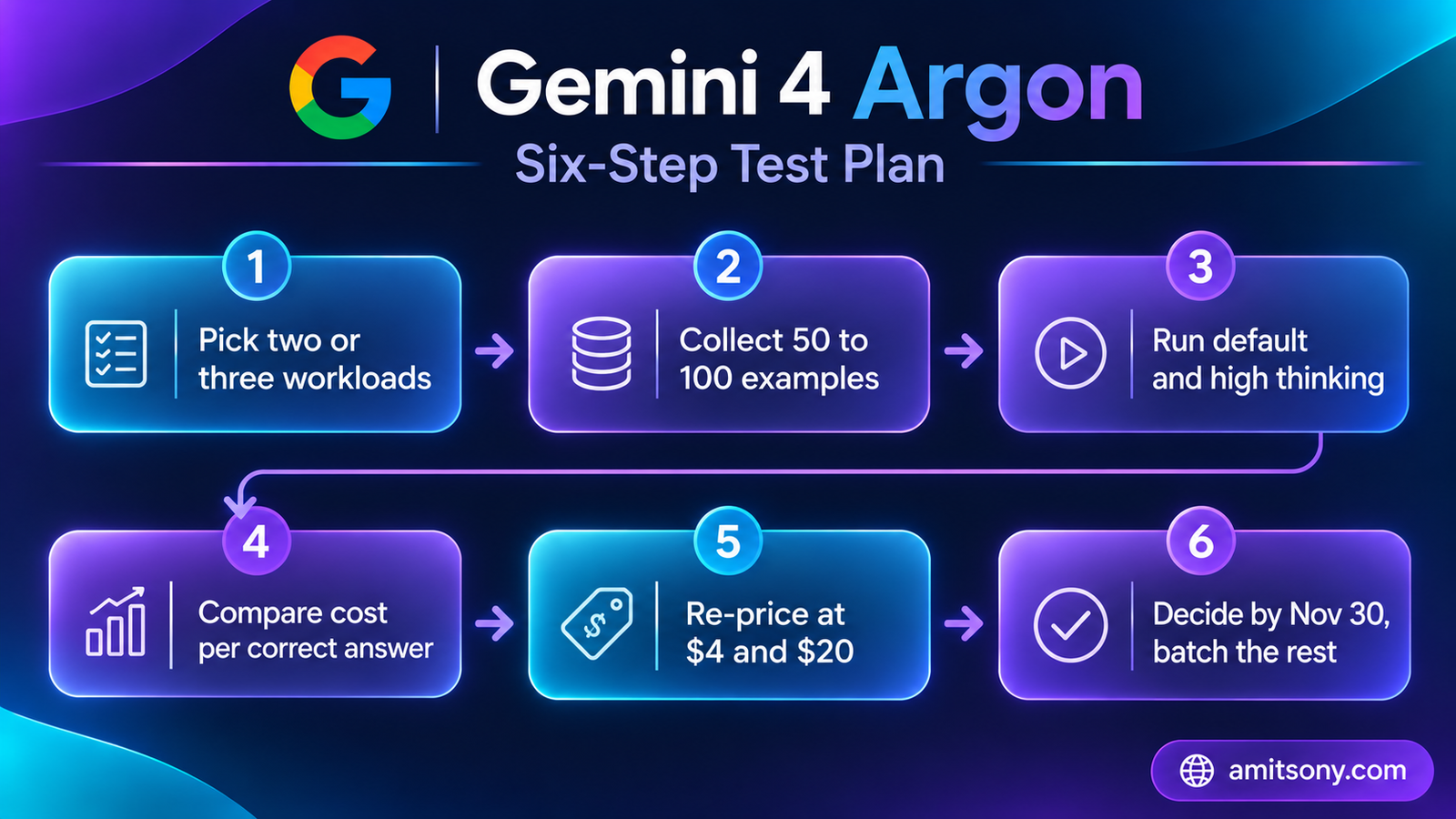
Step 1. Pick two or three real workloads, ideally one with very long inputs.
Step 2. Collect 50 to 100 real examples with a clear definition of a correct answer.
Step 3. Run them on Argon at default thinking, then at high. Run the same set on your current model.
Step 4. Record cost per correct answer, not price per million tokens. Count thinking tokens, because they bill as output.
Step 5. Re-price the result at $4 and $20, not the intro rate.
Step 6. Decide before November 30, and use batch or Flex for anything that can wait. That halves the bill.
Frequently Asked Questions
What is Gemini 4 Argon?
It is Google DeepMind's flagship Gemini 4 model, announced on September 30, 2026 and generally available since October 13, with a 1,048,576 token context window.
How much does Gemini 4 Argon cost?
$2 per million input tokens and $10 per million output tokens until November 30, 2026. From December 1 the price is $4 and $20.
Is Gemini 4 Argon better than Claude Opus 5.5?
It depends. Argon leads on long context and knowledge work, while Opus 5.5 leads on terminal coding and edges it on the independent Intelligence Index.
Is Gemini 4 Argon free?
Not on the API. It is not on the free tier, and consumers need a Google AI Pro or Ultra plan to use it in the Gemini app.
What is Gemini 4 Argon's context window?
1,048,576 tokens, shared by input, thinking and output. Default output is 65,536 tokens, and long decode can extend a reply much further.