

The best AI tools for lawyers depend on the job: CoCounsel or Lexis+ AI for research, Spellbook for contracts in Word, Clio Duo for practice management, and Harvey only for large firms. Prices run from about $20 to over $1,000 per seat per month. Verify every citation yourself, because courts are sanctioning lawyers who do not.

A lawyer's most expensive resource is time, and AI is aimed squarely at it. Research, first-pass contract review and document summaries all get faster. But few professions are punished as publicly for AI mistakes as law.
This guide sorts the tools by job, with reported prices and honest verdicts. It then covers the ethics rules and the verification routine that keep you out of the sanctions database.
What can AI tools do for lawyers, and what can they not do?
AI is useful for five jobs: legal research with citations, contract review and redlining, summarising and reviewing large document sets, drafting first versions, and handling intake and client messages.
It is not a replacement for judgement or checking. A Stanford study of legal research tools found hallucination rates of roughly 17 to 34 percent, even on products built specifically for lawyers. A general chatbot can be worse.
Treat AI as a fast junior who works at night and never admits uncertainty. You still sign the filing, so you still own every sentence in it.
Which AI tool is best for legal research?
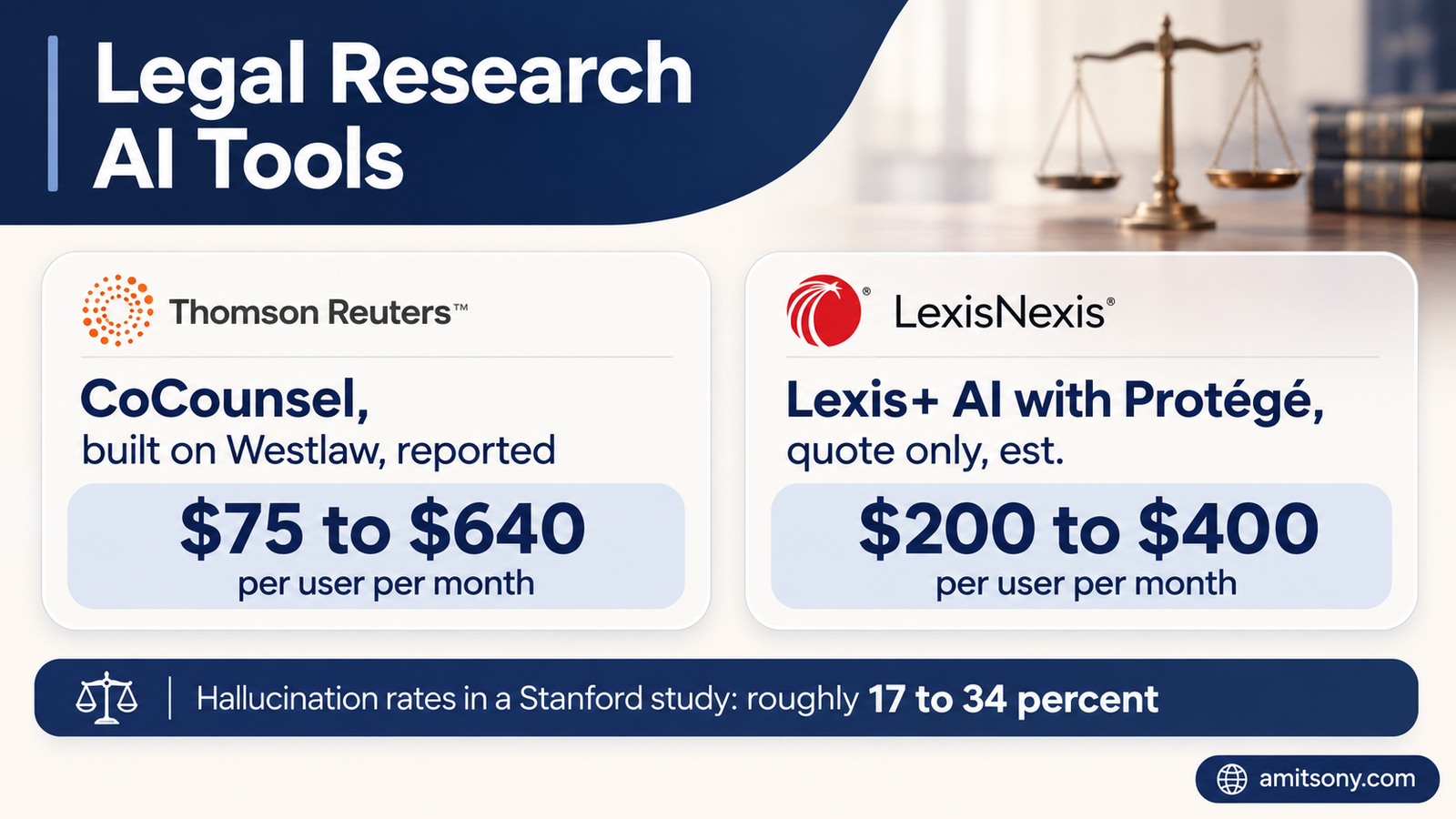
Two products dominate. CoCounsel is Thomson Reuters' assistant, built on Westlaw content. Reported pricing varies from roughly $75 to $640 per user per month, depending on the plan and bundle, and larger firms move to sales-led quotes.
Lexis+ AI is LexisNexis's rival, now delivered through its Protégé workflow platform, which replaced the first-generation Lexis+ AI in early 2026. Pricing is quote-only, and trackers estimate $200 to $400 per user per month on annual terms.
Both ground answers in a curated case-law database, which lowers the hallucination risk compared with a general chatbot. It does not remove it.
My verdict: pay for one of them only if you already subscribe to the matching research platform. Buying AI research on top of a database you do not use makes little sense.
Which AI tool is best for contract drafting and review?
Spellbook is the best-known option for transactional lawyers, mainly because it runs inside Microsoft Word. It suggests redlines, flags missing clauses and benchmarks language against market norms without leaving your document.
It no longer lists fixed prices. Reported figures range from about $99 to $350 per user per month, with team pricing negotiated. Be wary of old posts that quote around $500.
Legora is a collaborative platform for review, research and drafting. It is sales-led and annual, with reported pricing of roughly $300 to $800 per seat per month.
My verdict: for a small firm, try Spellbook first, and test it on your own template, not the vendor's demo contract. Contract tools look best on clean, standard documents and worst on messy real ones.
Is Harvey worth it, and who is it for?
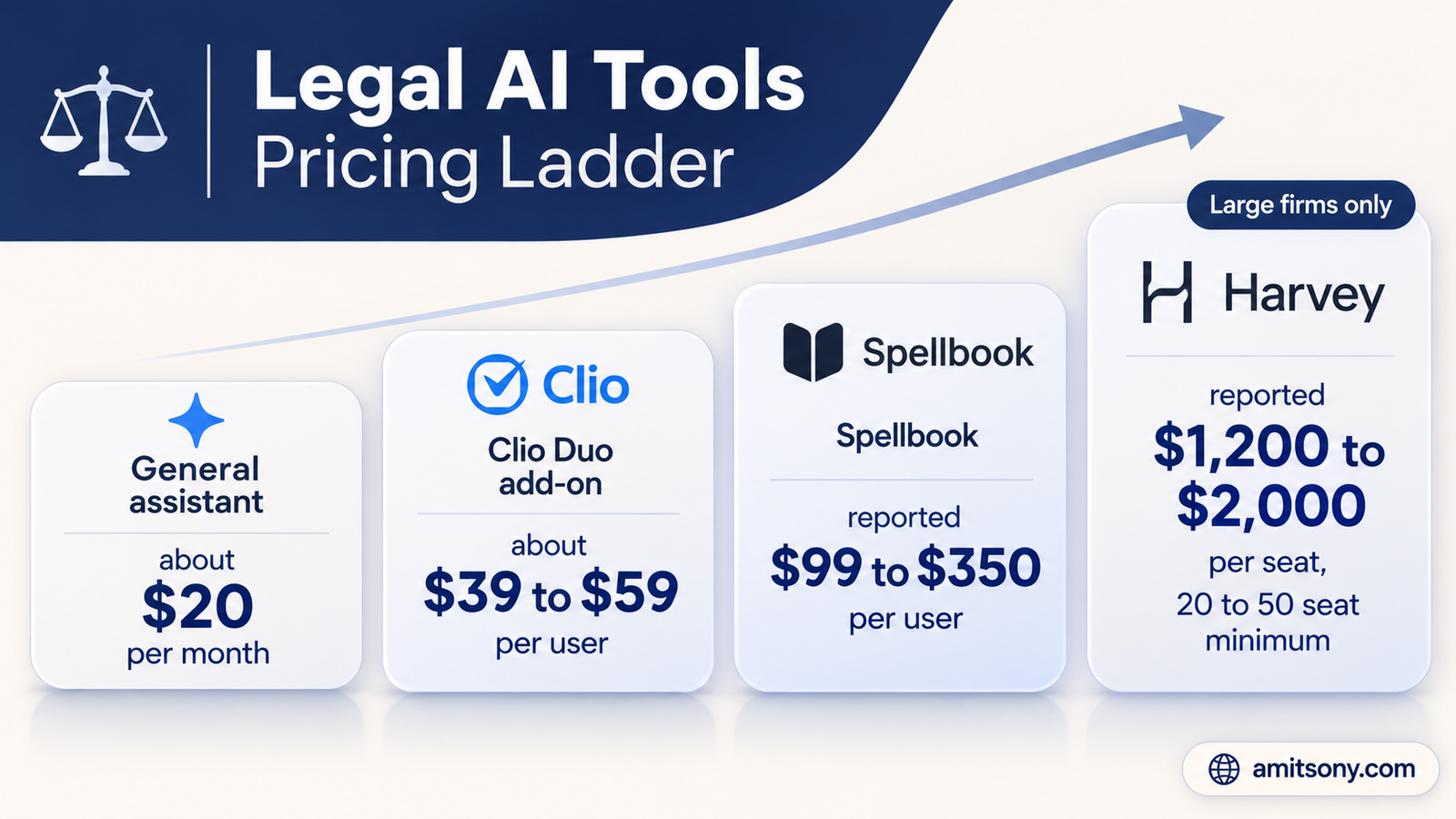
Harvey is the tool other products are measured against. It is enterprise-only and sales-led, with reported pricing around $1,200 to $2,000 per seat per month and seat minimums reported in the 20 to 50 range. That is a six-figure annual commitment.
For a large firm or corporate legal department with complex, high-volume work, that can make sense. It supports document review, drafting and workflows across big matter sets.
For everyone else, it is the wrong tool. If you have fewer than 50 lawyers, skip Harvey and spend the money on research and drafting tools that fit your practice.
What is the best AI for solo lawyers and small firms on a budget?
Start with the software you already use. Clio added AI through Clio Duo, which is reported at about $39 to $59 per user per month on top of a Clio plan. Clio also acquired vLex in 2025, which brought its Vincent legal research AI into the family. The AI sits inside your matter data, which is where most small firms lose time.
General assistants like Claude and ChatGPT cost around $20 per month, roughly ₹1,750. They are useful for non-confidential work such as drafting a client newsletter, restructuring an argument or summarising public material.
Be careful with consumer plans. Consumer tiers may use your content to improve models unless you change settings, and they come with no business confidentiality commitments. Do not paste client information into them. Move to a business plan with the right data terms before you do.
For intake, Smith.ai offers a free AI plan for 25 calls a month, so a solo lawyer can test after-hours call answering at no cost.
What do the ethics rules say about lawyers using AI?
This is general information, not legal advice, and state rules differ. Check your own bar.
ABA Formal Opinion 512, issued on July 29, 2024, is the main guide. It says existing duties of competence, confidentiality, communication, supervision and reasonable fees apply to generative AI. The ABA added further guidance for law firms in January 2026.
On confidentiality, some commentary says informed client consent is needed before client information goes into a self-learning AI tool, and that boilerplate engagement-letter language is not enough. On fees, you can bill for time actually spent prompting and reviewing, but not for time the tool saved.
Courts are less forgiving than bar regulators. A public database run by researcher Damien Charlotin lists around 2,180 decisions worldwide involving AI-hallucinated content as of October 2026. Of those, 864 are cases where the court identified a lawyer as the party using AI. The count includes warnings as well as sanctions.
Penalties are real. In March 2026 the Sixth Circuit ordered two lawyers to pay $15,000 each plus the other side's appellate fees over fake citations. In an Oregon case, sanctions and fee awards reached about $110,000 over 15 nonexistent cases and 8 fabricated quotations. No lawyer was sanctioned simply for using AI. They were sanctioned for not checking it.
How do you verify AI legal research step by step?
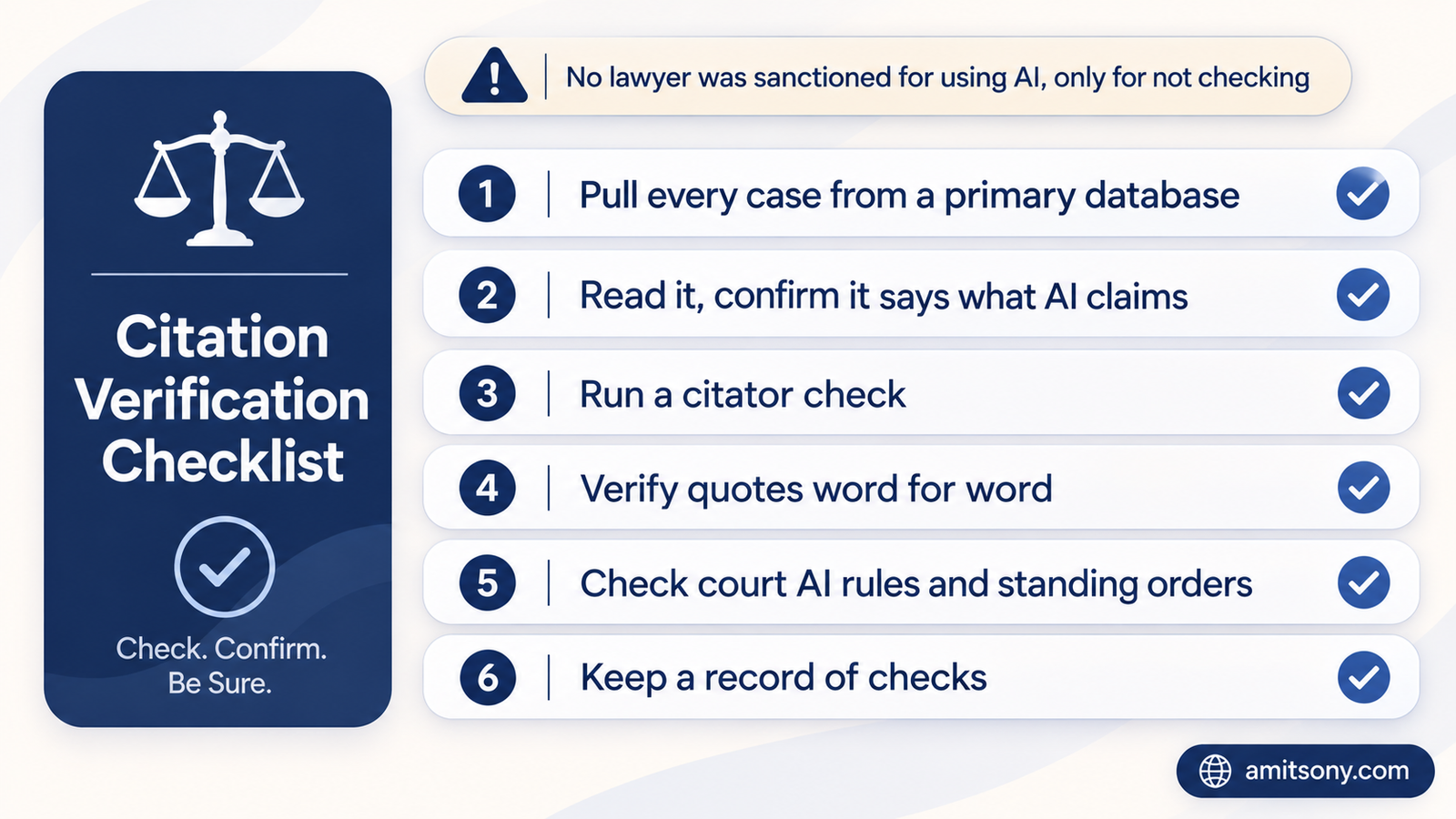
Step 1. Pull every case the AI cites from a primary database such as Westlaw or Lexis. If you cannot find it, it does not exist.
Step 2. Read the case. Confirm it actually says what the AI claims, in the right jurisdiction and for the right rule.
Step 3. Check that the case is still good law by running a citator check.
Step 4. Verify every quotation word for word, and every statute and regulation reference.
Step 5. Look for standing orders or local rules on AI disclosure in your court, and follow them.
Step 6. Keep a short record of what you checked and when. If anyone ever asks, you can show your work.
How should a law firm roll out AI safely?
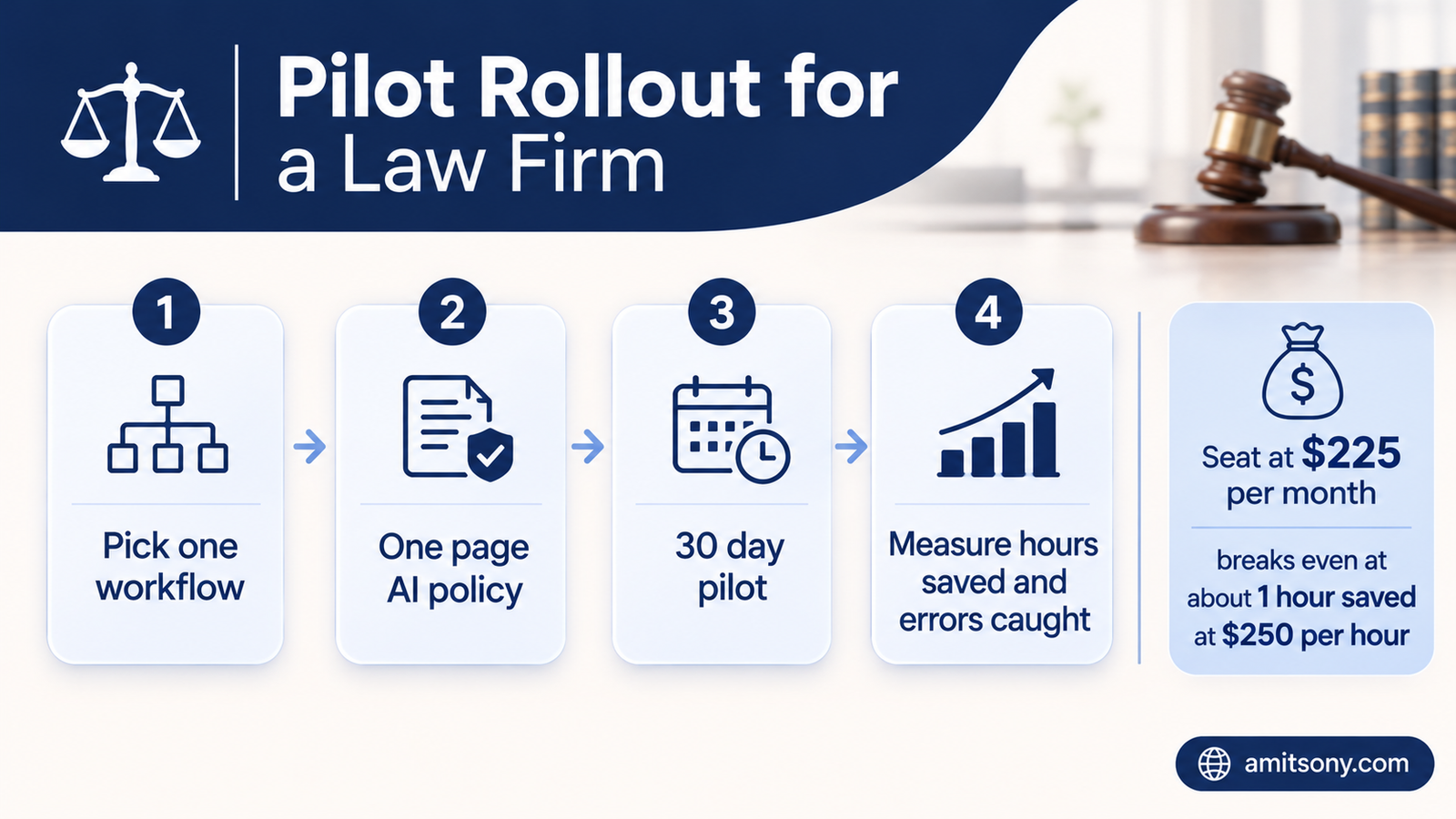
Pick one workflow, not ten. First-pass contract review, document summaries and internal drafting are good pilots because a mistake does not reach a client or a court before a lawyer reviews it.
Write a one-page policy. List the approved tools, ban client data in consumer chatbots, require citation checks and say how AI time is billed. Vendors should confirm in writing that they do not train on your data, how long they retain it and what security audits they hold.
Run a 30 day pilot with a few lawyers and measure two things: hours saved and errors caught. Then decide.
A quick break-even sum helps. Say a research seat costs $225 per user per month, so five lawyers cost $13,500 per year, around ₹11.9 lakh. If your billing rate is $250 per hour, a seat pays for itself if it saves roughly one hour a month. Under hourly billing, saved time shows up as capacity rather than extra revenue, so the case is stronger for flat-fee work. These numbers are illustrative.
Frequently Asked Questions
What are the best AI tools for lawyers in 2026?
CoCounsel and Lexis+ AI for research, Spellbook for contracts in Word, Clio Duo for practice management and Harvey for large firms.
Can lawyers use ChatGPT or Claude for client work?
Only with care. Consumer plans lack business confidentiality terms, so keep client data out and use a business plan with proper data terms.
Do lawyers have to disclose AI use to clients?
It depends on your state and the situation. ABA Opinion 512 points to informed consent when client information goes into a self-learning tool, so check your bar's rules.
Can lawyers bill for AI-assisted work?
Yes, for the time actually spent. You cannot bill for time the AI saved as if you had done the work manually.
How much does Harvey cost?
It does not publish prices. Reports put it around $1,200 to $2,000 per seat per month, with seat minimums of 20 to 50.