
AI content labeling means marking AI-made media so people can recognise it. C2PA adds signed metadata, SynthID hides a watermark in the content, and platforms add visible labels. Since August 2, 2026, the EU requires deepfake disclosure, and YouTube, Meta and TikTok expect creators to label realistic AI content.
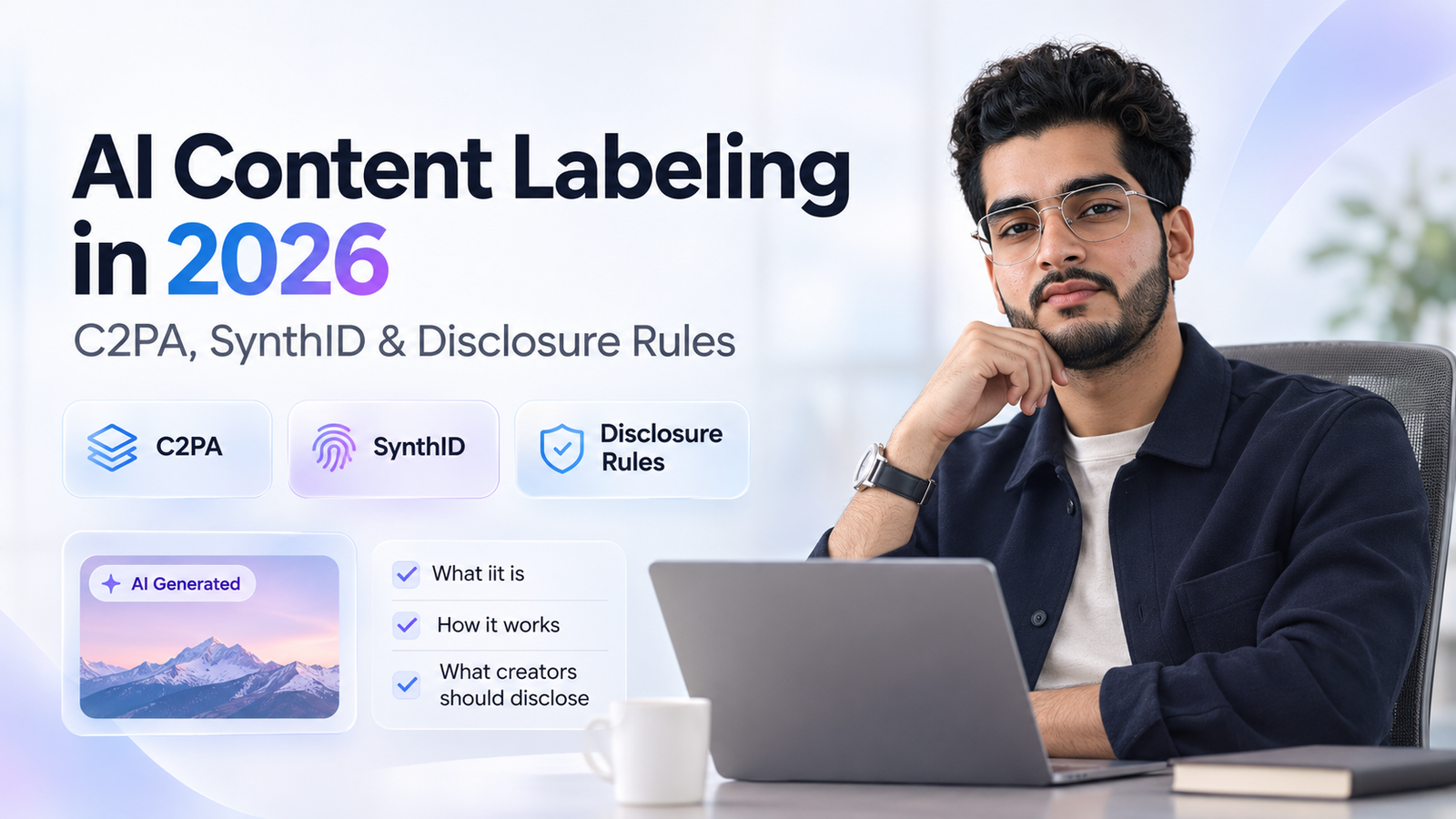
A year ago, labelling AI content was good manners. Since August 2026, in a growing number of places, it is the law.
The trouble is that three different things are called labelling: visible tags, signed metadata and invisible watermarks. This guide explains each one, what the rules require, and what you, as a creator, actually have to do.
What is AI content labeling, and why does it matter in 2026?
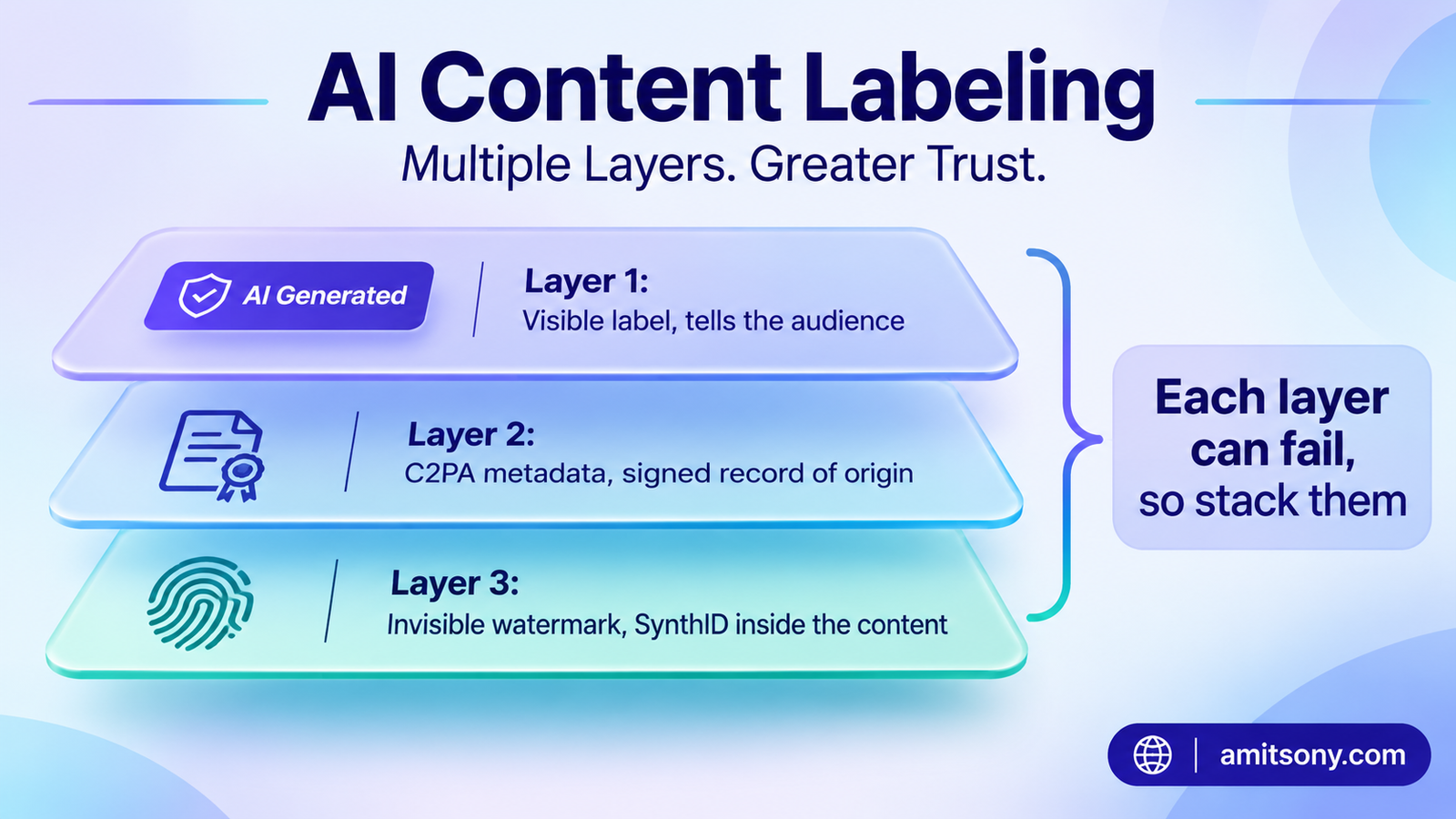
AI content labeling works in three layers. A visible label tells the audience in plain words that something is AI-generated. Metadata records where a file came from. An invisible watermark hides a signal inside the pixels, audio or text itself.
No single layer is enough. A visible label can be cropped out. Metadata can be stripped. A watermark can be damaged or missing. Good practice stacks them.
It matters now because regulators and platforms have moved at the same time. The EU, California, India, China and South Korea all have labelling rules in force or phasing in, and the major social platforms ask creators to flag realistic AI content. Ignoring the topic is no longer a safe option.
What is C2PA, and how do Content Credentials work?
C2PA is an open standard for content provenance. It attaches a cryptographically signed record, called a manifest, to a file. The record shows who made it, which tool was used and what edits followed. The public name for it is Content Credentials.
Support has grown fast. Google's Pixel 10 was the first phone to add Content Credentials to photos in its native camera app, and Gemini can read them. By October 2026, version 2.3 of the standard covers live video and text as well.
You can check any file with the Content Credentials Verifyverify tool, which shows the history if credentials are present.
Know the limits. Screenshots, re-encoding and many social platforms strip metadata. A missing credential proves nothing, and a present one proves where a file came from, not that its content is true.
What is SynthID, and how is it different from C2PA?
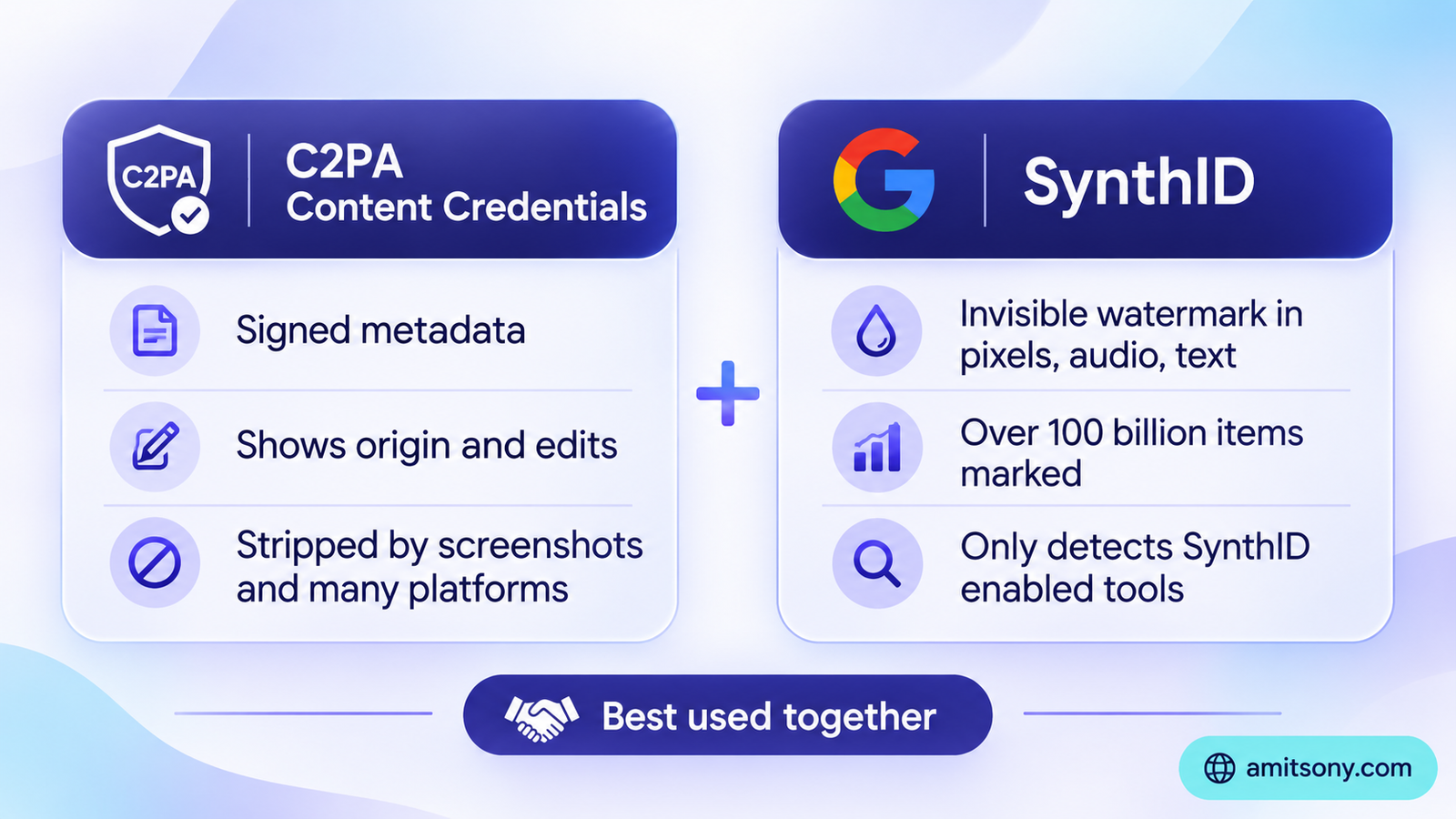
SynthID is Google's invisible watermark. It adjusts pixel values in images, adds inaudible patterns to audio and biases token choices in text, so the mark lives in the content itself. That helps it survive some screenshots and edits that kill metadata.
Google says it has marked more than 100 billion items. OpenAI's images now carry it too, and ElevenLabs and Kakao have been named as partners. In August 2026 Google also added a setting that lets users turn off the visible sparkle on Gemini creations while the invisible watermark and C2PA data stay.
To check a file, upload it to Gemini and ask whether it was made with AI, or use Google's SynthID Detector portal. Google says Gemini's SynthID check has been used 50 million times.
The catch is coverage. SynthID only detects content from systems that use it. No watermark does not mean no AI, and no watermark is safe against a determined attacker.
What do the EU, US, India and China require in 2026?
This is general information, not legal advice, and details change.
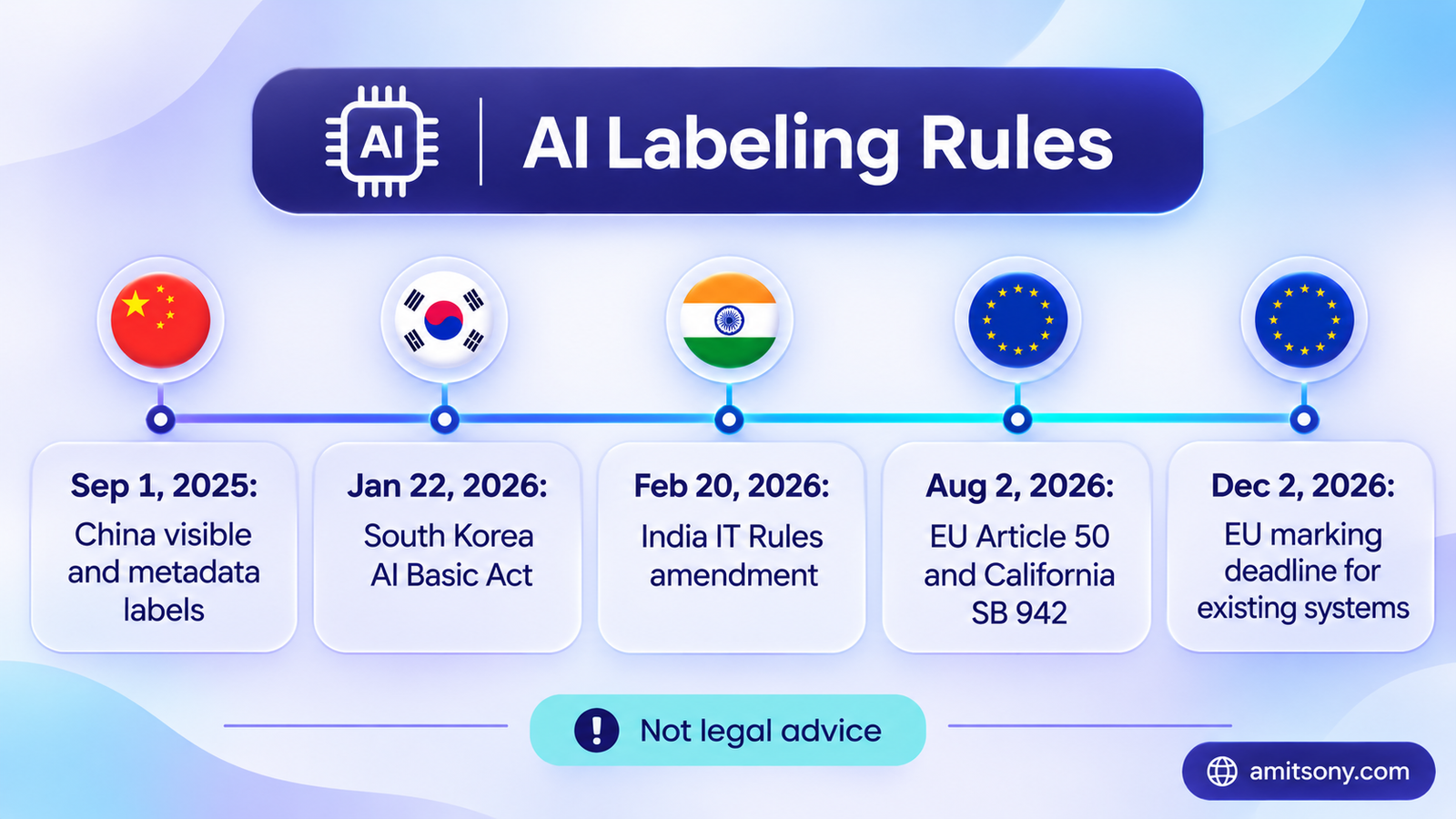
EU. Article 50 of the AI Act applies from August 2, 2026. Providers must mark generative output in a machine-readable form. Deployers must disclose deepfakes and AI-generated text published to inform the public on matters of public interest, with exceptions for content that has human editorial review. Systems already on the market before August 2 have until December 2, 2026 to add machine-readable marking. The Commission has also backed a Code of Practice and an EU AI icon.
California. SB 942, as amended by AB 853, became operative on August 2, 2026. It binds generative AI providers with more than one million monthly users, covers image, video and audio but not text, and carries fines of $5,000 per violation per day. Individual creators posting ordinary AI illustrations do not carry that duty.
India. The IT Rules amendment on synthetically generated information has been in force since February 20, 2026. It makes platforms label AI content and carry traceable metadata where feasible, with a three-hour takedown window for most harmful deepfakes.
China has required visible and metadata labels since September 1, 2025. South Korea's AI Basic Act took effect on January 22, 2026, with penalties expected later. New York's law on AI-generated fake human performers in ads took effect in June 2026.
What must creators disclose on YouTube, Instagram and TikTok?
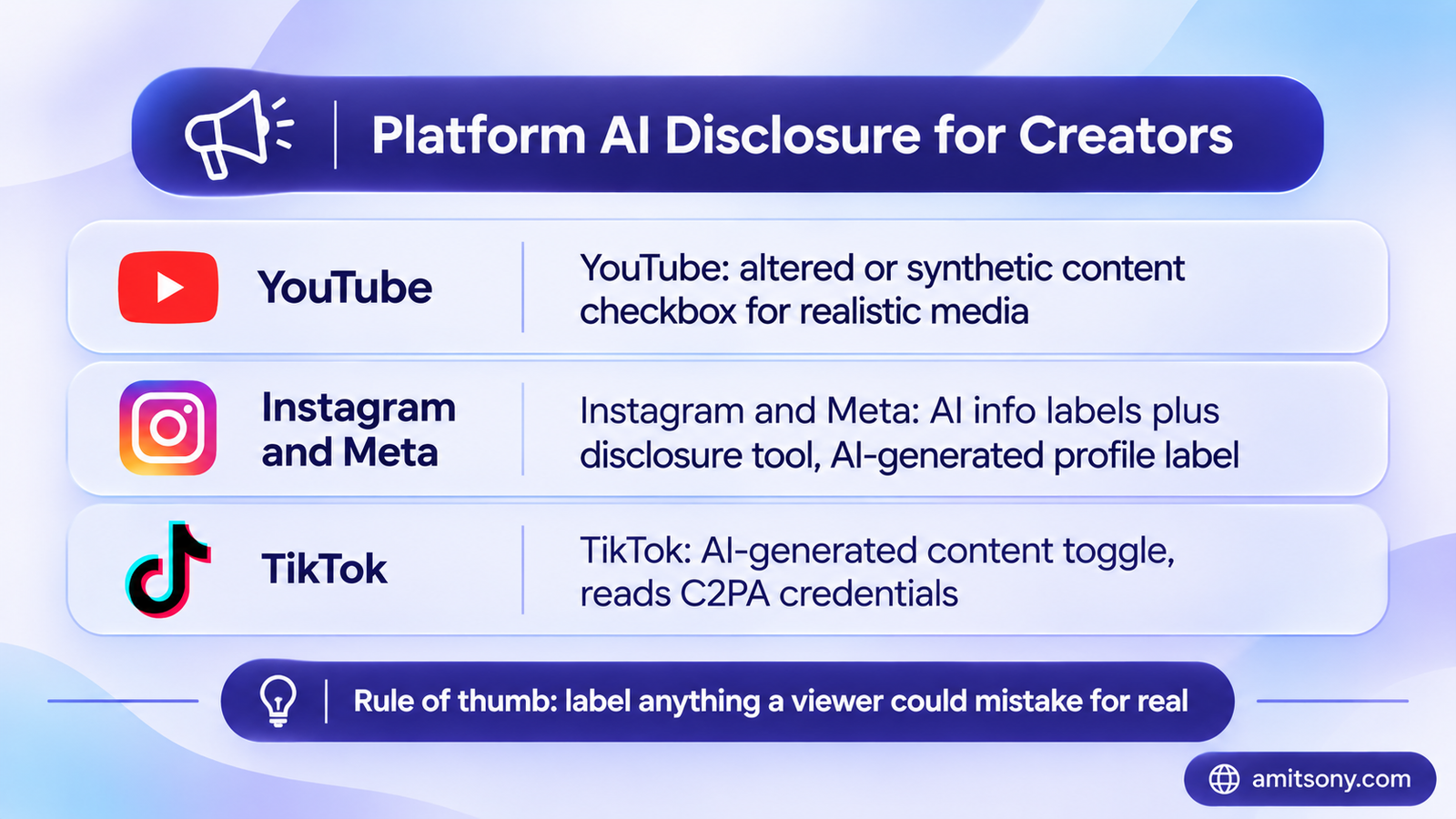
The rule of thumb across platforms is the same: label realistic content that a viewer could mistake for real.
YouTube asks you to tick the altered or synthetic content box when a video contains realistic AI-generated or AI-altered material. Clearly unrealistic content, such as obvious animation, is exempt, and so are AI-assisted scripts and captions. Using a synthetic voice to narrate a video still needs a label. Repeated failure to disclose can lead to labels added by YouTube, removal or loss of Partner Program access.
Instagram and the rest of Meta add automatic AI info labels and also ask creators to use the disclosure tool for photorealistic video and realistic audio. On August 31, 2026, Instagram renamed its AI creator label to AI-generated profile, to make it clearer when an account features an AI-generated person.
TikTok gives creators an AI-generated content toggle and scans uploads for C2PA credentials, which can trigger a label automatically. On a sponsored post, use the AI toggle and the commercial content toggle together.
An automated label is not a substitute for your own disclosure. A creator can disclose correctly and still get an automatic label, and a toggle does not make a misleading claim acceptable.
When do you not need to label AI content?
Not everything touched by AI needs a tag.
Brainstorming, outlines, grammar fixes, translation help and AI-assisted scripts are exempt on the major platforms. So is clearly stylised or unrealistic work, like a cartoon, an obvious fantasy scene or a clear illustration.
The EU softens the duty for evidently artistic, creative or satirical works, where disclosure should not spoil the work. California's law puts its duties on large AI providers, not on people who post a generated illustration.
The practical test is simple. Could a reasonable viewer mistake this for real footage, a real person or real audio? If yes, label it. If you are unsure, label it, because the cost of a label is tiny and the cost of being caught without one is not.
Sponsored posts have their own rules. A paid relationship needs a clear ad disclosure whether a human or an AI made the content, and every claim must still be truthful.
How do you label AI content properly, step by step?
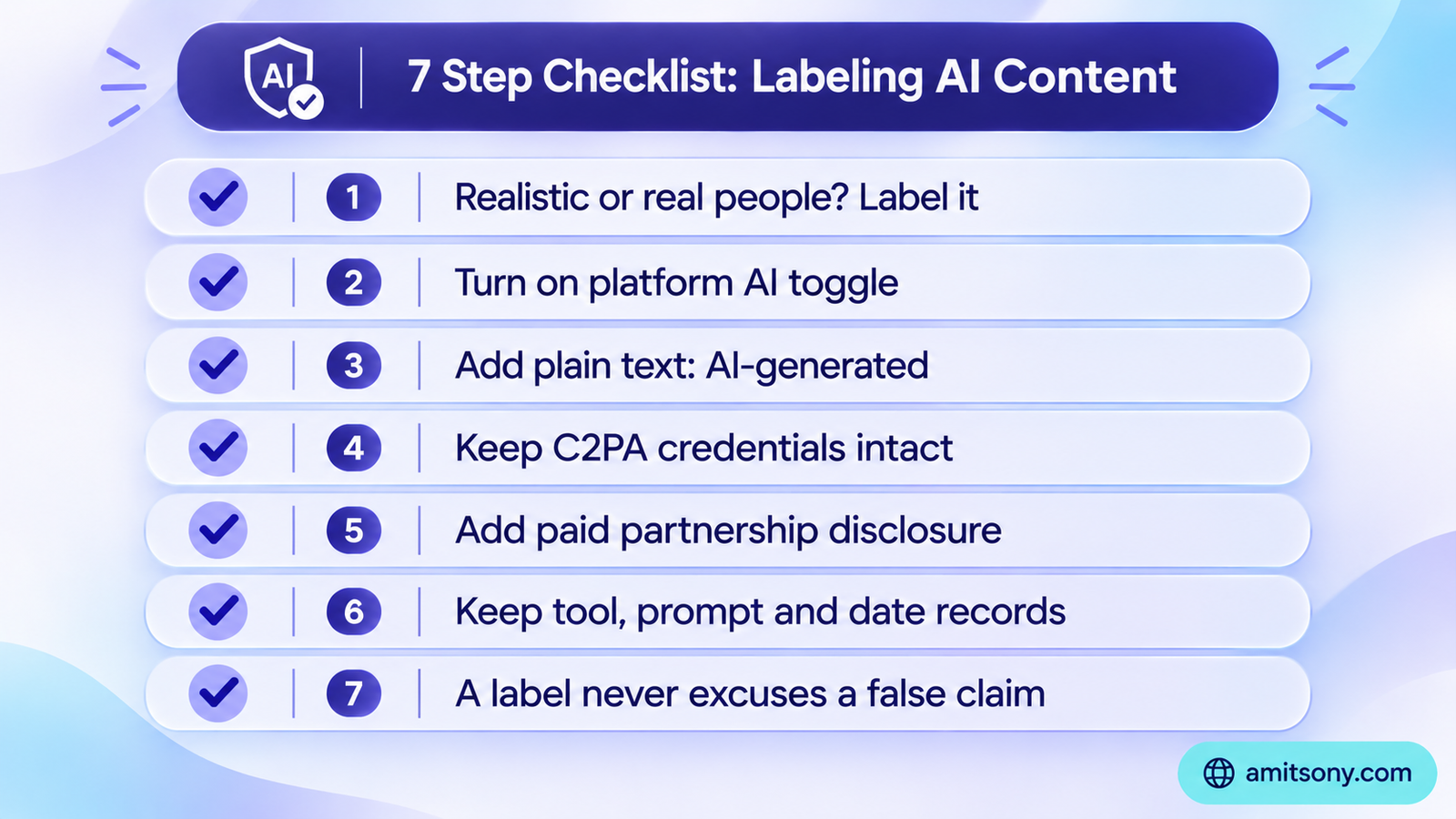
Step 1. Decide whether the content is realistic or shows real people, voices or places. If it is, it needs a label.
Step 2. Turn on the platform's AI toggle at upload.
Step 3. Add plain text to the post, such as "AI-generated" or "Made with AI". EU guidance suggests pairing any icon with text, because a sparkle alone is not enough, and the label should survive resharing.
Step 4. Keep Content Credentials intact. Export from tools that support C2PA, and avoid editing steps that strip metadata.
Step 5. For sponsored posts, add the paid partnership disclosure as well.
Step 6. Keep records of the tool, prompt, date and source files. If a platform or client questions the post, you can show how it was made.
Step 7. Never use a label to excuse a misleading claim. A disclosure does not fix a false statement.
Can you rely on C2PA and SynthID to detect AI content?
No. Treat both as signals, not proof.
A file with no credentials and no watermark could be human-made, AI-made by a tool that does not mark its output, or AI-made and stripped. A file with valid credentials tells you where it came from, not whether what it shows is true.
Watermarks help most when they are robust, and researchers keep finding that no scheme is secure against a dedicated attacker. Independent tests of open watermarking methods have also found that some detectors fire on a noticeable share of unmarked images, so verifiers need care.
For brands and newsrooms, the sensible approach is layered: sign your own content with C2PA, keep records, label visibly and treat detection results as one input among several.
Frequently Asked Questions
What is AI content labeling?
It means marking AI-generated or AI-altered media with visible labels, metadata or watermarks so audiences can recognise it.
What is the difference between C2PA and SynthID?
C2PA attaches signed metadata describing a file's origin. SynthID hides a watermark inside the content itself. Metadata is easy to strip, and a watermark only works for tools that use it.
Is AI content labeling mandatory?
In many places, yes. The EU's Article 50 applies from August 2, 2026, India's IT Rules amendment has applied since February 20, 2026, and platforms like YouTube, Meta and TikTok require creators to flag realistic AI content.
Do I have to label AI-written text?
Usually not for everyday use. The EU requires disclosure for AI-generated text published to inform the public on public-interest matters, with exceptions for human editorial review.
Can detectors prove a file is AI-generated?
No. Missing watermarks or credentials prove nothing, and detection is only as good as the tool that marked the file.