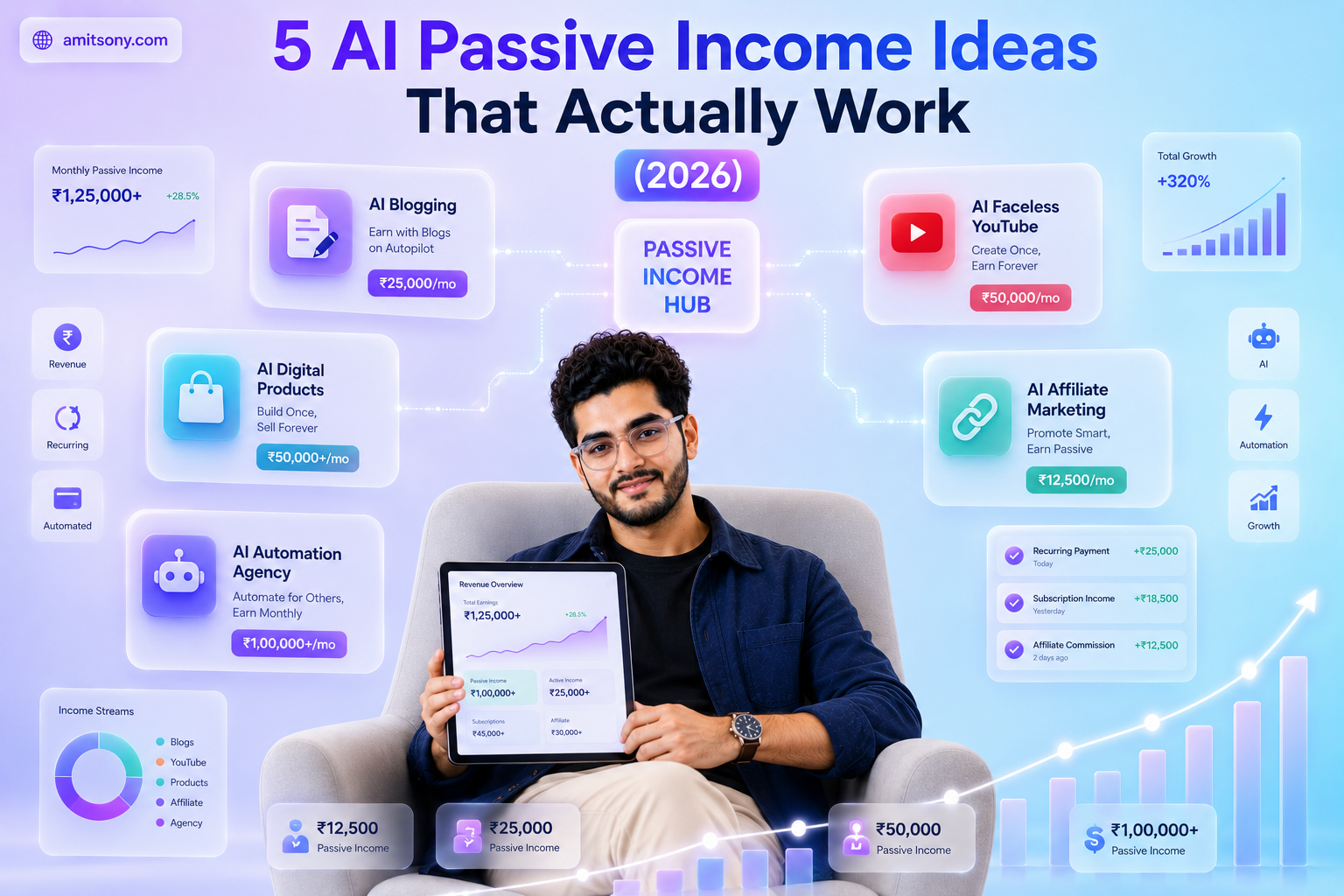

The best AI tools for passive income in 2026 are SEO writing platforms like Jasper for affiliate content, Canva Pro for digital products, ElevenLabs for faceless video, and Beehiiv for newsletter monetization. None of these generate income on their own. They compress months of setup work into weeks, with most realistic income showing up after two to six months of consistent effort.

Here's the sentence most articles on this topic won't say out loud: AI tools don't generate passive income. They generate leverage. The income still comes from an asset you build, an audience you earn, and a system you keep running after launch day.
That distinction matters because the gap between people who succeed with AI passive income and people who quietly give up after month two almost never comes down to which tool they picked. It comes down to whether they built one focused system or scattered their effort across five half-finished ideas. This guide walks through the tools that genuinely compress the build phase in 2026, organized by what they're actually good for, along with the honest timelines and income ranges creators are reporting right now.
What does AI passive income actually mean in 2026?
True passive income, meaning zero ongoing effort, doesn't really exist. What exists is high-leverage income, where you put in real, often substantial effort upfront, then earn on a much lighter maintenance schedule afterward.
AI's actual contribution is timeline compression. Building a profitable niche blog used to take three to five years of consistent writing, learning SEO, and slowly earning search trust. AI tools now compress that same build into twelve to eighteen months for someone willing to put in focused work.
This compression happens because AI tools fall into three useful categories, and the strongest passive income builds combine more than one. Creation accelerators cut the time from idea to finished, sellable asset. Distribution amplifiers help existing content keep earning without ongoing manual maintenance. Research engines give your content the depth and accuracy that actually earns trust, since thin AI-generated content rarely holds up over months.
The honest failure pattern worth naming upfront: most people who start an AI passive income project don't make it past month three, and that's rarely the tool's fault. It's almost always a missing system. Publishing content with no clear monetization path, jumping between five niches before any of them gain traction, or expecting income before search engines or audiences have had time to build trust are the three patterns that kill momentum fastest.
Which AI tools work best for affiliate content and SEO income?
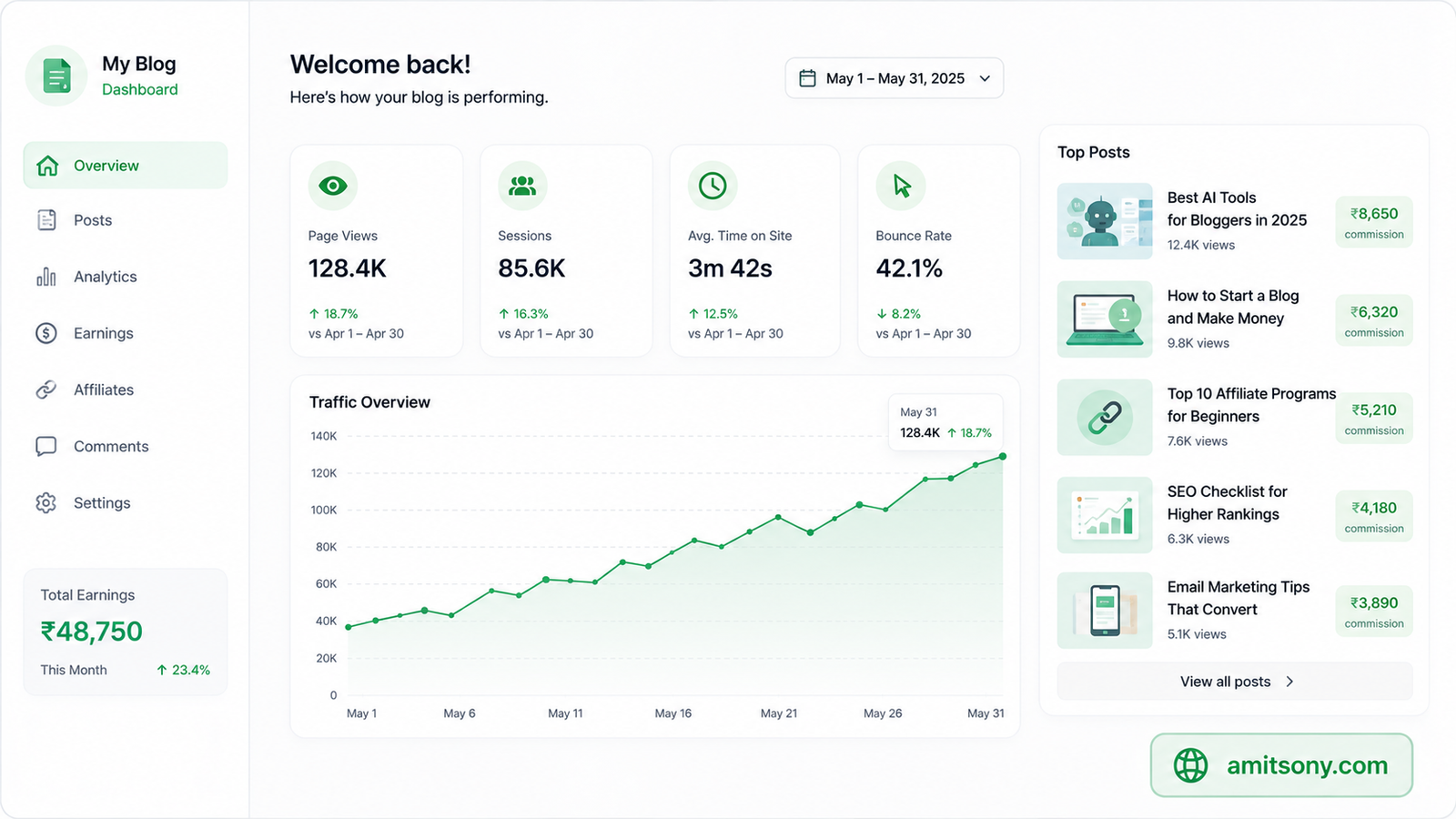
Affiliate content remains one of the clearest passive income models because the effort is front-loaded. You write and optimize a piece once, and it can earn commissions for years with minimal upkeep, provided it actually ranks and actually helps the reader.
Jasper is built specifically for this kind of content at scale, handling blog posts, product comparisons, and email sequences while maintaining a consistent brand voice across everything it produces. Pricing runs $49 a month on the Creator plan, climbing to $69 a month on Pro. A well-optimized affiliate blog publishing 20 or more articles a month with Jasper's help has realistically generated $2,000 to $8,000 a month within twelve months for established creators.
Rankpilot approaches the same problem from a different angle, consolidating keyword research, content structure, and on-page optimization into a single workflow rather than requiring separate tools for each step. Creators using this kind of consolidated pipeline report monthly earnings in the $500 to $5,000 range, with established creators clustering closer to $2,000 a month.
There's a hard truth that belongs in this section and rarely makes it into other guides. Google's AI Overviews now appear on roughly 48% of all search queries, and affiliate sites broadly saw measurable ranking declines following a March 2026 core update, with some reports citing 71% of affiliate sites affected. This doesn't mean affiliate content is dead. It means thin, generic AI output is dying faster than ever, while genuinely useful, well-edited, original content is becoming more valuable specifically because there's less of it.
Budget real human editing time into this model, not as an afterthought. Fifteen to twenty minutes of editing per piece, minimum, is what separates content that ranks from content that gets quietly buried.
What's the best AI tool for selling digital products?

Digital products carry the highest margins of any passive income model on this list, since there's no inventory, no shipping, and no per-unit cost once the product exists.
Canva Pro has quietly become the dominant tool here, and not for the reason people expect. Its Magic Design and AI-assisted background generation features turn one person into a functioning one-person design operation for the kind of polished PDF guides, prompt packs, and templates that actually sell on platforms like Gumroad. Pricing sits around $15 a month.
One creator's first serious Gumroad product, a prompt pack for freelancers, was built entirely inside Canva Pro across roughly four hours spread over two evenings. That product has earned money in every single month since launch, including months where the creator did zero promotional work.
The honest caveat worth including here: Canva's AI design features are impressive in range but occasionally frustrating in precision. Expect to manually adjust spacing, fonts, or layout details the AI gets close to right but not quite exact. This isn't a dealbreaker, just a realistic expectation.
For creators wanting to go beyond static PDFs, Midjourney paired with Printful opens up print-on-demand, where AI-generated designs get applied to physical products with zero inventory risk. A startup cost of roughly $60 to $90 a month, covering Midjourney, Printful, and a Shopify storefront, typically produces a first sale within two to eight weeks.
How do AI tools help with faceless YouTube and video income?
Faceless video content has become one of the most realistic entry points for people who have ideas but don't want to appear on camera, and the tooling here matured significantly through 2025 and into 2026.
ElevenLabs solves the single biggest barrier in this model: voiceover quality. Its AI-generated narration has crossed a real threshold where most viewers genuinely can't distinguish it from a professional voice actor, which removes the need to record, re-record, or hire someone for every script.
Worth being direct about something most guides gloss over: a faceless YouTube channel is not actually passive income. It's a content business that happens to use AI tools instead of a camera. Scripting, editing, thumbnail testing, and retention optimization are all genuinely ongoing work, even after the production barrier drops.
Where this model becomes high-leverage rather than purely active is in the compounding nature of the catalog. A video published today can keep earning ad revenue and driving affiliate clicks for years, which is the real passive element, even though new uploads still require real effort.
Pair ElevenLabs with a solid script workflow using ChatGPT or Claude for drafting, and you have a genuine content machine rather than a one-off video. The realistic income ceiling here scales with niche and consistency, the same way it does for blogging, typically landing in the $3,000 to $15,000 a month range for channels with six or more months of consistent output behind them.
Which AI tool is best for newsletter monetization?
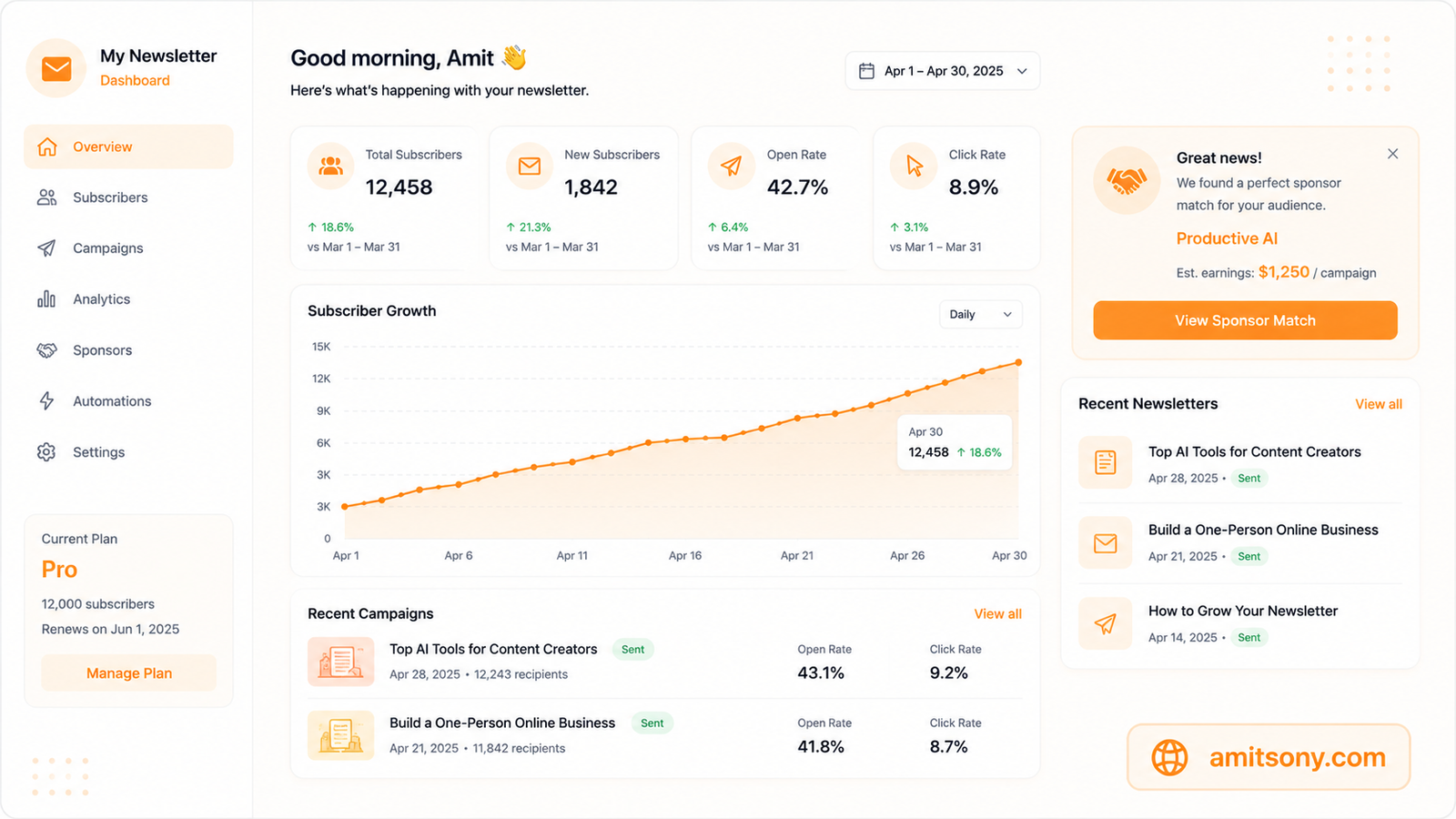
Newsletters occupy an interesting middle ground in 2026, since the audience-building work is genuinely active, but the monetization layer on top can run with minimal daily input.
Beehiiv combines AI writing assistance, audience growth tools, and a built-in ad network that automatically matches your list with relevant sponsors. The free plan covers basic use, with the Grow plan at $49 a month and Scale at $99 a month unlocking more advanced monetization and automation features.
The numbers here are genuinely encouraging at moderate scale. A newsletter with 5,000 subscribers on Beehiiv's ad network can realistically earn $500 to $1,500 a month from automated sponsor placements alone, based on typical CPM rates in finance and tech niches specifically. One creator in the personal finance space reported roughly $3,800 a month at 12,000 subscribers, combining ad revenue with paid subscriptions.
The honest framing that matters: building the subscriber list is the real work, and it's not passive in any sense. What becomes passive is the sponsor matching and ad placement process once you've reached a list size that attracts advertiser interest, generally somewhere past the 1,000 to 2,000 subscriber mark.
What about AI-powered niche websites and affiliate sites?
Niche affiliate sites remain one of the lowest-barrier entry points into AI passive income, particularly for beginners who want to test an idea before committing serious time or money.
Hostinger AI lets you spin up a focused affiliate or local business site without touching code, with plans starting around $2.99 a month on longer commitment terms. The model is straightforward: build a site around long-tail keywords in one specific niche, fill it with genuinely helpful content, and monetize through affiliate links and display ads.
A single well-targeted niche site has realistically generated $300 to $1,500 a month in affiliate revenue within eight to twelve months of consistent publishing. Some operators run portfolios of five to ten sites simultaneously, reaching combined estimated income in the $3,000 to $10,000 a month range, though this requires significantly more upfront content production across multiple properties.
The starting move that actually works here is testing before scaling. Build the minimum viable version of the site, publish a focused batch of content, and measure whether the niche shows real traffic potential before investing more time or money. This single habit separates people who end up with a working asset from people who spend months building something nobody searches for.
How honest are the income numbers in this space, really?
This question deserves its own section because most guides either inflate the numbers or skip this conversation entirely.
The income figures throughout this article are based on self-reported creator data and publicly shared case studies. They are genuinely achievable, but they are not guaranteed, and they assume consistent effort over the full breakeven period, not three weeks of enthusiasm followed by silence.
The realistic pattern almost everyone experiences looks like a hockey stick, not a straight line. A content library earning $2,000 a month by month twelve likely looked closer to $200 a month by month two. The early numbers are not the final numbers, and the growth comes from consistent output compounding over time, not from a lucky break.
The single biggest predictor of who succeeds isn't which tool they chose. It's whether they got one method to a meaningful income floor, often cited as around $500 a month, before adding a second method on top. Stacking three half-built systems rarely outperforms one fully working one.
If there's one thing worth taking from the more honest corners of this space, it's this: treat the first two to six months as the active building phase, expect it to feel like real work because it is, and judge the tools by whether they reduce that timeline, not by whether they eliminate the work entirely.
Frequently Asked Questions
Is AI passive income actually passive, or is that misleading marketing?
It's high-leverage income rather than truly passive income. Real upfront effort is required to build the asset, and ongoing maintenance is genuinely lighter afterward, but it never reaches zero effort.
How much money do I need to start with AI passive income tools?
Most models in this guide can start for under $100 a month in tool costs, and several, like niche affiliate sites or digital products, can begin with under $20 a month using entry-level plans.
How long before I see real income from an AI passive income project?
Most realistic timelines run two to six months before income becomes meaningful, with the majority of growth happening after month three rather than in the first few weeks.
Is affiliate content still worth doing with AI Overviews taking over search results?
Yes, but the bar for quality has risen. Thin, generic AI content is losing visibility, while well-edited, genuinely useful content with real human input continues to perform.
Which AI passive income method has the lowest startup cost?
Niche affiliate websites built on platforms like Hostinger AI have the lowest entry cost, often starting under $5 a month, though they still require real content effort to generate traffic.
Can I combine multiple AI passive income methods at once?
It's possible but not recommended early on. Getting one method to a stable income floor before adding a second consistently outperforms running several half-built systems simultaneously.