
An AI automation agency builds and sells AI-powered workflows to businesses — replacing manual, repetitive tasks with intelligent systems. In 2026, you can launch with $2,000–$5,000, pick one niche, learn a tool like Make.com or n8n, land your first client, and scale to $10,000+/month within 6–12 months.
The market timing has never been better. Over 80% of businesses now use AI in some form — but the vast majority haven't figured out how to actually automate their operations. That gap is your business.
An AI automation agency steps in exactly there. You identify the workflows draining time and money from a business, build systems that handle those tasks automatically, and charge a recurring monthly retainer to maintain them. No product inventory. No massive team. Just leverage — and the right knowledge.
What exactly is an AI automation agency and why does the model work?
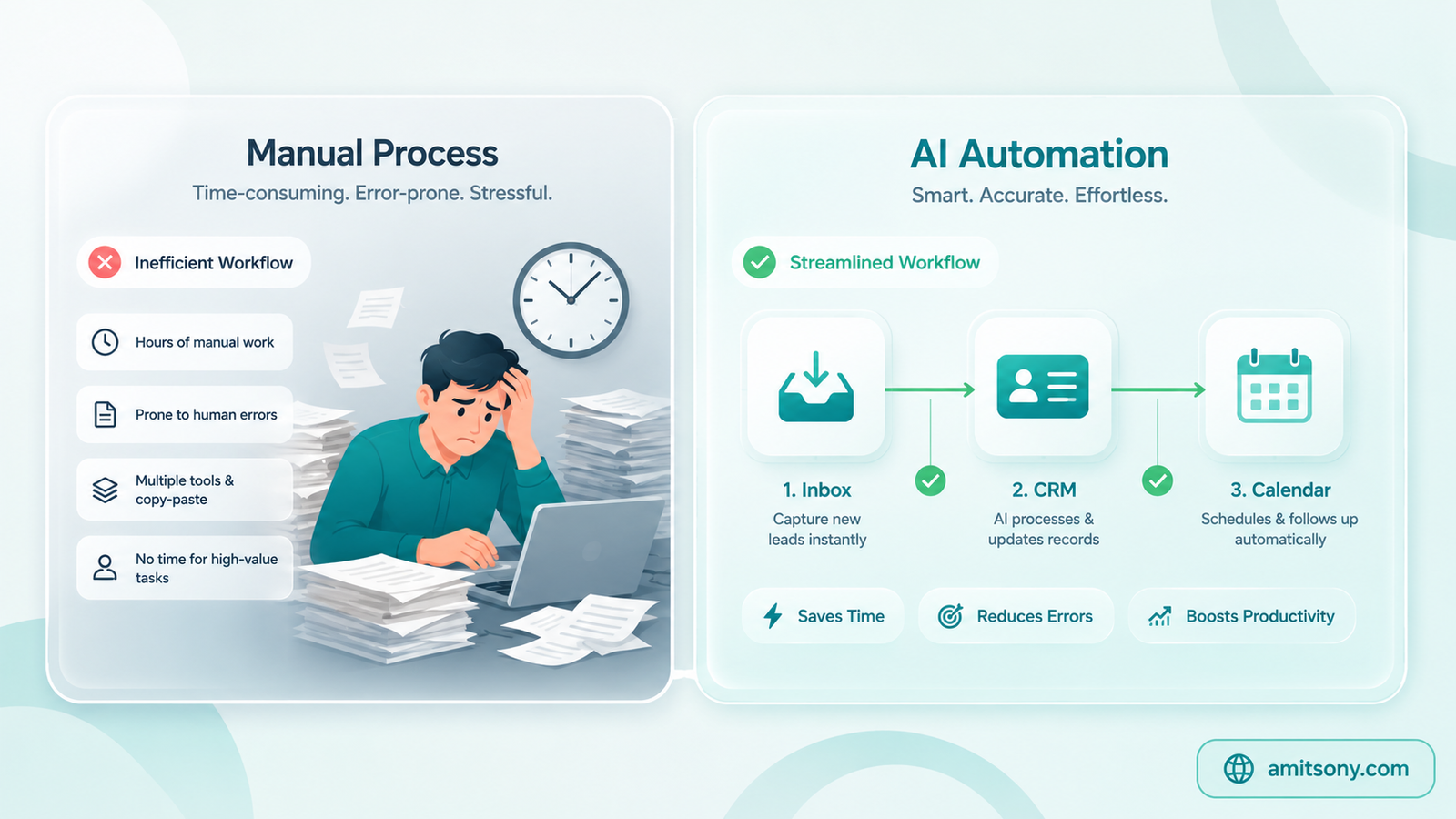
An AI automation agency is a service business that designs, builds, and maintains AI-powered workflow systems for paying clients. Think of it as the plumbing layer between a company's existing tools — their CRM, inbox, calendar, database — and the repetitive tasks that slow them down.
The model works because the economics are stacked in your favor. You might pay $200–$500/month in tool and API costs to maintain a client's automation stack, while charging them $2,000–$5,000/month for the system. That's a 60–80% gross margin on a recurring revenue stream.
What actually sells isn't the technology. Businesses don't want "AI workflows." They want to stop losing leads, reduce response times, and cut the admin hours bleeding their team dry. Your job is to translate a real operational pain into an automated fix — and then quantify the ROI in plain numbers.
The barrier to entry dropped significantly in 2025. Today, tools like Make.com, n8n, and Relevance AI let you build sophisticated automations with minimal code. What separates successful agencies is the ability to understand business problems and communicate results — not coding skill.
Which niche should you pick for your AI automation agency?
Picking a niche is the single most important decision you'll make early on. Generalist agencies burn out fast. Niche agencies build repeatable systems, command higher prices, and win clients faster because they speak the client's language.
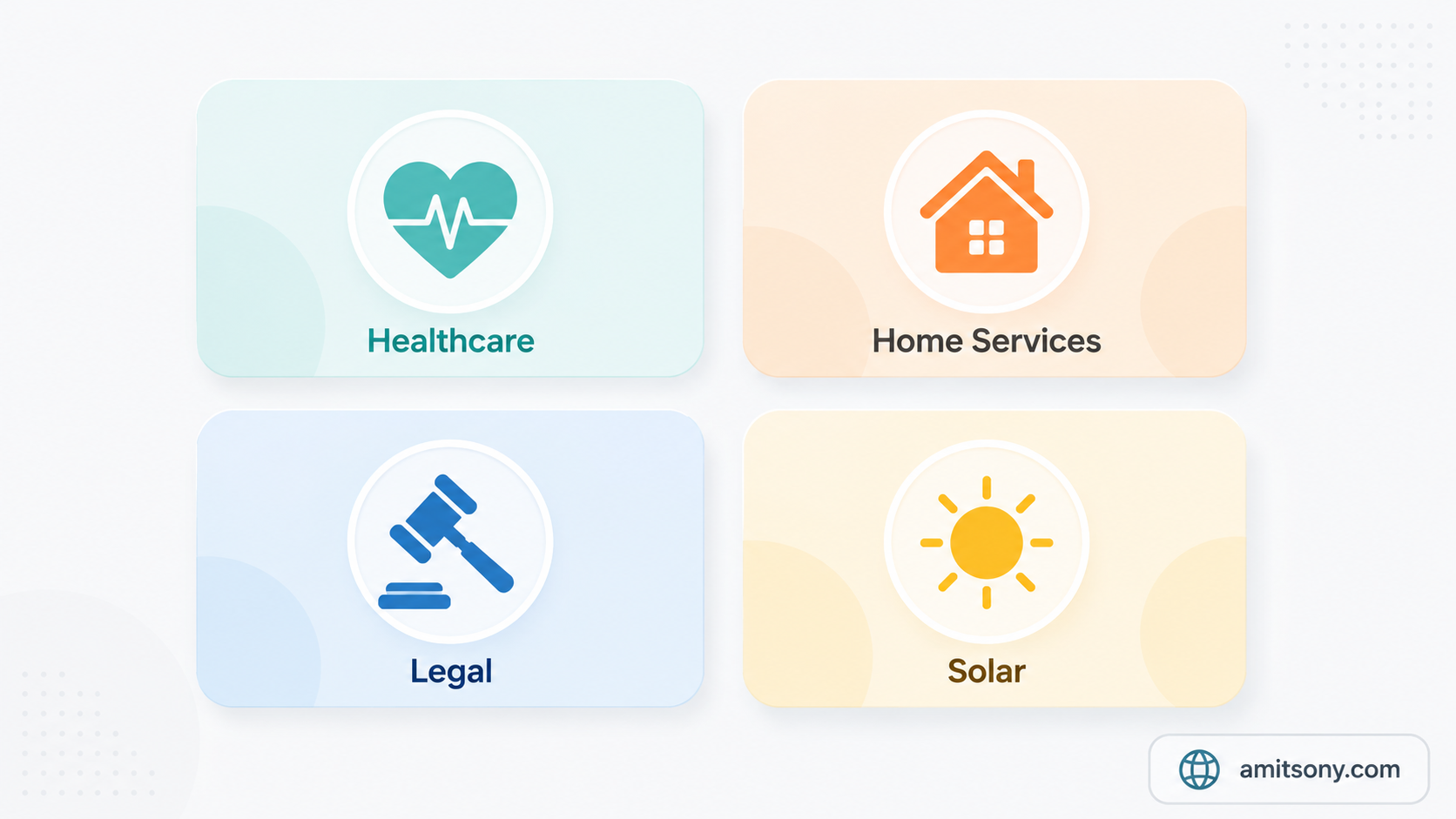
The highest-return niches right now are ones where the business has high lead volume, repetitive communication, and a clearly measurable cost to doing nothing. Real estate, law firms, med spas, home services like HVAC and plumbing, and e-commerce brands all check these boxes.
Med spas and healthcare practices are the standout niche in 2026 — nearly 90% of agencies serving this vertical hit retainers of $3,000+/month. The reasons are simple: high call volume, constant appointment scheduling, no-show reminders, and follow-up sequences are all automatable, and these businesses have the budget to pay for it.
Solar and home services are close behind. A residential solar company generates $25,000–$40,000 per deal. If your AI system helps them convert even one extra lead per month from better follow-up, you've justified a $4,000 retainer instantly. HVAC and plumbing companies face the same dynamic — they miss calls constantly while on job sites.
Law firms are another underserved goldmine. A personal injury firm might spend up to $800 per inbound lead but take 24–48 hours to respond. Automating intake and follow-up alone can double their conversion rate — and they'll happily pay $3,000–$5,000/month for that.
Pick one. Build three or four repeatable workflow templates for that vertical. Become the agency that specifically solves automation problems for that type of business. You'll close deals faster and deliver better results.
What tools do you actually need to run an AI automation agency?
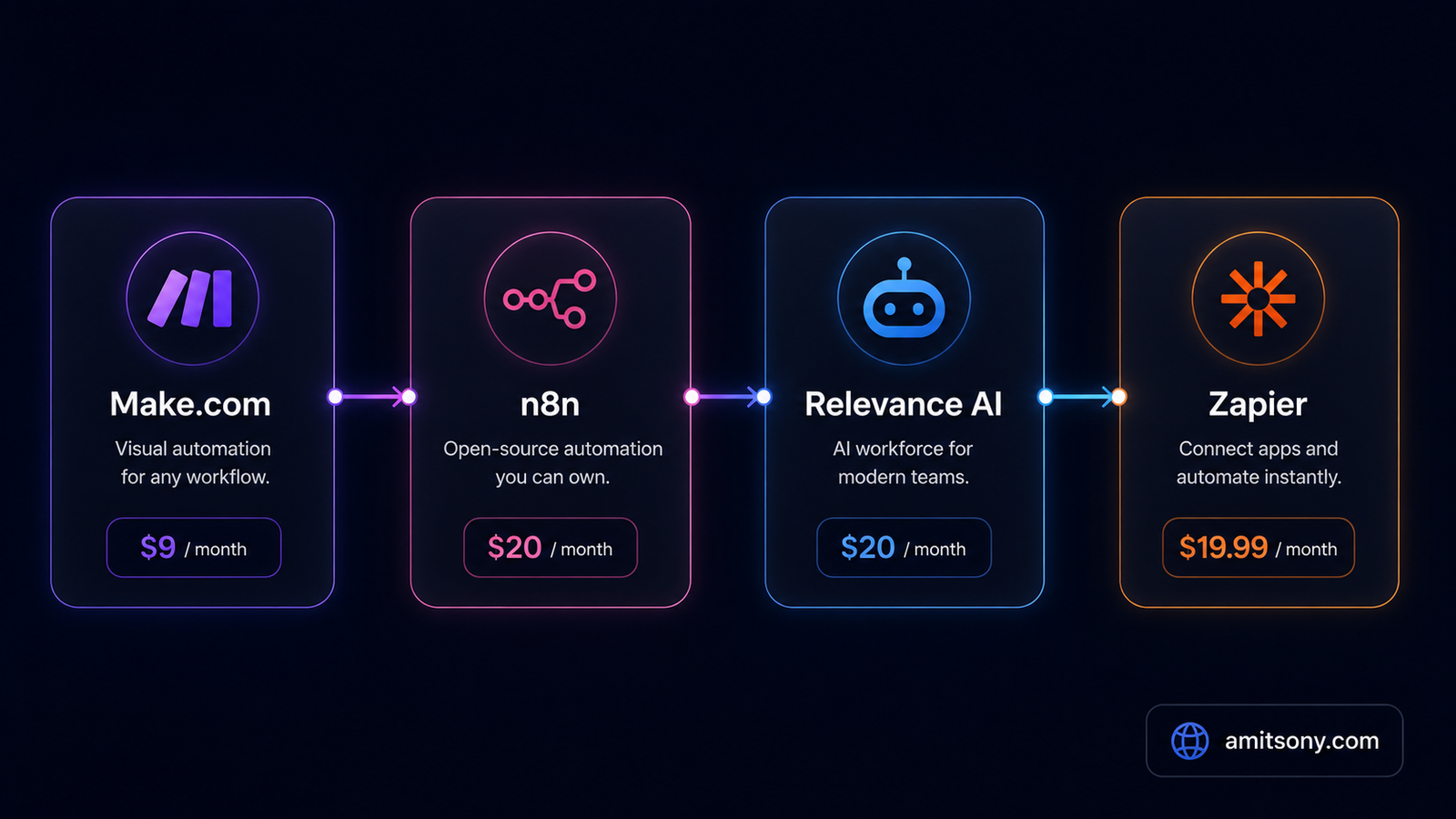
You don't need a giant tech stack. Most successful solo operators run their entire delivery on 3–5 tools.
Make.com is the go-to starting point for most agency owners. Its visual workflow canvas makes complex branching logic easy to build and debug. At $9/month for 10,000 operations, it offers dramatically better value than Zapier's comparable tier — roughly 13x more operations at half the price. It handles 1,500+ integrations and is ideal for client-facing builds.
n8n is the developer-friendly alternative. It's self-hostable, gives you real code fallback in JavaScript and Python, and is especially strong for more complex or custom agent deployments. For agencies doing enterprise work, n8n's flexibility is worth the steeper learning curve.
Relevance AI and Lindy handle the agent layer — situations where you need AI to make decisions at runtime rather than follow a fixed flow. These are priced at $30–$150/user/month for SMB tiers and are ideal when you're building multi-step reasoning workflows rather than simple trigger-action automations.
Zapier still wins for the fastest, simplest connectors. If a client needs two SaaS tools glued together quickly, Zapier gets it done. But for anything with logic, branches, or data transformation, Make.com or n8n is the better choice.
For AI itself, OpenAI's API is the default. Claude's API works well for longer reasoning tasks and document workflows. Keep API costs separate from your retainer — they pass through to the client at cost or with a small markup.
How do you get your first AI automation agency client?
This is where most people stall. They spend weeks building demos and setting up websites before ever talking to a potential client. That's the wrong order.
Your first client almost certainly already knows you. Start by listing every business owner in your network — friends, former colleagues, local services you use, LinkedIn connections. You're not pitching yet. You're offering a free 30-minute workflow audit to identify where they're losing time or leads.
Lead with the problem in every conversation. "How much time does your team spend manually entering lead data each week?" lands infinitely better than "I can build you an AI pipeline." When people see their own pain reflected back clearly, they're already half-sold.
Build two or three demos before you start outreach. A working lead-capture-to-CRM flow and an AI-powered support auto-responder are a great starting pair. Record a short Loom walkthrough of each — you'll send this in place of a long proposal.
For organic growth, LinkedIn is where the deals happen. Post honestly about what you built, what it does, and what problem it solved. One clear post per week beats ten vague ones. The goal isn't virality; it's establishing credibility in your niche so the right people start reaching out.
Once you have one paying client, document the case study immediately. What problem did they have? What did you build? What changed? Concrete before-and-after numbers are your most powerful sales asset.
How should you price your AI automation services?
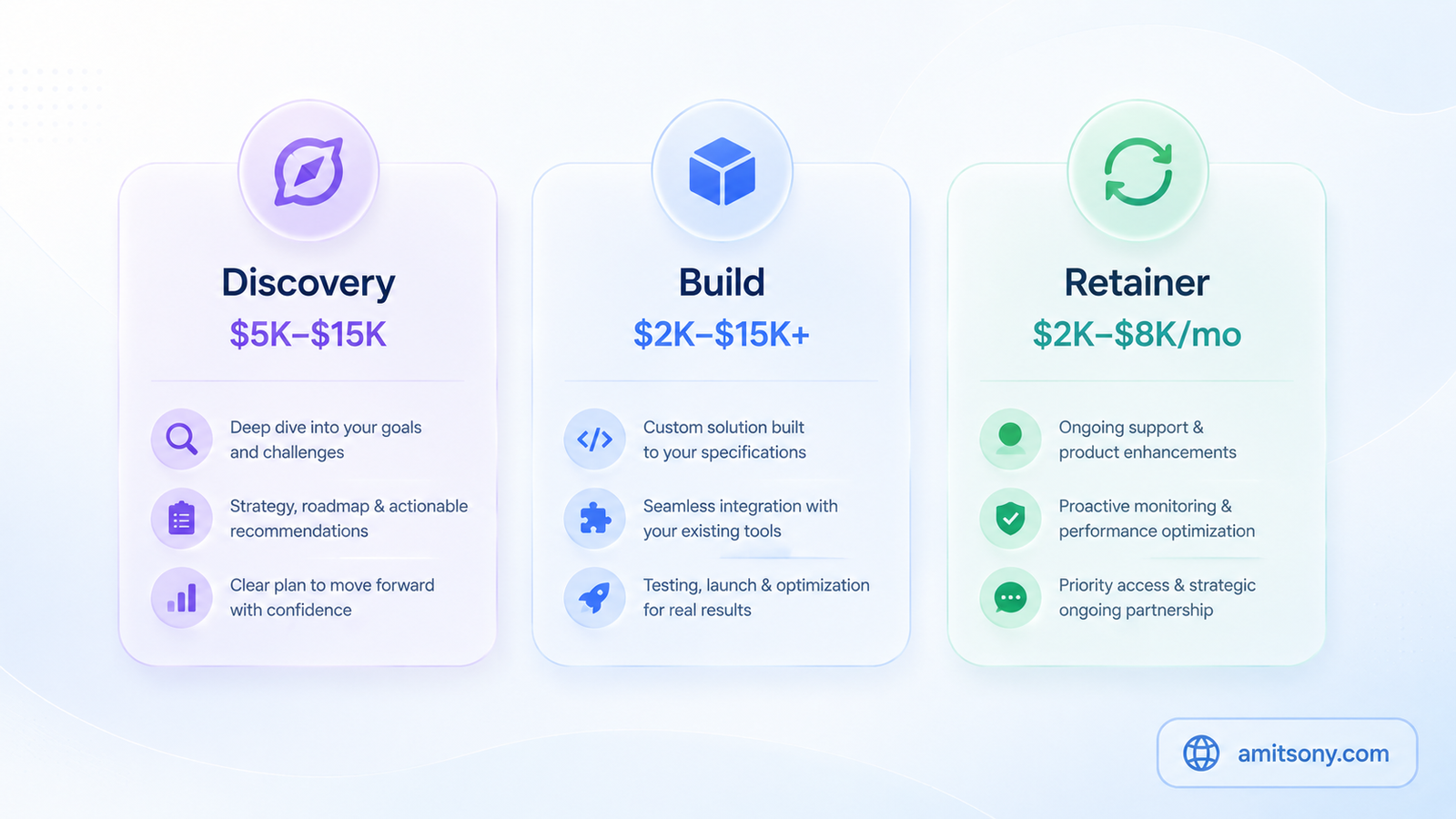
Most beginners underprice because they think about their own costs. Price instead from the client's side — what is this automation worth to them?
The standard agency structure in 2026 has three tiers. A discovery or audit phase runs $5,000–$15,000 for two to four weeks of workflow analysis, identifying automation opportunities and calculating potential ROI. This isn't optional fluff — it protects you from scope creep.
The build phase is where most of the revenue lives. Simple single-workflow builds — a lead routing system, a support ticket classifier — typically run $1,500–$5,000. More complex projects with document processing, multi-system routing, or LLM classification land at $6,000–$15,000+. Real estate agency chatbot builds with CRM integration, scheduling, and 24/7 lead qualification have been sold for $10,000 setup fees.
Monthly retainers are where the business model truly scales. Support retainers run $2,000–$8,000/month depending on system complexity. For a typical SMB client, $2,000–$3,000/month is a fair starting point. As you prove ROI and add departments, you scale up.
Avoid hourly billing. AI makes you faster, and hourly billing punishes that speed. If a workflow that used to take 10 hours now takes 2, your income collapses under an hourly model. Value-based pricing — anchored on what the automation is worth to the business — is the only pricing model that makes sense in 2026.
A useful sanity check: if your automation saves a client $5,000/month in labor, charging $2,000/month is a straightforward sell. The ROI is obvious. Run this math in every proposal.
How do you scale an AI automation agency past $10K/month?
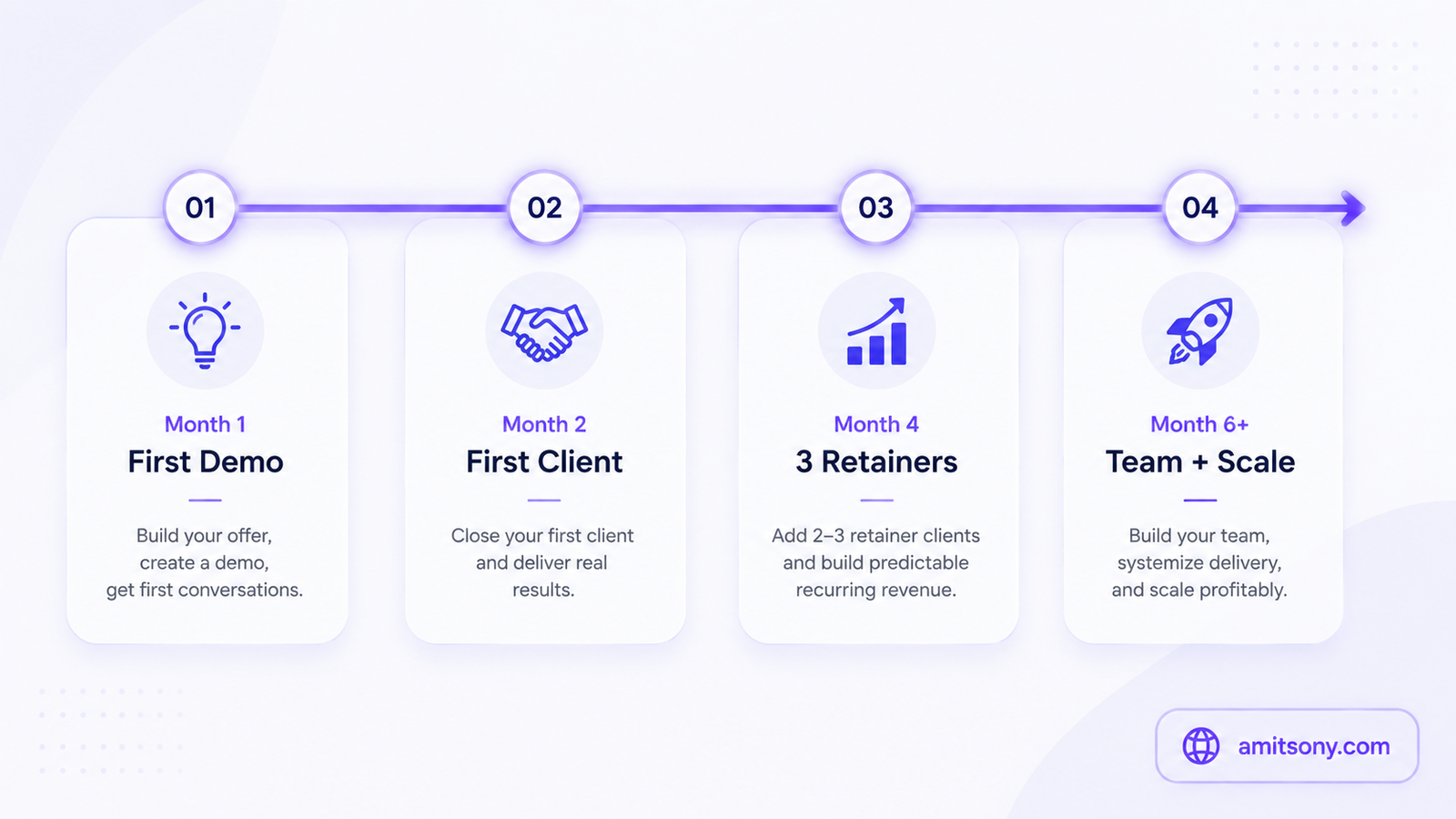
Getting to $10,000/month is mostly a client acquisition problem. Getting beyond it is a systems and hiring problem.
The fastest path to $10K/month is three to five retainer clients at $2,000–$3,000/month each. That's achievable in 4–6 months if you're actively doing outreach and delivering results. The math is straightforward — the delivery is what requires focus.
Scale beyond that by productizing your service. Instead of building custom workflows for each client from scratch, develop two to three repeatable "packages" designed for your niche. A real estate agency package, for example, might include lead capture automation, CRM enrichment, and an appointment booking flow — all pre-built and ready to deploy. Delivery time drops, margins go up.
Hire a delivery person before you hire a salesperson. Your bottleneck at $10K/month is usually your own time on builds. A part-time contractor who can handle implementation under your direction — especially someone proficient in Make.com or n8n — frees you to focus on client acquisition and strategy.
Automate your own operations before anything else. Your outreach follow-ups, client reporting, onboarding sequences, and invoicing should all run on the same tools you sell. It reduces your overhead, sharpens your expertise, and gives you a live case study to show prospects.
By month six, successful agencies are running monthly reporting dashboards for each client showing hours saved, leads processed, and error rates. That data is what converts a one-off project client into a long-term partner — and the most powerful argument against churn.
What mistakes kill most new AI automation agencies?
The biggest one is going too broad too fast. Agencies that try to serve every industry with every AI tool end up with weak positioning, slow sales cycles, and clients who don't stay.
Skipping the demo stage is the second most common mistake. Many founders try to sell AI automation conceptually — with decks and pitch calls — before building anything. Buyers need to see the system working. A 3-minute Loom of a real workflow doing real things closes deals that polished proposals never do.
Underestimating client education kills retention. Most clients have never used an automated system before. If you don't actively show them what the system is doing and why, they quietly lose confidence and cancel the retainer at month three. Monthly reports and brief walkthrough calls are non-negotiable.
Confusing complexity with value is a trap for technical builders. Clients don't pay more for a more complicated system — they pay more when you can show them more money saved or more revenue earned. Always anchor your work to the business outcome, not the number of workflow steps.
Finally, many agencies forget to include hosting and API costs in their pricing model. Your tool subscriptions, OpenAI API usage, and cloud hosting can easily run $200–$500/month per client. These should either pass through to the client directly or be baked transparently into your retainer — not quietly absorbed into your margins.
Frequently Asked Questions
How much does it cost to start an AI automation agency in 2026?
Startup costs typically run $2,000–$5,000, covering tool subscriptions like Make.com or n8n, Claude or OpenAI API access, and basic business setup. You don't need office space or employees to begin.
Do I need coding skills to run an AI automation agency?
No. Most successful agency owners use no-code platforms like Make.com and n8n for the majority of their builds. Basic logic thinking and strong problem-solving matter far more than writing code.
What's a realistic monthly income for an AI automation agency?
Most agencies reach $5,000–$10,000/month within 3–6 months with 3–5 retainer clients. Established agencies serving one focused niche commonly scale to $20,000–$50,000/month within the first year.
Which niche is easiest for beginners to start with?
Home services like HVAC and plumbing companies are ideal for beginners — the pain point is obvious, the automation is simple, and competition from other AI agencies is still low.
How do I find my first client for my AI automation agency?
Start with your existing network. Offer a free workflow audit to business owners you know. Build two working demos and send a short Loom recording rather than a written proposal.
What's the difference between AI automation and just regular automation?
Traditional automation follows fixed rules — if X happens, do Y. AI automation adds a reasoning layer, letting the system classify, summarize, make decisions, and handle exceptions that a rigid rule-based flow couldn't manage.