

World models predict what happens next in physical reality, not the next word in a sentence. They learn physics, causality, and spatial relationships from video and simulation rather than text. Yann LeCun left Meta to build one, Fei-Fei Li raised over $1.2 billion for hers. Whether they replace LLMs or complement them is still genuinely contested.
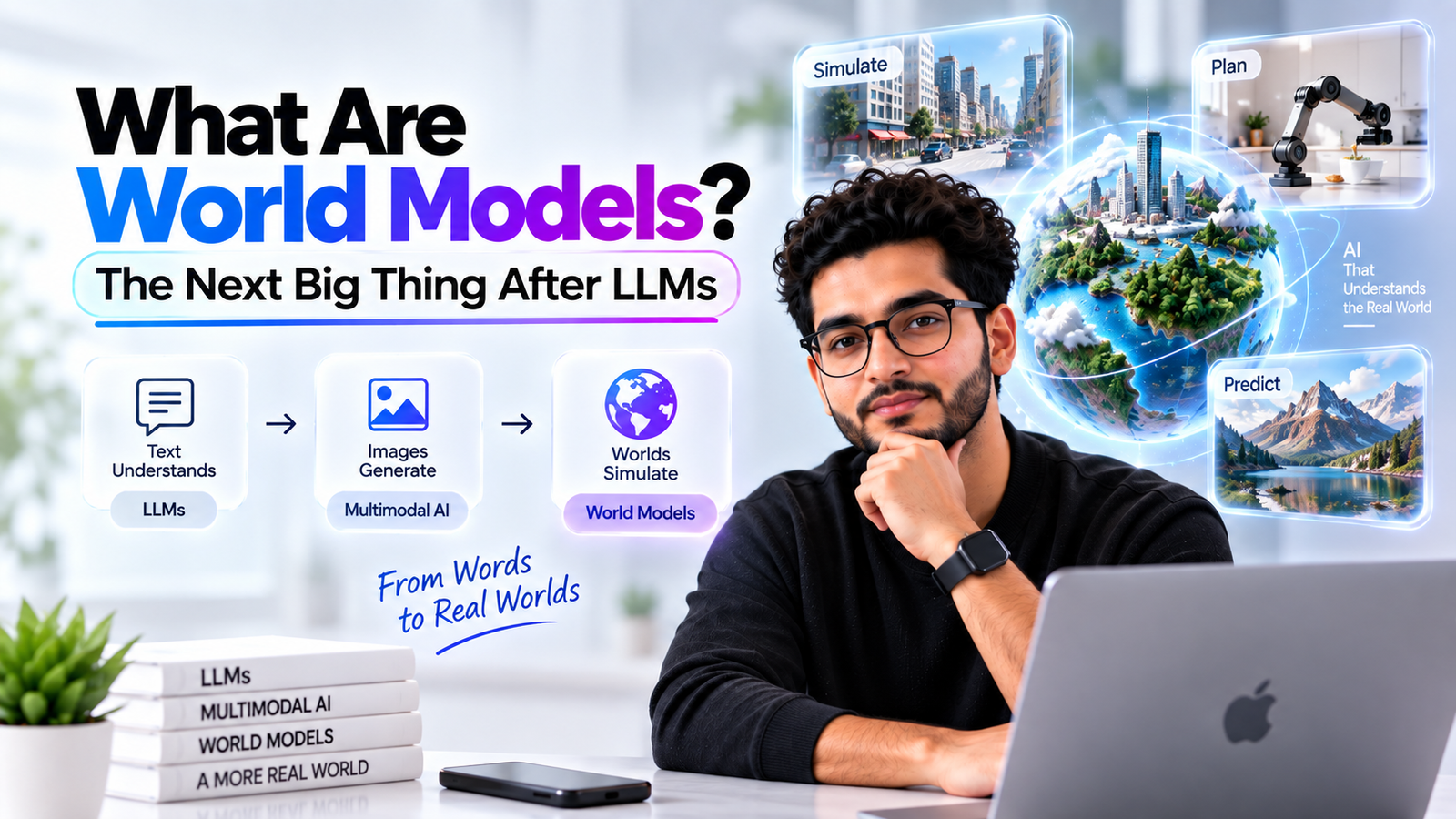
A human learns to drive in roughly 20 hours. Self-driving systems have consumed millions of hours of driving data and still struggle with reliability a teenager reaches in a weekend. Yann LeCun used exactly that comparison at the 2026 World AI Cannes Festival to make his case: the current path most AI companies are on has a ceiling, and scaling language models won't get past it.
That argument is the entire premise behind world models, the most debated architectural bet in AI right now. This guide covers what they actually are, who's building them, and why it's worth staying skeptical of anyone declaring the outcome already decided.
What Exactly Is a World Model?
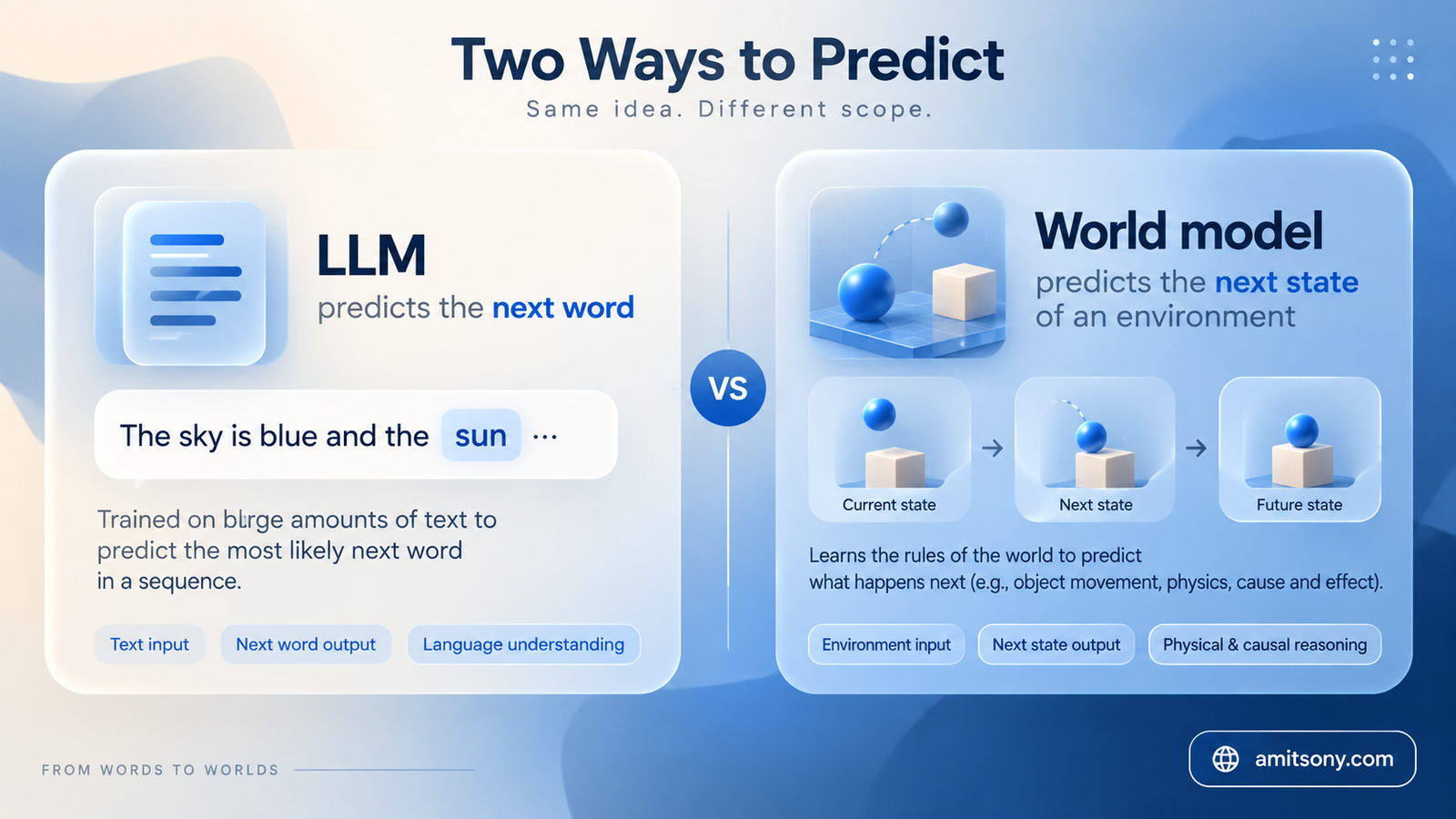
An LLM predicts the next token in a sequence of text. A world model predicts the next state of an environment given an action taken within it, what happens to the objects in a room if you push one of them, how a liquid behaves when a container tips.
The training data is the core difference. LLMs learn from text. World models learn from video, simulation, and multimodal sensor data, absorbing physics, object permanence, cause and effect, and spatial relationships that never get written down explicitly in text anywhere.
That's the structural argument LeCun and others make: a system trained only on descriptions of the world has no direct experience of how the world behaves. Text is a compressed, lossy record of reality, not reality itself.
What Evidence Suggests LLMs Actually Have This Gap?
A 2024 study from researchers at MIT, Harvard, and Cornell tested whether LLMs build genuine internal maps of physical space. The models failed to produce reliable turn-by-turn maps of New York City, and performance degraded sharply when detours were introduced, exactly the situation where an internal spatial model would matter most.
LeCun has made the point more bluntly, arguing that current systems are less capable than a house cat at basic physical reasoning, and warning against confusing an LLM's enormous knowledge retrieval ability with actual intelligence.
The critique isn't that LLMs are useless, it's that fluent text generation and grounded physical understanding are genuinely different capabilities, and one doesn't automatically produce the other.
Who Is Actually Building World Models?
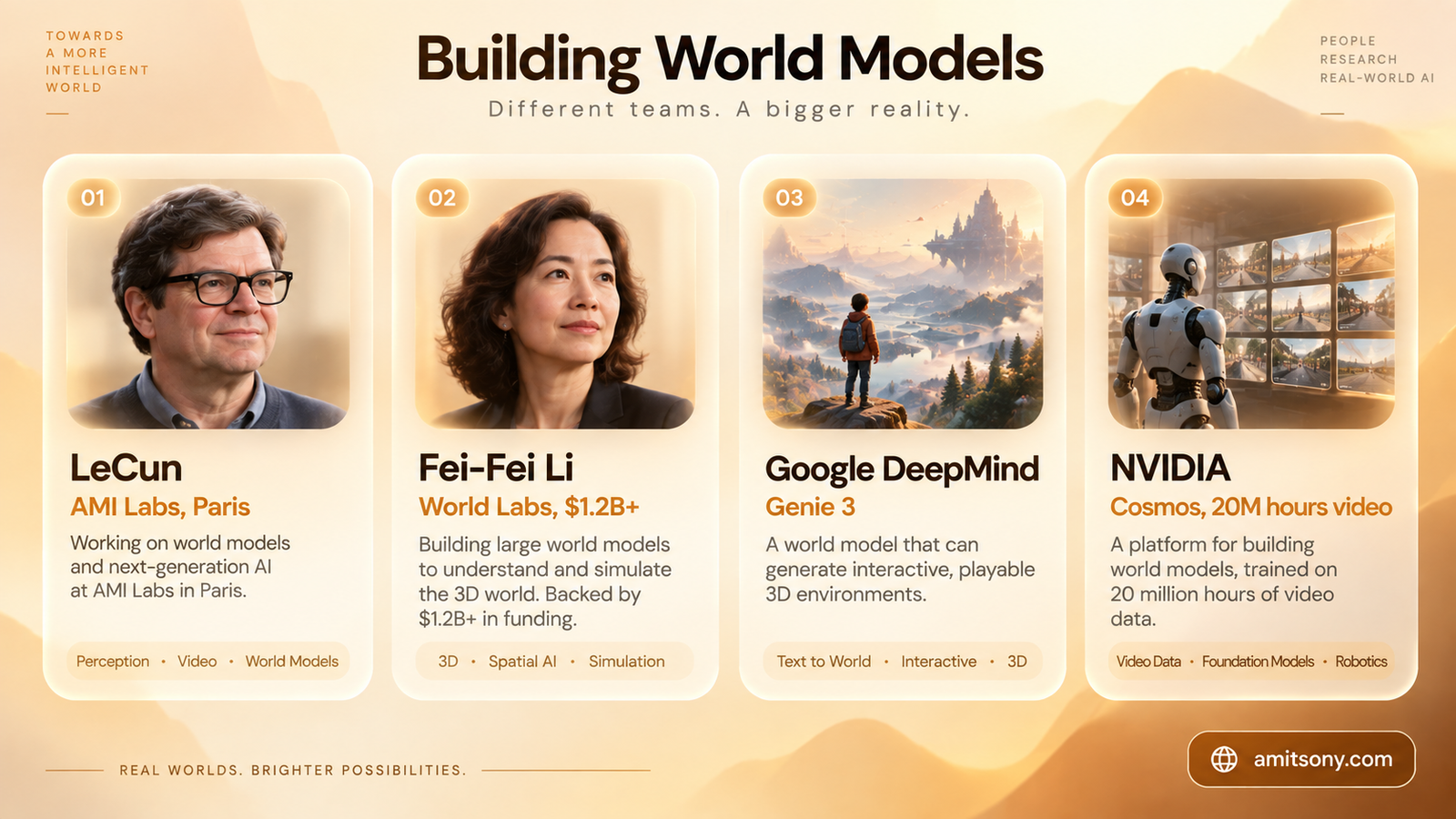
Yann LeCun left Meta after 12 years as Chief AI Scientist to start AMI Labs, reportedly seeking a $5 billion valuation. He deliberately based it in Paris rather than the Bay Area, with a pointed explanation: Silicon Valley, in his framing, is too fixated on generative models to see past them.
Fei-Fei Li, the researcher behind ImageNet, founded World Labs and raised over $1.2 billion for spatial intelligence work. Google DeepMind published Genie 3, which generates interactive 3D environments in real time. NVIDIA shipped Cosmos, trained on 20 million hours of real-world video, which reportedly hit 2 million downloads in its first month.
The scale of capital involved is the clearest signal here. Whether or not the technical bet pays off, some of the most credentialed people in the field have staked their careers and billions in funding on it.
Why Is Video the Training Data of Choice?
Internet text is largely saturated, the readily available supply has been consumed by existing models. Video and interactive environments are the next reservoir, and crucially they contain information text never captures: how things move, how forces propagate, what happens over time.
OpenAI reportedly offered around $500 million to acquire Medal, a gameplay-video sharing platform. The deal fell through, but the intent was telling, gameplay footage is a massive corpus of action-and-consequence data, exactly what training a world model requires.
Videogames and simulated environments are particularly useful because they're interactive, a model can take an action and observe the result, rather than just passively watching a recording of someone else's action.
Where Are World Models Already Being Used?
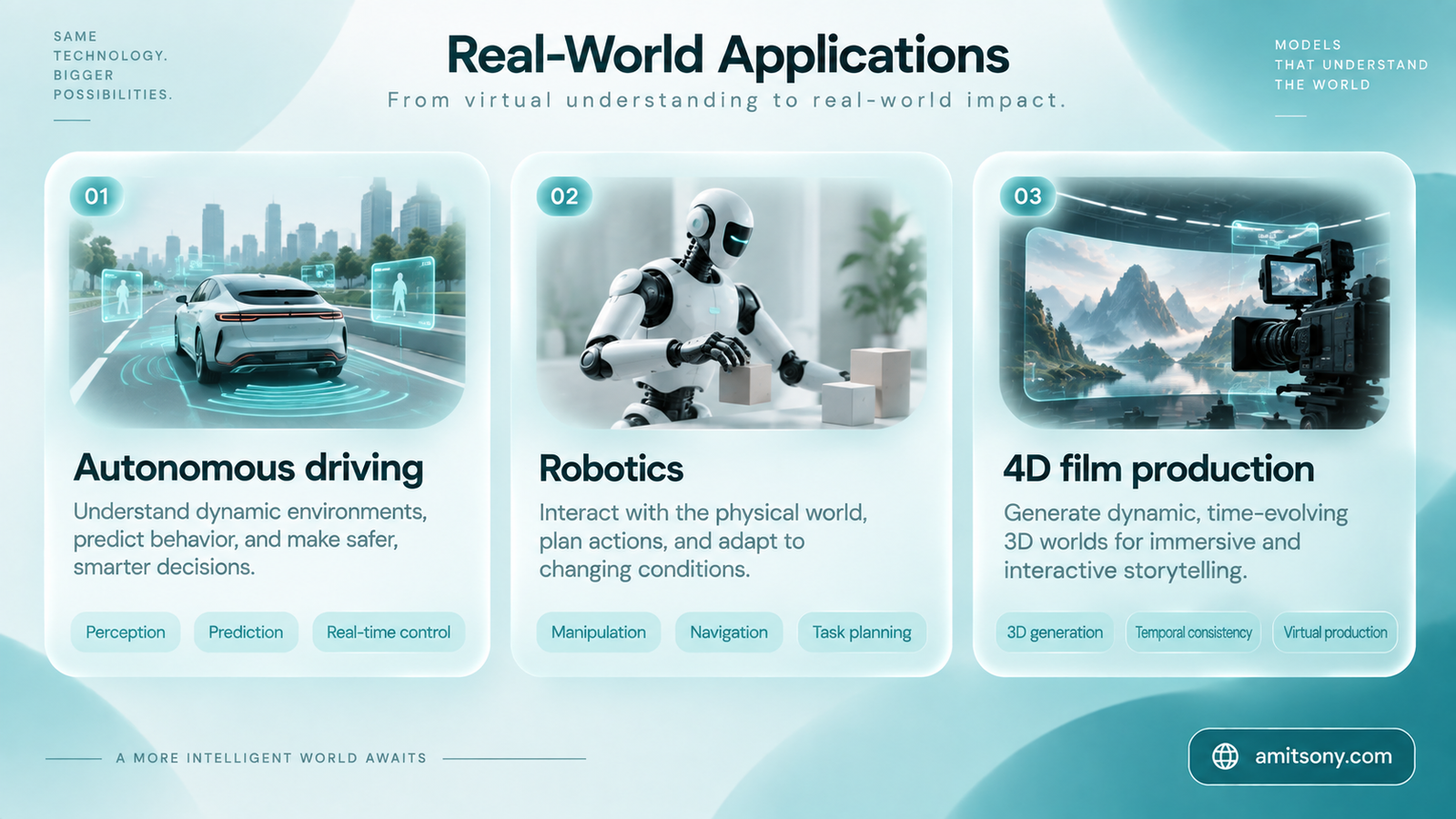
Autonomous driving is the most mature application, world model approaches reportedly underpin a large majority of autonomous driving training work, and robotaxi deployments continued expanding through 2026.
Robotics is the other obvious fit. A robot manipulating physical objects needs to predict consequences before acting, which is precisely what a world model provides and what a text-trained system structurally cannot.
Film and content production is a less obvious application that's emerging, converting existing footage into navigable 4D representations, letting a filmmaker change camera angles after a shoot rather than reshooting.
Will World Models Actually Replace LLMs?
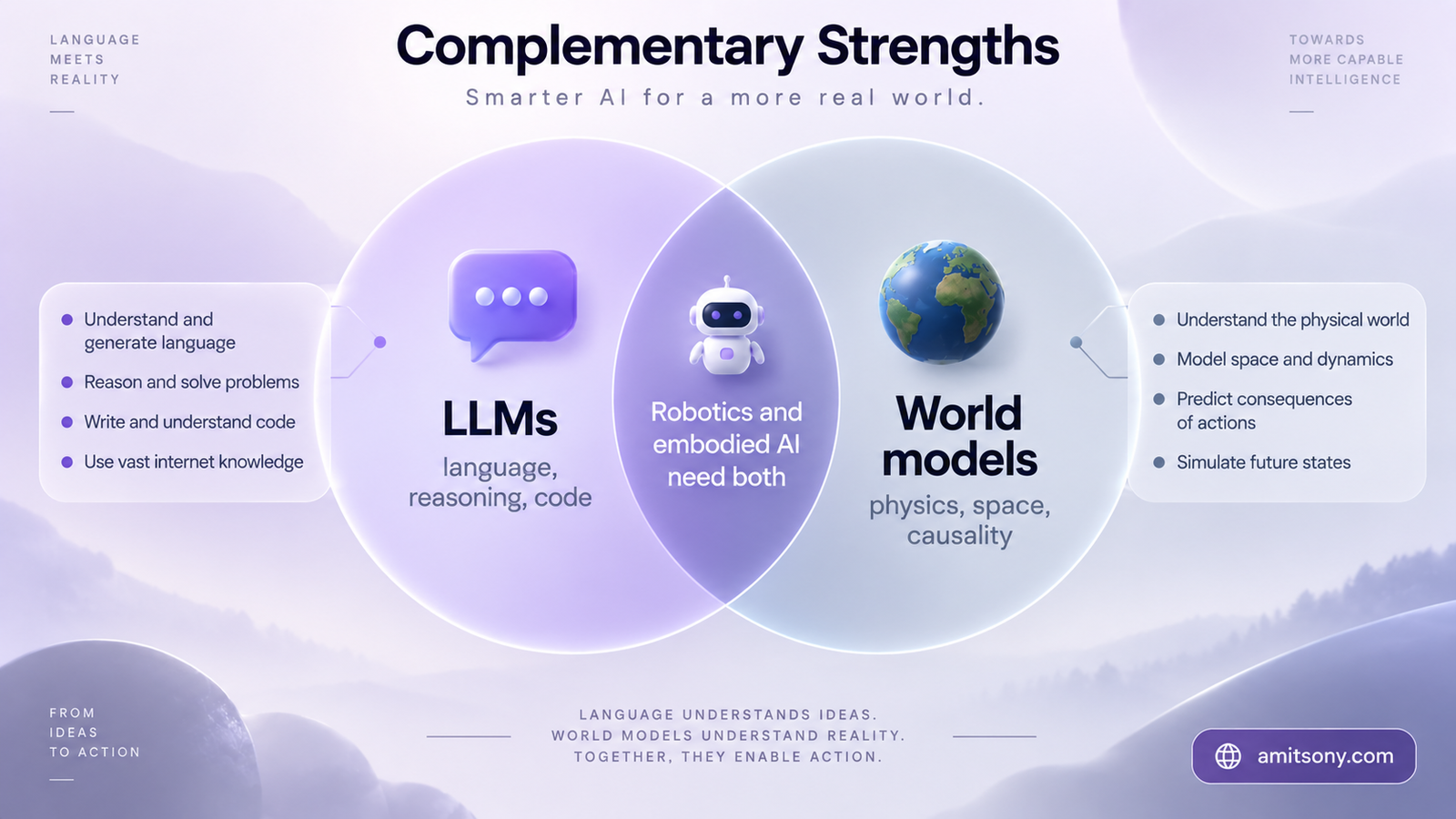
This is where honest coverage has to slow down. Plenty of writing on this topic states flatly that world models will replace LLMs, which is a prediction being presented as a finding.
The more defensible read is that these architectures target different problems. LLMs handle language, reasoning over text, code, and knowledge retrieval. World models target physical and spatial understanding. A robot needs both, the ability to reason about a goal and the ability to predict what happens when it moves its arm.
Worth noting too: the strongest advocates for world models are also the people raising billions to build them. That doesn't make the technical argument wrong, LeCun's critique of LLM limitations predates his startup by years, but it's a reason to read confident predictions of LLM obsolescence with the funding context in mind.
A reasonable position for 2026: world models are a genuinely important research direction with real early applications, and the question of whether they replace or complement LLMs is still open. Anyone claiming certainty either way is ahead of the evidence.
What Should You Actually Watch For Next?
Evaluation standards are the real thing to track. Impressive generated video is easy to produce and easy to cherry-pick, while a model that genuinely predicts physical consequences accurately, and stays consistent over long sequences, is a much harder benchmark to hit.
Closed-loop usefulness is the other signal, whether a world model actually improves a robot's or a vehicle's real-world performance, not just whether its generated footage looks convincing in a demo reel.
Quick Verdict
World models are a genuine architectural shift, not just rebranding, they learn from fundamentally different data and target fundamentally different capabilities than LLMs. Whether they become the dominant paradigm or a complementary one is genuinely unresolved. Treat the technology as real and the "LLMs are finished" framing as marketing.
Frequently Asked Questions
What's the difference between a world model and an LLM?
An LLM predicts the next word in text. A world model predicts the next state of a physical environment given an action, learning physics, causality, and spatial relationships from video and simulation instead of text.
Who is building world models?
Yann LeCun's AMI Labs, Fei-Fei Li's World Labs, Google DeepMind with Genie 3, and NVIDIA with Cosmos are the most prominent, with billions in combined funding behind them.
Will world models replace LLMs?
Genuinely unresolved. Advocates argue they're the path to AGI, but a more defensible read is that they solve different problems, language reasoning versus physical understanding, and embodied AI likely needs both.
Why do world models train on video instead of text?
Internet text is largely saturated, and video captures physics, motion, and cause-and-effect that text never records explicitly. Interactive environments like videogames are especially valuable since a model can act and observe results.
Where are world models actually used today?
Autonomous driving is the most mature application, with robotics as the other major fit. Film production is an emerging use case, converting footage into navigable 4D representations.